










Copper Spring Contacts: Manufacturing Towards A High-Precision And Intelligent Era: Industry Evolution And Technological Path
Apr 02, 2026
Leave a message
Against the backdrop of accelerated upgrading in global manufacturing, stamping, as a fundamental process in metal processing, is undergoing a profound transformation from traditional mass production to high precision, flexibility, and intelligence. Stamping technology is widely used in automobiles, electronics, hardware, medical devices, and home appliances, serving as a crucial foundation for modern industrial systems. With continuous advancements in materials technology and equipment capabilities, the objects processed by stamping have expanded from single metal sheets to composite materials and multi-layered structural materials, propelling the industry into a diversified development stage.
From the perspective of industrial structure changes, traditional small-batch red-copper stamping parts are gradually being replaced by sheet metal processing. This trend stems from the development of flexible manufacturing technologies and the maturity of welding and CNC equipment, making sheet metal processing, with its low mold investment, more economical in small-batch scenarios. However, in high-volume production areas such as automotive parts, power equipment, and electronic components, stamping processes for Copper Pressed Components still possess irreplaceable advantages, particularly in terms of efficiency, cost control, and consistency. Against this backdrop, how to achieve rapid response to market demands, shorten mold development cycles, and improve production efficiency has become a core concern for the industry.
Currently, the technological development focus of the stamping industry is gradually shifting towards digitalization, automation, and intelligent inspection. Enterprises are not only concerned with production efficiency and equipment utilization, but also place greater emphasis on building capabilities for end-to-end data acquisition and online quality monitoring. This is particularly true in the production of Electrical Copper Stamping Parts, where dimensional accuracy and performance stability requirements are extremely high. Traditional methods relying on manual sampling are no longer sufficient to meet the demands of modern manufacturing, making online inspection technology a key area for improvement and a crucial area for breakthroughs.

At the specific process level, deep drawing and shallow drawing remain core technologies in stamping. Their processing quality highly depends on the coordinated control of multiple factors, including material properties, die design, and equipment stability. By introducing a "data + model" analysis method, the forming process can be predicted and optimized, effectively improving forming accuracy and consistency of Copper Pressed Stamped Parts. In processes such as Copper Sheet Stamping, this data-driven optimization model is gradually becoming mainstream.
With the development of composite material technology, the demand for stamping equipment suitable for new materials is constantly growing. Processes such as die pressing, blanking, and shallow drawing are expanding into new application scenarios, driving stamping technology towards higher value-added areas. This is not only a result of market demand but also a reflection of the combined effect of long-term technological accumulation and industrial upgrading. In the manufacturing of connecting parts such as Copper Stamping Processing and Connecting, the application of new materials further improves the performance and structural integration of Copper Stamped parts.
Fine stamping technology, as an important branch of high-end stamping, is also continuously evolving. The future development trend will extend from single stamping to an integrated "stamping + forming" approach, particularly promising for the processing of thick plates and high-strength materials. Simultaneously, the integrated development of precision high-speed stamping technology makes "high precision + high efficiency" possible. This model has been validated in the production of stacked Custom Metal Copper Stamps and is gradually being extended to more application areas.
Regarding the forming of complex structural parts, while special processes such as multi-point forming, roll forming, and explosive forming have limited application scope, they possess irreplaceable advantages in specific fields. Meanwhile, hydroforming and pneumatic forming technologies have developed rapidly in recent years, demonstrating good adaptability in the manufacturing of high-strength steel and lightweight structures. These technological advancements provide more technical pathways for Custom Copper Stamping and the manufacturing of complex structural parts.
At the equipment level, the development of servo presses is particularly noteworthy. Through controllable slider motion curves and precise pressure adjustment capabilities, servo stamping technology significantly improves forming quality and process flexibility. With the maturity of domestically produced servo systems, equipment costs are gradually decreasing, making their application more widespread in mid-to-high-end manufacturing fields. In the future, servo multi-station stamping equipment is expected to replace the traditional multi-machine line mode and become an important equipment foundation for the large-scale production of Copper Stamping Parts.
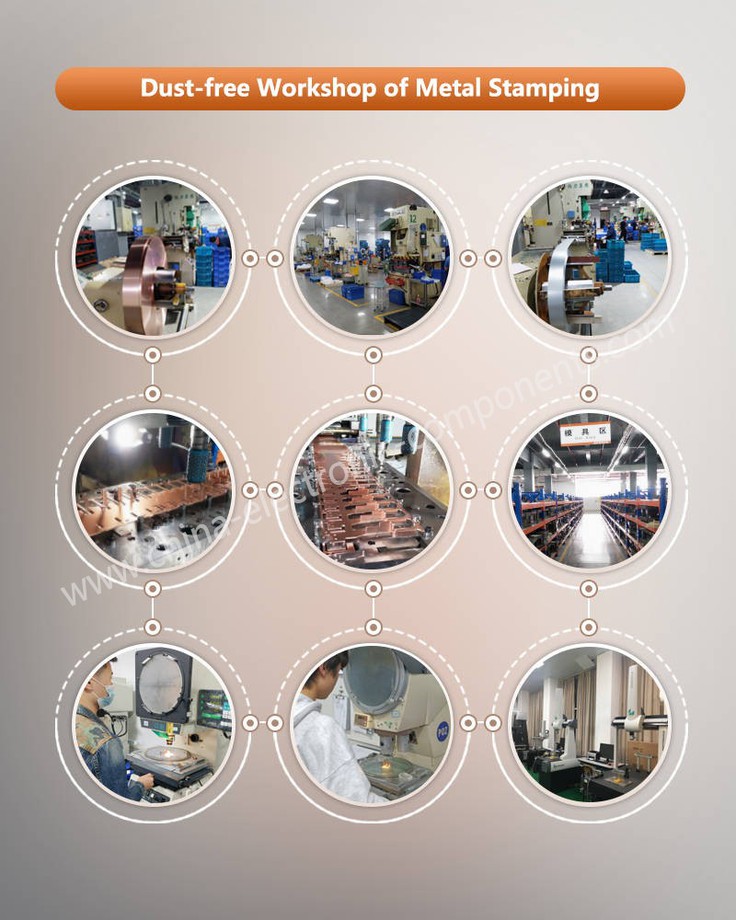
Furthermore, hot stamping technology is increasingly mature in the forming of high-strength steel and aluminum alloys, providing an effective solution for lightweight structural design. Meanwhile, cold stamping technology still holds advantages in energy saving and cost control; the two will coexist and complement each other for a long time. In the manufacturing of high-performance electrical components such as Copper Metal Stamping Electrical Silver Contact Parts, the combination of heat treatment and stamping processes has also become an important research direction.
Spinning technology, as a supplementary process, demonstrates unique advantages in the manufacturing of axisymmetric structural parts. Its application in sheet and tube forming is constantly expanding, providing new solutions for complex geometries. With the diversification of manufacturing demands, companies need to flexibly select process paths based on the characteristics of Silver Plate Over Copper to achieve the optimal balance between performance and cost.
Overall, the Stamping Riveting Electrical Copper Press Parts For Switch Socket industry is continuously developing towards greater complexity, precision, lightweighting, and intelligence. Material composites, structural integration, and high-speed production have become clear trends. In this process, companies need to continuously improve their process capabilities and equipment levels, and build a data-driven manufacturing system to maintain their advantage in the fierce market competition.
contact us
For more information on Copper Stamping and customized solutions, please contact us. We will provide you with professional technical support and efficient manufacturing services to help your projects be successfully implemented.

Send Inquiry