



Technological Upgrades in High-Voltage DC Relays: Ceramic-to-Metal Sealing Processes Enhance The Reliability Of High-Voltage Electrical Connections
Nov 15, 2026
Leave a message
With the shift toward higher voltages in new energy vehicles, the scaling up of energy storage systems, and the transition of data center power architectures toward direct current (DC), the application scope for high-voltage DC relays continues to expand. As critical control and protection components in high-voltage DC circuits, their performance is directly linked to the safety of circuit connection, load switching, and fault interruption. Meanwhile, as system operating voltages and current levels continue to rise, increasingly stringent requirements are placed on the relays' insulation performance, sealing reliability, arc resistance, and long-term operational stability.
In the structural design of high-voltage DC relays, ceramic sealing technology has emerged as a key technical trend. Compared to traditional resin-encapsulated structures, ceramic materials offer superior insulation, heat resistance, and dimensional stability. By establishing a reliable bond between ceramic and metal, it is possible to create a compact structure that provides electrical insulation, mechanical support, and hermetic sealing-ensuring the reliable operation of high-voltage DC relays under complex, demanding conditions.

Structural Characteristics and Application Value of High-Voltage DC Relays
A high-voltage DC relay is a switching device that uses electromagnetic actuation to connect or disconnect DC circuits. It typically consists of a coil, a core, an armature, moving and stationary contacts, an insulating structure, and a sealed housing. During operation, the control circuit supplies current to the coil, generating an electromagnetic force that moves the armature; this causes the moving contacts to engage with or separate from the stationary contacts, thereby controlling the state of the main circuit.
Compared to standard low-voltage relays, high-voltage DC relays must handle significantly higher operating voltages and load currents. In DC circuits, in particular, there is no "natural zero-crossing" point-as found in AC circuits-which means that any electric arc generated during contact separation does not extinguish on its own. Consequently, product design must account for more than just the current-carrying capacity of the contacts; it must also carefully balance factors such as contact gap, arc-extinguishing mechanisms, insulation distances, sealing integrity, and thermal management.
Currently, high-voltage DC relays are primarily used in battery systems for new energy vehicles, high-voltage power distribution units, charging equipment, electrochemical energy storage systems, photovoltaic power equipment, and industrial DC power supplies. In new energy vehicles, relays manage the high-voltage connection and isolation between the traction battery and the electric drive system, while also facilitating processes such as pre-charging, battery charging, and fault protection. As vehicle voltage architectures shift toward 800V and higher, relays must demonstrate improved voltage withstand capabilities, enhanced breaking capacity, and greater insulation reliability.
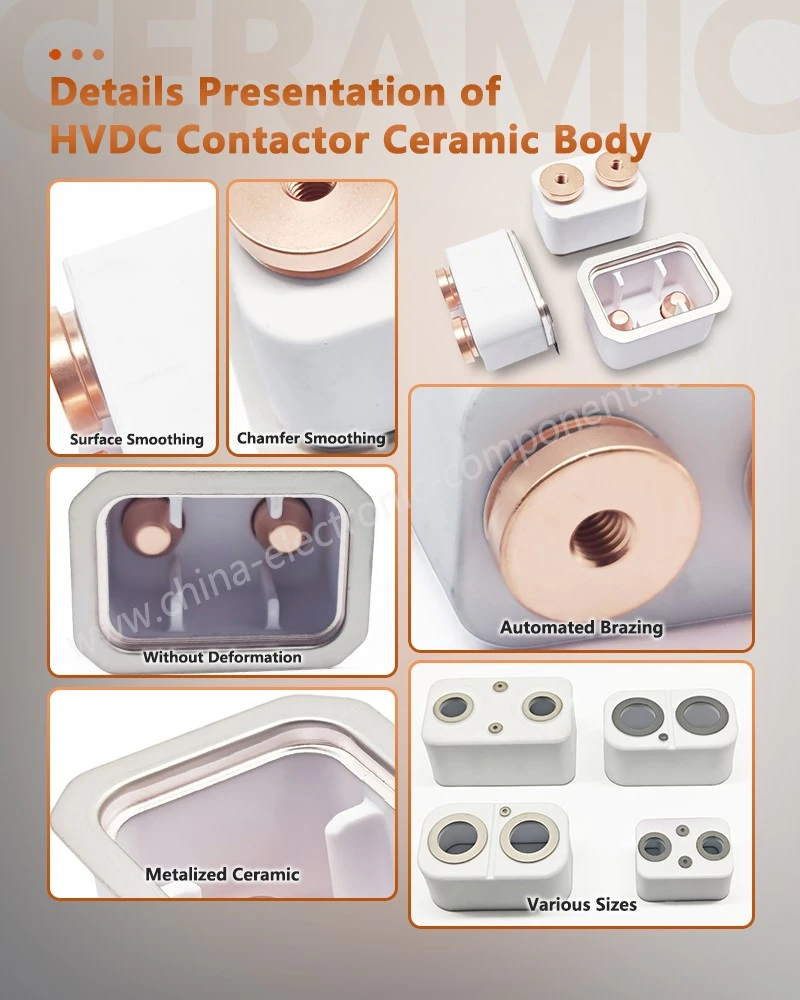
Ceramic-sealed structures have emerged as a key technical direction for high-voltage relays
A core technical challenge for high-voltage DC relays lies in achieving stable insulation and effective arc quenching within a compact design. Because DC arcs tend to persist longer, the contact-breaking process can generate high temperatures and localized thermal stress. If the sealing structure, insulating materials, or internal gaseous environment are unstable, the relay's electrical lifespan and long-term operational safety may be compromised.
Currently, the market primarily features two types of product architectures: resin-encapsulated and ceramic-sealed. Resin encapsulation offers a relatively mature manufacturing process and flexible structural design, making it suitable for certain low-to-medium voltage applications or specific industrial uses. In contrast, ceramic-sealed structures utilize ceramic insulators joined to metal terminals and housings to create a stable, hermetically sealed chamber. This configuration allows for the integration of specific protective gases and arc-quenching mechanisms tailored to the product design.
Ceramic materials possess high dielectric strength, excellent heat resistance, and superior chemical stability, enabling them to form a reliable insulating barrier within the relay. For products subjected to sustained high voltages, large currents, and fluctuating temperatures, ceramic-sealed structures help minimize the risk of external moisture or contaminants entering the internal cavity, while providing a stable operating environment for the internal contact system.
In this type of structure, the quality of the bond between the ceramic and the metal is critical. Because ceramics and metals differ in their coefficients of thermal expansion, surface properties, and processing characteristics, direct joining can easily lead to interfacial stress or sealing defects. Consequently, the ceramic metallization process has become a vital technical step in achieving highly reliable packaging.
Ceramic metallization enhances the reliability of insulation and sealing structures
Ceramic metallization refers to a specialized process used to form a conductive, bondable metal layer on the surface of a ceramic. This enables ceramic materials-which are otherwise difficult to weld directly-to be reliably joined to metal terminals, flanges, or housings. This technology is widely applied in high-voltage electrical devices, vacuum electronic devices, power semiconductor packaging, and high-reliability electronic components.
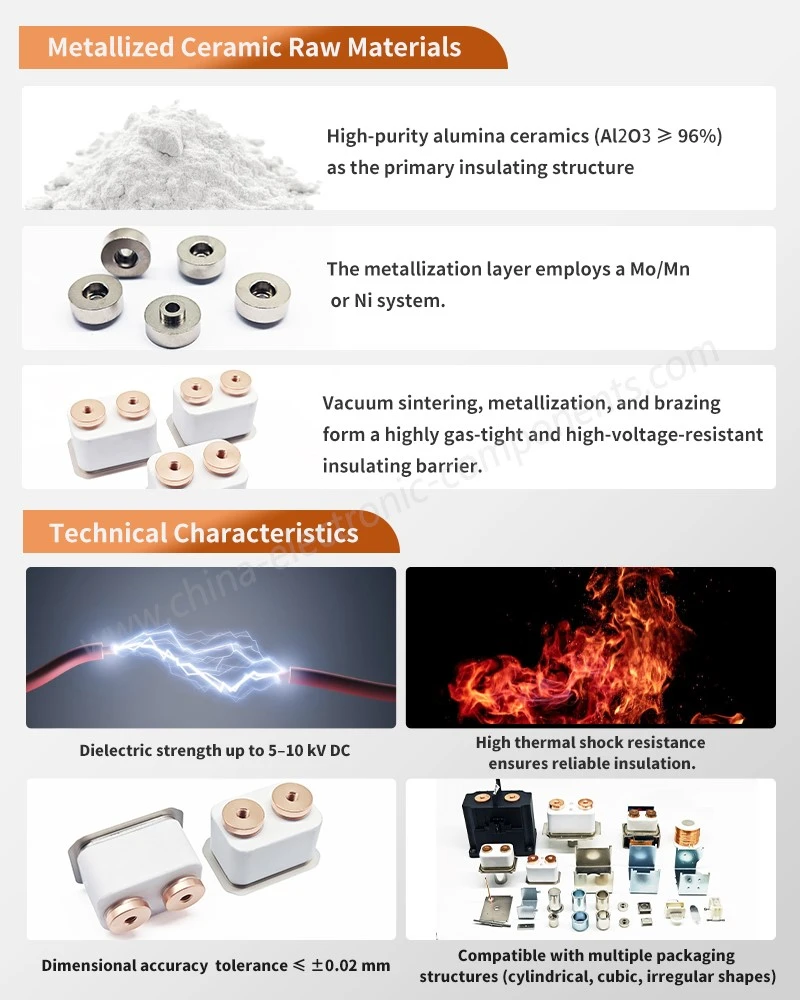
In high-voltage DC relays, metallized ceramics serve not only as electrical insulators but also contribute to structural support, hermetic sealing, and electrical isolation. The adhesion, uniformity, and thickness control of the metallized layer-as well as its compatibility with subsequent brazing or soldering processes-directly influence the reliability of the final component. Alumina-based metallized ceramics are created by applying a metal coating to the surface of alumina ceramic components, enabling them to be joined to metal structures.
Due to their excellent electrical insulation, mechanical strength, and thermal stability, alumina ceramics are a preferred material for high-voltage electrical insulation structures. The specific purity and grade of the alumina substrate can be selected based on the product's electrical requirements, mechanical load, and operating temperature. For components with complex geometries or stringent dimensional tolerances, precision machining is required to control features such as aperture sizes, end-face flatness, concentricity, and critical mating dimensions.
The manufacturing of precision metallized ceramics encompasses not only the processing of the ceramic substrate but also surface cleaning, the application of the metallized layer, sintering (or other relevant treatments), subsequent metal joining, and quality inspection. Seamless integration between these process steps is essential to prevent interface defects caused by surface contamination, non-uniformity in the metal layer, or residual processing stresses.
Key Processes in Precision Ceramic Machining and Metallized Joining
Ceramic insulating components used in high-voltage DC relays often feature complex structures, which may include central holes, steps, positioning grooves, or designated areas for metal attachment. Given that alumina ceramics are both hard and brittle, improper control of machining parameters, clamping methods, or grinding techniques can easily lead to micro-cracks, edge chipping, or dimensional deviations.
Consequently, the precision machining of alumina ceramic parts requires the development of a tailored processing strategy based on the specific structure and dimensional requirements of each component. For thin-walled, slender, or complex-geometry parts, careful management of localized stress and thermal impact during machining is critical; furthermore, dimensional inspection must be employed to verify the precision of key features.
The surface quality of the ceramic substrate also plays a vital role in determining the integrity of the subsequent metallized layer. Following the processing of the ceramic substrate, a metallization process is applied based on the product's structural requirements. The choice of metallization process depends on the ceramic material, the method of metal attachment, and the intended operating environment. Key process parameters to control include the coverage area of the metallization, the quality of interlayer bonding, surface integrity, and compatibility with subsequent joining processes.
For components intended for brazing, the metallized layer must also meet specific requirements for wettability and bond integrity.
In high-voltage electrical components, the joint between ceramic and metal requires careful consideration of factors such as differences in thermal expansion, brazing temperatures, joining materials, and structural stresses. Joining ceramics to metal is not merely a combination of materials; it is a systematic process involving interface design, thermal process control, and the verification of hermetic sealing. A well-designed joint structure helps minimize stress concentrations during thermal cycling, thereby reducing the risk of interfacial cracking or leakage.
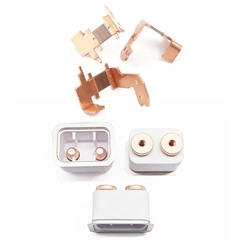
For insulating components made of alumina, metallized alumina ceramics can form reliable bonds with metal structures, allowing ceramic insulators to be integrated into relay housings, terminals, and other electrical connection points. In cases with specific structural requirements, the metallized areas may need to be selectively designed to balance insulation clearance, bond strength, and assembly precision.
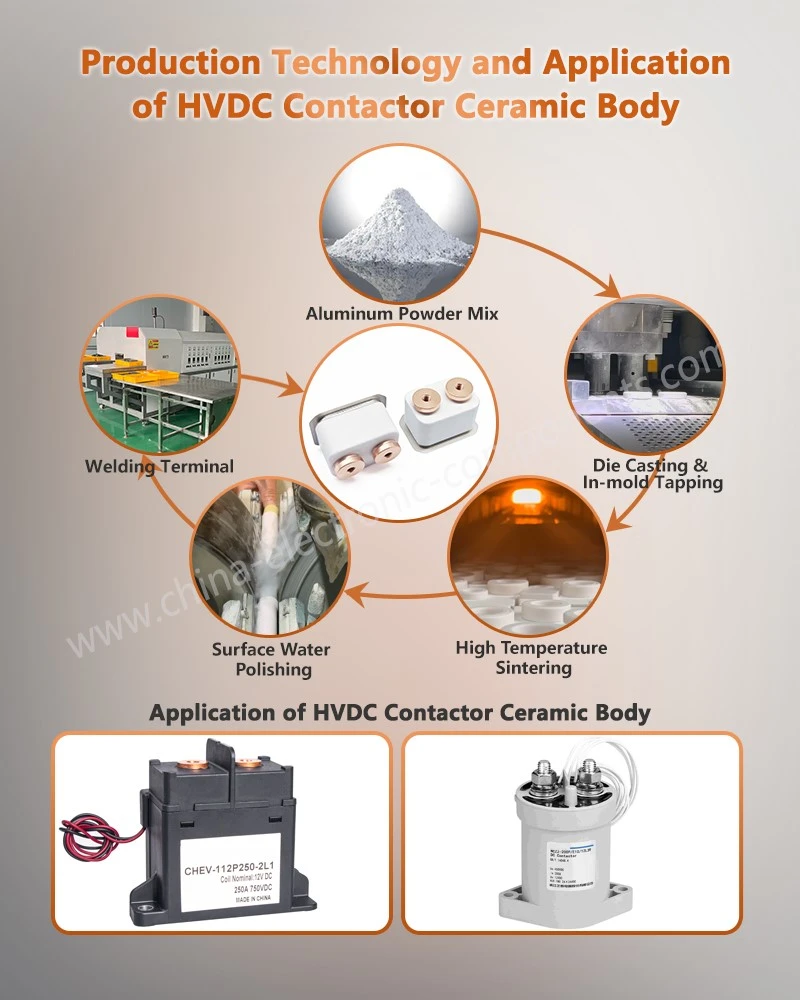
Design Requirements for Ceramic Enclosures in High-Voltage DC (HVDC) Relays
The ceramic enclosure serves as a critical component for internal insulation and sealing within an HVDC relay. Its design must be evaluated holistically, taking into account operating voltage, contact structure, internal gaseous environment, mounting method, and operating temperature. Beyond providing electrical isolation, the enclosure must withstand assembly loads, internal pressure fluctuations, and thermal stresses encountered during operation.
Key design considerations for HVDC relay ceramic enclosures include insulation clearance, wall thickness distribution, end-connection structures, metallized regions, and sealing interfaces. Dimensional deviations in the ceramic enclosure can affect the positioning of internal components and alter electrical clearances and creepage distances; therefore, critical dimensions and tolerance requirements must be clearly defined during the design phase.
In high-voltage applications, the dielectric properties of the ceramic material alone do not fully determine the insulation capability of the entire component. Actual insulation performance is also influenced by factors such as structural dimensions, surface conditions, the geometry of metal edges, environmental contamination, and assembly gaps. Therefore, design verification must incorporate withstand voltage, insulation resistance, and other relevant electrical tests, tailored to specific voltage ratings and applicable standards.
For structures requiring connections to metal end caps or terminals, metallized ceramic housings must also meet requirements for hermeticity and mechanical reliability. While components such as metallized ceramic housings for power semiconductors utilize similar concepts for ceramic-to-metal joining, the specific operating voltages, thermal loads, and packaging configurations vary by device; consequently, structural parameters cannot be applied interchangeably.
High-Strength Ceramic Components and Electrical Reliability Control
During the long-term operation of high-voltage DC relays, ceramic components are subjected to temperature fluctuations, mechanical vibrations, assembly stresses, and potential internal pressure variations. The intrinsic strength of the material, manufacturing defects, and the condition of the joining interfaces all influence the operational reliability of these components.
The development of high-strength metallized ceramic components requires a dual focus on the strength of the ceramic substrate and the quality of the metallized joints. For parts featuring thin walls, apertures, or complex transition geometries, it is critical to evaluate areas prone to stress concentration, ensuring that the overall structural integrity is not compromised by localized thinning or processing-induced damage.
Quality control for metallized ceramic components typically encompasses visual inspection, measurement of critical dimensions, assessment of the metallization layer's adhesion, and verification of joint quality. Hermetic components must undergo leak testing in accordance with product specifications, while high-voltage insulating components require rigorous withstand voltage and insulation performance testing. Testing methodologies and acceptance criteria should be established based on specific product blueprints, technical agreements, and relevant industry standards.
Furthermore, in mass production, it is essential to monitor material consistency across batches, the stability of the metallization layer, and variations in dimensional tolerances. Through raw material inspection, the recording of process parameters, spot checks at critical manufacturing stages, and final product verification, manufacturers can enhance product consistency and mitigate the risks of dimensional mismatches or joint failures during assembly.
The High-Voltage DC Relay Supply Chain: A Shift Toward High-Reliability Materials and Precision Manufacturing
The supply chain for high-voltage DC relays comprises upstream raw materials and key components, midstream relay design and manufacturing, and downstream applications-including new energy vehicles (NEVs), energy storage systems, charging infrastructure, and industrial power supplies.
Upstream materials include silver-based contact materials, copper, ferromagnetic materials, engineering plastics, ceramic substrates, and insulating materials. Among these, contact materials influence electrical conductivity, contact resistance, and electrical endurance; copper is primarily used for coils and conductive structures; and ceramic materials serve functions such as high-voltage insulation, structural support, and hermetic sealing. As products evolve toward higher voltage ratings, the importance of material performance and the manufacturing quality of components becomes increasingly critical.
The midstream manufacturing segment encompasses electromagnetic system design, contact processing, coil winding, ceramic sealing, the assembly of arc-extinguishing components, and final product testing. The performance of a relay is not determined by any single part; rather, it relies on the precise coordination between contacts, insulating components, sealing structures, and the drive system. In particular, the dimensions and bonding quality of metallized ceramic components directly impact subsequent assembly and sealing processes.
Downstream applications are expanding from new energy vehicles (NEVs) to energy storage systems, charging infrastructure, and power supply equipment for data centers. As high-voltage DC power distribution architectures gain traction, the associated equipment demands greater reliability, compactness, and ease of maintenance for high-voltage switching devices-driving increased demand for ceramic insulating structures and precision metallized components.
Industry Trends: A Convergence of High-Voltage Capability, Integration, and Precision Manufacturing
The transition to higher-voltage platforms in new energy vehicles is a key driver for the advancement of high-voltage DC relay technology. As architectures evolve from 400V to 800V and beyond, relays must meet more stringent insulation requirements and handle increasingly complex circuit-breaking conditions. Simultaneously, the growth of energy storage systems and data center power architectures is broadening the potential application scope for high-voltage DC switching devices.
A second trend is the shift toward modular and integrated product structures. Relays are increasingly being combined into tighter systems with fuses, sensors, connectors, and power distribution components. While modular design helps reduce external connections and optimize spatial layout, it also necessitates greater synergy among internal insulating components, connection structures, and thermal management systems.
A third trend involves the continuous advancement of ceramic materials and precision manufacturing processes. The increasing demand for high reliability and long-term stability in high-voltage electrical equipment has driven continuous advancements in high-purity alumina materials, precision ceramic machining, and metallization-based joining technologies. Precision metallized alumina ceramic components can be custom-engineered to meet specific electrical design requirements-encompassing material selection, the configuration of metallized zones, precise dimensional specifications, and joining methods.
Furthermore, high-purity, metallized advanced ceramic components offer essential material and process solutions for high-reliability electrical packaging. Future industry competition will extend beyond the performance of complete relay units to encompass critical materials, core components, precision machining capabilities, and rigorous quality validation.
Engineering Procurement Focus: Shifting from Individual Materials to Integrated Component Validation
For relay manufacturers and procurement teams in the high-voltage electrical sector, the selection of metallized ceramic components must be evaluated based on specific application conditions. During the procurement phase, it is insufficient to focus solely on ceramic purity or the name of the metallization process; one must also verify the specific material grade, component dimensions, tolerance requirements, metallized zone layout, joining methods, hermeticity standards, and the intended operating environment.
For projects involving components such as ceramic housings for high-voltage DC relays, insulating tubes, metallized alumina ceramics, or other precision insulating parts, it is advisable to provide product drawings, material specifications, operating voltage, temperature ranges, assembly methods, and the expected service environment when requesting a quote. For projects still in the design phase, providing prototypes or structural concepts allows for an assessment of the manufacturability regarding ceramic machining, metallization, and ceramic-to-metal joining.
Through early-stage engineering reviews, sample validation, and critical dimension inspection, the compatibility between these components and the overall relay structure can be more effectively ensured. For projects requiring custom development or volume procurement, please submit your drawings and technical specifications for inquiry; we look forward to discussing material selection, precision machining, metallization processes, quality inspection, and mass production solutions.
contact us

Send Inquiry