










Insulating Powder Coatings: A Reliable Protective Shield For Busbars in The New Energy Era
May 12, 2026
Leave a message
In the field of modern electrical and electronic engineering, insulating powder coatings, as a specialized environmentally friendly polymer material, are playing an irreplaceable role. They not only possess the excellent protective and decorative properties of traditional powder coatings but also boast superior electrical insulation characteristics. Their applications are extremely wide-ranging, from precision 3C manufacturing and medical equipment to high-power electric vehicle components with extremely high safety requirements. Particularly in new energy vehicles, insulating powder coatings provide crucial insulation protection and thermal management solutions for battery pack casings, battery modules, cooling systems, and epoxy powder coated busbars.
The core working principle of insulating powder coatings is to uniformly adsorb fine powder particles onto a conductive metal surface through processes such as electrostatic spraying or fluidized bed coating. Subsequently, high-temperature baking melts, levels, and solidifies the powder, ultimately forming a uniform and dense insulating film on the workpiece surface. Among various insulation systems, the application of epoxy powder coated insulated busbars is particularly prominent. Epoxy resin-based coatings, thanks to the abundance of hydroxyl and ether bonds in their molecular structure, can form an extremely strong adhesion to metal surfaces, creating an indestructible electrical isolation barrier.
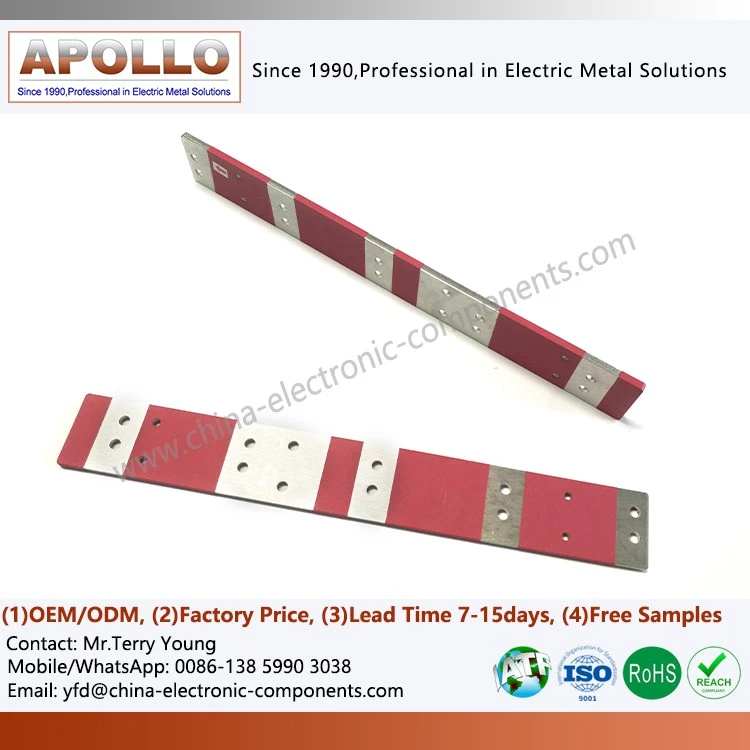
As the global automotive industry upgrades to high-voltage platforms of 800V and even higher, unprecedented challenges are being placed on the insulation reliability of electrical systems. High-quality insulation coating busbars not only need to withstand extremely high operating voltages but also must possess exceptional resistance to tracking to prevent the formation of conductive paths due to surface discharge in humid or contaminated environments, thus preventing short-circuit faults. Modern high-performance insulating powder coatings often boast voltage breakdown resistance reaching thousands of volts and have passed the stringent UL94-V0 flame-retardant certification, safeguarding the safe operation of high-voltage electrical systems.
In actual electrical cabinets and battery packs, we often see the application of a composite process of electroplating and powder coating busbars. Typically, copper or aluminum busbars are first electroplated to improve their basic conductivity and corrosion resistance, followed by a layer of insulating powder coating. This dual protection not only ensures excellent conductive contact surfaces but also achieves comprehensive electrical isolation and physical protection through the powder coating, significantly extending the service life of components under complex operating conditions.
Another significant advantage of using epoxy powder coating busbars lies in their superior corner coverage. In traditional liquid insulating varnish coatings, the edges and corners of workpieces often suffer from insufficient coating or even missed areas (the "Faraday cage" effect). Powder coatings, with their electrostatic adsorption properties, can perfectly cover every sharp edge and corner of the workpiece, providing all-around, seamless insulation protection and effectively preventing edge discharge.
Currently, powder-coated busbars on the market are mainly divided into two categories: epoxy and polyester. Epoxy insulating powder coatings, with their excellent adhesion, chemical corrosion resistance, and mechanical strength, have become the preferred choice for the internal insulation of motor rotors, transformers, and high-voltage electrical appliances. Polyester insulating powder coatings, on the other hand, with their excellent weather resistance and UV resistance, are more often used in outdoor instrument housings, appliance panels, and other applications requiring long-term resistance to environmental aging.

For purchasing and engineering personnel, selecting the appropriate busbar insulating coating powder is crucial. In addition to basic insulation resistance and withstand voltage indicators, the coating's resistance to electrolyte corrosion in specific environments must also be considered. Especially inside the power battery pack, the busbar may come into contact with trace amounts of electrolyte volatiles. High-quality insulating powder must have extremely strong chemical inertness to ensure that the coating does not soften or peel off under long-term contact.
Looking ahead, with the rise of electric vertical takeoff and landing (eVTOL) aircraft and ultra-large capacity energy storage systems, the performance requirements for EV busbar powder coatings will reach new heights. Future insulating powder coatings will evolve towards higher tracking indices (CTI), lower dielectric losses, and superior flame retardancy, continuously providing the most fundamental and robust material support for humanity's electrification transformation.
If you need more information on the technical parameters of insulating powder coatings, or customized solutions for insulated copper bus bars, please feel free to contact us. We will provide you with professional product selection and technical support to help make your electrical systems safer and more reliable.
contact us

Send Inquiry