










High-voltage DC Relay Breaks The Deadlock Again
May 06, 2026
Leave a message
In high-voltage DC applications such as new energy vehicles, energy storage systems, and DC charging infrastructure, the performance of high-voltage DC relays directly affects the system's safety, reliability, and long-term operational stability. As system voltage levels continue to evolve towards 750VDC and above, relays face higher requirements in terms of insulation performance, arc control, and structural sealing. Ceramic sealing structures are gradually becoming one of the mainstream technological approaches.
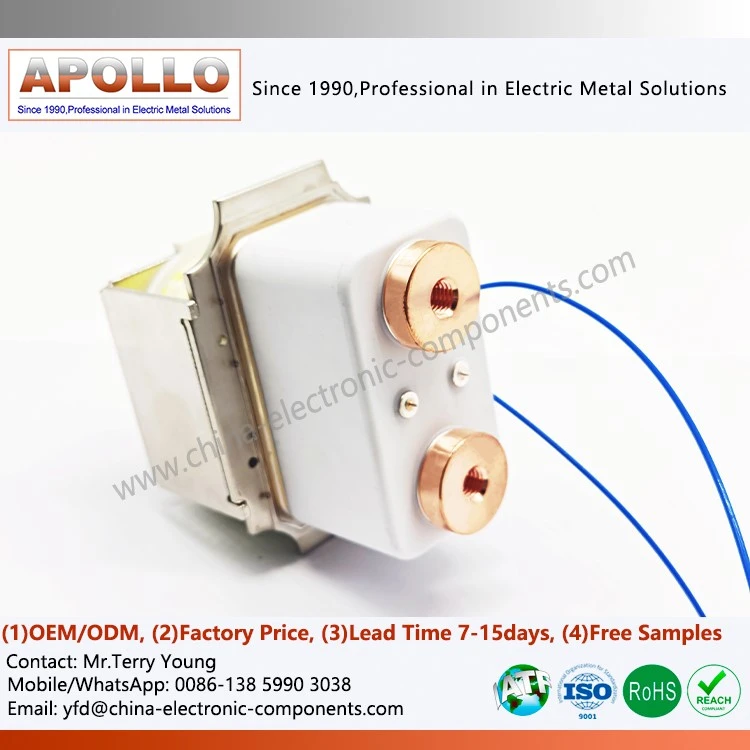
From a structural design perspective, relays employing ceramic brazing sealing technology achieve complete isolation between the internal arc space and the external environment through a reliable connection between high-density alumina ceramics and metal components. This structure effectively reduces the risk of arc leakage and prevents corrosion of the contact system by external dust, moisture, and other factors. In this type of structure, Alumina Metallized Ceramics and Precision Metallized Ceramics are widely used at critical insulation interfaces. They achieve high-strength connections between ceramics and metals through the metallization of alumina ceramics process, ensuring long-term airtightness and electrical stability.
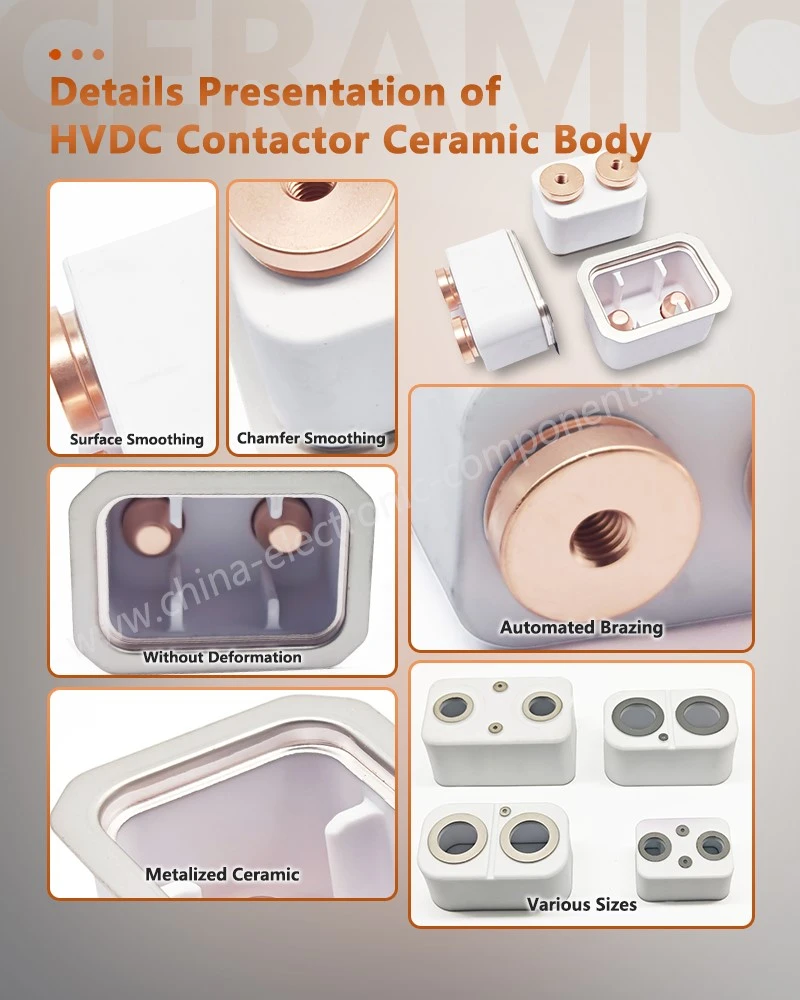
Regarding gas environment control, the relay interior is typically potted with a hydrogen-based mixed gas. This design helps suppress contact oxidation and arc energy accumulation, significantly reducing contact resistance fluctuations and extending electrical life. Under high temperature and high current continuous carrying conditions, this type of design maintains low contact resistance, effectively reducing localized heating and material degradation. Simultaneously, the packaging system based on Metallized Alumina Ceramics for Electrical Components exhibits excellent characteristics in high temperature resistance, arc erosion resistance, and insulation stability.
In terms of electrical performance, high-voltage DC relays must balance continuous current-carrying capacity and transient surge withstand capability. In typical applications, the relay must support continuous current output in the hundreds of amperes and withstand transient surge currents in the thousands of amperes to adapt to system startup, capacitor charging, and sudden load changes. Furthermore, a reasonable overload tolerance curve design is crucial for improving system safety margins. Regarding mechanical life, structural stability under high-frequency breaking conditions is equally critical, placing higher fatigue resistance requirements on internal elastic elements and contact systems.
With the development of high-voltage platforms, the voltage rating range of relays is continuously expanding, typically covering the 750VDC to 1000VDC range. To meet the insulation requirements at higher voltage levels, relays must employ high insulation resistance materials and a well-designed electric field distribution. In this process, technologies such as High-Strength Metallized Ceramic Components and Metallized Ceramic Housings for Power Semiconductors are introduced to improve overall withstand voltage performance and reduce the risk of breakdown.
Simultaneously, the application of Metallized Ceramic Insulating Tubes with Metalized Ceramic Parts in critical conductive paths helps optimize electric field uniformity and enhance local insulation capabilities.
In terms of application adaptability, high-voltage DC relays must meet the requirements of complex operating conditions in various scenarios. In the field of new energy vehicles, they need to have wide-temperature operating capabilities and shock resistance to adapt to vibrations and temperature fluctuations during vehicle operation; in charging systems, they need to support the coordinated operation of the pre-charging circuit to reduce the surge current at the moment of main circuit closure; in energy storage systems, equipment typically faces high humidity and outdoor environmental challenges, thus placing higher demands on sealing performance and environmental resistance. In the aforementioned scenarios, structural solutions such as the EV HVDC Relay Ceramic Housing and HVDC Contactor High Purity Ceramics Shell for Relay utilize precision machining of alumina ceramic parts to provide high-precision dimensional control and consistency assurance, thereby enhancing system integration reliability.

From a materials and manufacturing process perspective, metallization of alumina is one of the core processes for achieving reliable connections between ceramics and metals. It forms a metallization layer on the alumina surface, giving it weldability and conductivity. Alumina Metallized Ceramics for Bonding and Metallized Ceramics for Electrical, developed based on this process, are widely used in high-voltage electrical components, providing stable insulation and structural support for relays, power semiconductors, and connectors. Simultaneously, Alumina Metallized Ceramics for Electronic Applications exhibit excellent dielectric properties and thermal stability under high-frequency and high-voltage environments.
In summary, high-voltage DC relays based on ceramic sealing and metallized ceramic technologies are becoming key fundamental components in high-voltage electrical systems. By applying wear-resistant and highly reliable materials such as Metallized Alumina Ceramics Wear Resistant For EV Relay, these products have achieved significant improvements in electrical performance, environmental adaptability, and service life, providing important support for the safe operation of high-voltage DC systems.
contact us

Send Inquiry