










Accelerating The Intelligent Transformation Of Power Distribution Cabinets: IoT And Digital Technologies Drive Upgrades To Power Distribution Systems
Nov 03, 2026
Leave a message
With the advancement of industrial automation, the integration of new energy sources, the construction of data centers, and the development of smart cities, power systems now demand higher levels of safety, stability, and operational efficiency from power distribution equipment. As essential components for the distribution, control, and protection of electrical energy, power distribution cabinets are evolving from traditional electrical hardware into intelligent, networked, and modular systems. By integrating sensors, smart controllers, communication modules, and data analysis systems, modern power distribution equipment can perform operational status monitoring, early anomaly warning, remote management, and energy data analysis-providing a foundational pillar for the digital transformation of power systems.

The Intelligentization of Power Distribution Cabinets Drives the Digital Upgrade of Power Systems
Traditional power distribution cabinets primarily handle basic functions such as power distribution, circuit control, and protection against overloads and short circuits; their operational status typically relies on periodic manual inspections by on-site personnel. As power distribution systems scale up and load structures become increasingly complex, relying solely on manual inspections makes it difficult to detect potential faults promptly. Furthermore, such methods struggle to meet the requirements of modern industry for continuous power supply and refined energy management.
Intelligent power distribution equipment-equipped with sensors for current, voltage, temperature, and power quality-can continuously collect operational data and transmit it to a backend management platform via a communication network. Operations and maintenance (O&M) personnel can remotely monitor equipment status, identify abnormal parameters, and schedule repairs based on early-warning alerts, thereby reducing the risk of unplanned downtime.
In large-scale industrial parks, commercial buildings, and infrastructure projects, the design of power distribution cabinets is shifting from a focus on simple cable distribution toward comprehensive power management. Beyond meeting requirements for cable termination, circuit distribution, and safety protection, these units must now also account for internal spatial layout, thermal management, cable organization, and ease of future maintenance.
IoT, Big Data, and Artificial Intelligence as Key Technological Drivers
Internet of Things (IoT) technology serves as a vital foundation for intelligent power distribution systems. By deploying monitoring sensors on circuit breakers, busbar connection points, cable joints, and other critical electrical components, it is possible to capture real-time data on current, voltage, temperature, and overall equipment status. For outdoor power distribution facilities spread across wide areas, remote communication capabilities help reduce the frequency of on-site inspections and improve the efficiency of fault response. In the construction of telecommunications infrastructure, outdoor fiber optic distribution cabinets are primarily used for the entry, anchoring, splicing, distribution, and protection of optical fiber cables.
As telecommunications networks evolve toward higher density and greater bandwidth, fiber optic distribution equipment must feature an optimized internal architecture, reliable sealing, and a modular design that facilitates expansion and maintenance-all essential for long-term, stable operation in complex outdoor environments.
Big data analytics further enhances the management capabilities of power distribution systems. By leveraging long-term data-such as current loads, temperature fluctuations, equipment operating hours, and fault records-management platforms can identify load patterns, analyze anomalous operational trends, and provide actionable insights for equipment maintenance and capacity planning. In industrial settings characterized by significant fluctuations in power demand, data analytics also helps optimize distribution schemes and improve energy efficiency.
The integration of artificial intelligence (AI) is shifting power distribution systems from passive monitoring toward proactive, early-warning capabilities. By analyzing historical fault data alongside real-time operational parameters, these systems can detect potential issues-such as abnormal temperature rises, overloads, or fluctuations in power quality-thereby assisting operations and maintenance (O&M) personnel with diagnostics. However, the accuracy of AI algorithms remains contingent upon sensor quality, data integrity, and the specific operational environment; continuous validation is required to ensure long-term reliability.
Data Center Development Drives Demand for Highly Reliable Power Distribution Equipment
The rapid expansion of cloud computing, AI-driven processing, and digital infrastructure has led to a sustained increase in the power requirements of data centers. Servers, networking hardware, storage systems, and cooling infrastructure all demand a stable, uninterrupted power supply; any failure within the power distribution chain can disrupt data services.
Consequently, power distribution systems in data centers place a heightened emphasis on power redundancy, load monitoring, fault isolation, and the management of equipment operational status. Beyond requiring sound circuit configurations and electrical protection, distribution cabinets for data centers must accommodate high-density equipment installation, efficient cable organization, thermal management, and rapid maintenance procedures.
In high-power-density applications, the design of internal busbars, connection terminals, and cable joints is particularly critical. These connection points must maintain stable contact resistance and sufficient current-carrying capacity to prevent localized overheating, which could otherwise compromise system performance. At the same time, a rational structural layout helps reduce cable crossing and space congestion, thereby improving the efficiency of equipment installation and maintenance.
As data center construction moves toward standardization and prefabrication, power distribution equipment is increasingly adopting integrated designs. By completing cabinet fabrication, component installation, internal wiring, and factory testing in advance, the workload for on-site assembly is reduced, and configuration consistency across different pieces of equipment is enhanced.

Modularization and Structural Optimization Enhance the Adaptability of Power Distribution Equipment
Modularization is a key development trend for modern power distribution equipment. While traditional fixed cabinets have inherent limitations regarding functional expansion and long-term maintenance, modular structures allow for the configuration of specific functional units based on actual load requirements, facilitating equipment expansion, servicing, and system upgrades.
Intelligent distribution cabinets typically integrate electrical protection, parameter acquisition, communication management, and control functions, providing the equipment with more comprehensive operational monitoring capabilities. Their internal structure requires the strategic arrangement of circuit breakers, control modules, busbars, terminals, and cable pathways, ensuring sufficient electrical clearance and heat dissipation space between functional units.
For industrial power distribution projects requiring flexible configuration, modular distribution cabinets can be designed through the combination of various functional modules, tailored to specific voltage levels, circuit counts, and installation environments. Modular structures not only improve space utilization within the cabinet but also simplify future retrofitting, meeting the expansion needs of projects of various scales.
Regarding cabinet materials, metal structures remain a primary choice for industrial power distribution equipment. Wall-mounted metal distribution units are suitable for buildings or industrial settings with limited space; their design must balance load-bearing capacity, installation methods, internal component layout, and protection ratings.
Furthermore, steel distribution cabinets-valued for their superior mechanical strength and structural stability-are widely used in industrial power distribution and outdoor electrical installations. Material selection should account for the installation environment, corrosion risks, equipment weight, and protection requirements, with careful consideration given to sheet metal thickness, surface treatment, and structural reinforcement.
Expansion of Communication Networks Drives Upgrades in Fiber Optic Distribution Equipment
Beyond power distribution systems, the digital transformation of communication infrastructure has also spurred technological upgrades in distribution equipment. As the demand for 5G networks, the Industrial Internet, and data center interconnectivity grows, the number of fiber-optic connections is steadily increasing. This places higher requirements on fiber-optic cable management, splice protection, and distribution capacity.
Modular fiber cabinets utilize modular units to manage fiber splicing, distribution, and storage space. This improves the organizational efficiency of fiber resources and facilitates future capacity expansion. The design of such equipment must account for fiber bend radii, splice protection, internal routing paths, and sufficient space for maintenance operations, ensuring that improper cabling does not lead to signal loss or mechanical damage.
For communication nodes that require centralized management of multiple fiber-optic cables, fiber distribution hub cabinets provide a consolidated space for fiber access and distribution. As communication networks expand their coverage, this equipment must also be adaptable to various installation methods and environmental conditions, featuring enhanced resistance to dust, moisture, and external mechanical impact.
Furthermore, multi-tiered solutions-such as cable distribution cabinets with distinct upper and lower sections-allow for the optimization of internal functional zones based on specific project requirements. By effectively segregating different types of cables or distribution units, these designs improve both space utilization and on-site management efficiency.
New Energy Grid Integration and Outdoor Power Distribution Drive Advancements in Equipment Protection Technology
The expanding scale of photovoltaic (PV) power, wind power, and energy storage systems has introduced new requirements for power distribution equipment, particularly regarding the integration of distributed energy sources, power conversion, and energy dispatch. Because new energy projects are often characterized by geographically dispersed installations, complex operating environments, and significant load fluctuations, the associated power distribution equipment must offer robust electrical protection and strong environmental adaptability.
In photovoltaic power plants, energy storage facilities, and industrial energy management systems, power distribution cabinets must be designed according to specific system parameters, including voltage levels, rated current, the number of circuits, and short-circuit current ratings. Additionally, internal components-such as busbar connections, circuit breaker selection, cable securing methods, and temperature rise control-must all comply with relevant engineering standards.
For outdoor communication and power distribution infrastructure, both outdoor fiber distribution cabinets and outdoor electrical enclosures must be designed with careful consideration for environmental factors, including rain, dust, corrosion, and temperature fluctuations. The cabinet's sealing structure, door design, ventilation and heat dissipation mechanisms, and surface protective treatments are all critical factors that influence the long-term operational performance of the equipment.
As project environments become increasingly diverse, equipment manufacturing is shifting from purely standardized products toward a model that combines standardized platforms with customized configurations. This evolution ensures that equipment can meet the specific requirements of different regions, installation spaces, and system architectures.
Technical Challenges and Future Development of Intelligent Power Distribution Cabinets
Although intelligent power distribution equipment holds significant potential, its development faces several challenges.
First is the issue of data security. Once power distribution equipment is connected to a communication network, robust cybersecurity measures must be implemented for operational data and remote control interfaces to prevent unauthorized access and manipulation.
Second is the challenge of communication protocols and device compatibility. Since intelligent meters, controllers, and communication modules from different manufacturers may utilize varying data interfaces and protocols, system integration requires careful attention to communication compatibility and data standardization.
Third is the concern regarding long-term operational reliability. The integration of sensors, communication modules, and electronic control units into power distribution equipment-beyond meeting traditional electrical performance standards-necessitates rigorous validation of electronic components regarding operating temperature ranges, electromagnetic interference (EMI) resistance, and long-term stability.
Looking ahead, the adoption of edge computing, 5G communication, and digital twin technology will enable more granular condition monitoring and operational management of power distribution equipment. Edge computing allows for data processing at the device level, thereby reducing communication latency; meanwhile, digital twins-by synthesizing device structure, operational parameters, and maintenance records-can support comprehensive condition assessment and performance optimization.
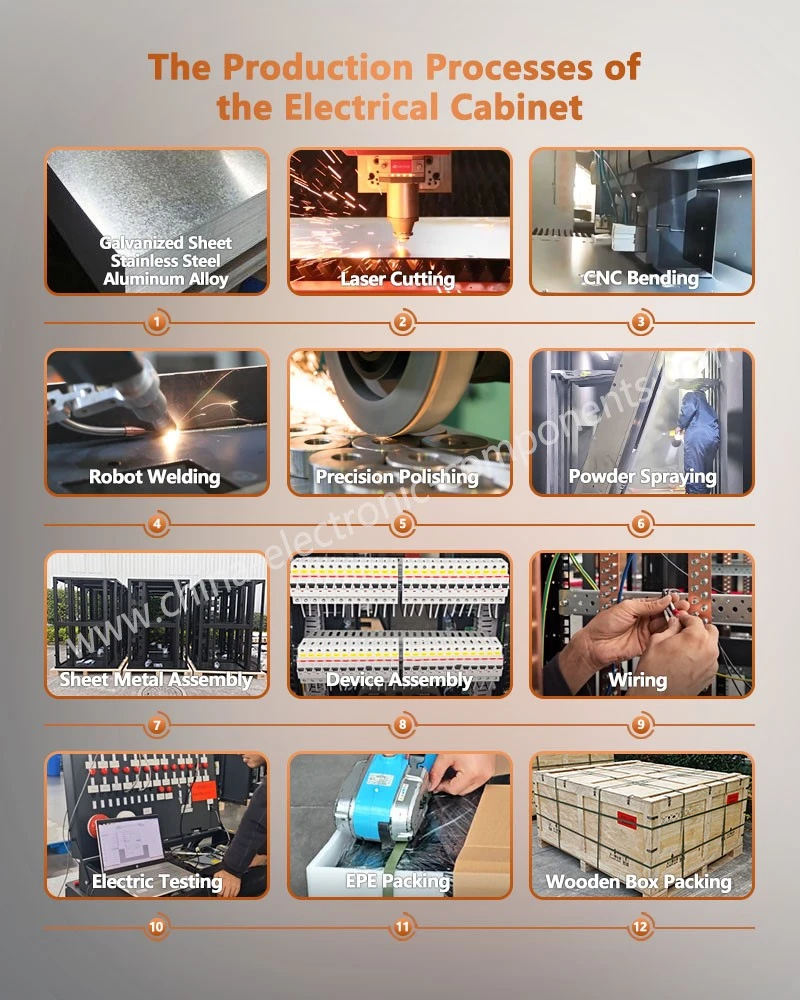
From a manufacturing perspective, the advancement of power distribution equipment relies not only on intelligent control technologies but also on continuous improvements in cabinet structural design, metal fabrication, and electrical connection processes. High-precision sheet metal processing, automated welding, precision stamping, anti-corrosion surface treatments, and standardized assembly collectively determine the equipment's structural integrity, installation precision, and long-term reliability.
Engineering Procurement: A Greater Focus on Structural Design and Full-Lifecycle Reliability
As power distribution systems evolve toward greater intelligence, integration, and modularity, the criteria used in engineering procurement are shifting. Rather than focusing solely on individual specifications or purchase price, the evaluation of power distribution equipment now encompasses a broader set of indicators, including electrical performance, structural quality, environmental adaptability, and long-term maintenance costs.
During the project selection phase, procurement and engineering teams should clearly define the equipment's rated voltage, rated current, short-circuit withstand capacity, ingress protection (IP) rating, mounting method, enclosure dimensions, and the configuration of the internal power rack distribution cabinet. For outdoor power distribution equipment, it is also necessary to specify the actual installation environment, temperature and humidity conditions, and anti-corrosion requirements. For data center and new energy projects, the focus should be on confirming the power supply architecture, load requirements, thermal management conditions, and provisions for future capacity expansion.
When the procurement involves customized enclosures or metal structural components, it is advisable to provide 2D or 3D drawings, material specifications, sheet metal thickness, surface treatment standards, and assembly interface details in advance. This enables the manufacturing team to conduct structural assessments, process planning, and sample verification. Thorough communication regarding design requirements and quality acceptance criteria during the early stages ensures better alignment between the equipment and the project site, establishing a reliable foundation for subsequent mass production, installation, and long-term operation.
contact us

Send Inquiry