










Technical Classifications And Application Differences Between Copper Braid And Copper Foil Flexible Connectors: An Analysis Of Component Selection And Manufacturing Processes For Flexible Conductive Elements
Oct 31, 2026
Leave a message
With the continuous development of new energy vehicles, energy storage systems, industrial electrical equipment, and power electronics, high-current transmission systems have placed increasingly stringent demands on the electrical conductivity, flexibility, heat dissipation, and operational reliability of connection components. While traditional rigid copper busbars offer excellent electrical conductivity and structural stability, they often fall short in applications requiring flexibility-such as those involving equipment vibration, thermal expansion compensation, or complex spatial routing. Consequently, flexible copper connectors have emerged as a vital component in power connection systems.
Flexible copper connectors achieve a combination of electrical conductivity and mechanical flexibility, typically through methods such as braiding multiple copper strands or laminating layers of copper foil. Based on their structural configuration and manufacturing process, they are primarily categorized into two types: braided copper connectors and laminated copper foil connectors. Both utilize highly conductive copper as their core material, yet they differ in terms of structural design, current-carrying characteristics, mechanical properties, and intended applications.
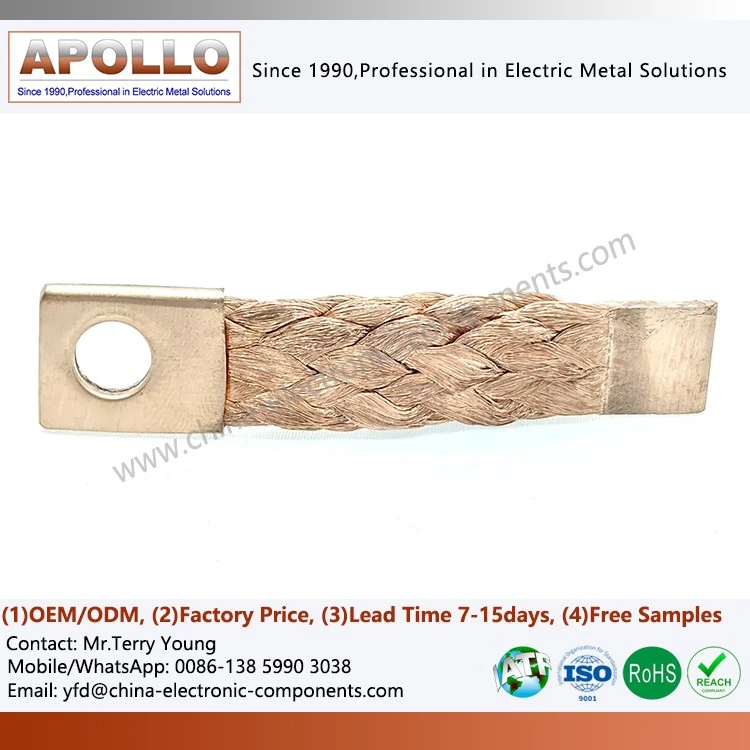
Braided Copper Connectors: Balancing Electrical Conductivity and Mechanical Flexibility
Braided copper connectors are generally constructed from multiple fine copper strands, processed via braiding or stranding techniques to create a flexible conductive structure. They offer superior bending adaptability and vibration compensation, effectively absorbing mechanical displacement during equipment operation and reducing the stress exerted on rigid connection points.
In terms of product architecture, these flexible electrical connectors can be customized-varying in cross-sectional area, length, and terminal design-to suit specific installation spaces, current-carrying requirements, and connection methods.
Braided copper connectors primarily include the following types:
The first is the flat-braided structure. This design consists of multiple fine copper strands interwoven into a flat, ribbon-like conductor. Featuring a wide contact surface and excellent bending flexibility, it is well-suited for applications within battery modules, power distribution cabinets, transformers, and various electrical equipment. For scenarios requiring current transmission within confined spaces, the flat structure offers superior routing adaptability.
The second is the stranded-braided structure. In this configuration, multiple copper strands are first twisted (stranded) together and subsequently processed through a braiding technique to form a flexible conductor. Compared to standard flat-braided structures, this type offers distinct advantages in environments characterized by multi-directional bending and vibration. It is well-suited for use in transformers, switchgear, and power connection points subject to mechanical vibration.
A third type is the tinned copper braided structure. By applying a tin coating to the surface of the copper wires, the material's resistance to oxidation and corrosion in certain environments is enhanced, thereby minimizing the impact of surface oxidation on the connection interface. This tinned configuration is particularly valuable for operating environments exposed to humidity, salt spray, or other corrosive risks.
In the manufacturing of flexible copper braids, the design typically accounts for factors such as wire diameter, braid density, number of strands, and total cross-sectional area. Since these parameters influence the product's flexibility, conductive cross-section, and mechanical strength, they must be carefully balanced based on the actual operating current and installation requirements.
For high-current electrical systems, flexible copper braided connectors must not only meet rated current transmission requirements but also ensure mechanical stability under short-circuit conditions, maintain high-quality welding at the connection terminals, and account for temperature rise during long-term operation.
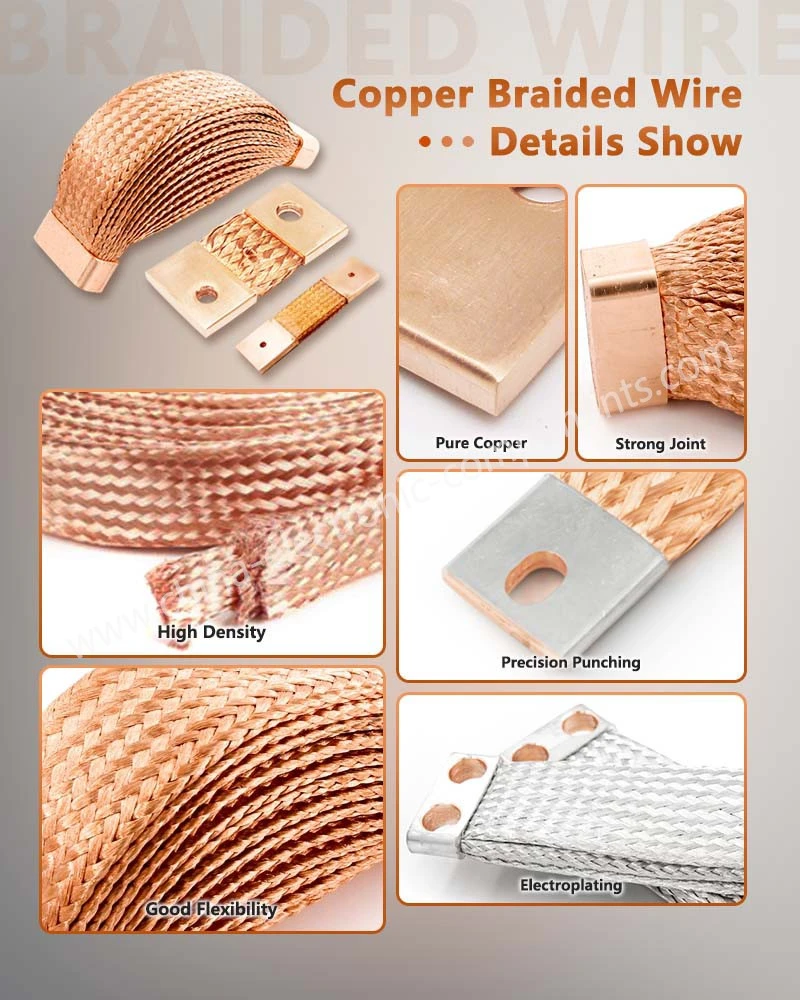
Copper Foil Flexible Connectors: Suitable for High-Current and Highly Integrated Applications
Copper foil flexible connectors are generally composed of multiple layers of thin copper foil, with the ends joined together through crimping, diffusion welding, or other appropriate processes. Unlike braided copper structures, these connectors achieve flexibility through the layered arrangement of thin copper sheets, allowing them to accommodate equipment installation tolerances and displacements caused by thermal expansion.
In terms of material properties, copper foil offers excellent electrical and thermal conductivity. By adjusting the thickness, number of layers, width, and length of the copper foil, it is possible to create components with varying cross-sectional areas and degrees of flexibility, meeting the structural requirements of diverse electrical equipment.
Copper foil flexible connectors are primarily manufactured using the following methods:
The first method involves crimping and welding. Multiple layers of copper foil are cut, stacked, and aligned at the ends, which are then joined to form a terminal connection through pressure processing and welding techniques. The ends can be designed-featuring drilled holes, punched holes, or specialized mounting structures-to accommodate the specific bolting requirements of various types of equipment.
The second type is a diffusion-bonded (molecular diffusion welded) structure. By precisely controlling temperature, pressure, and processing time, a stable metallurgical bond is formed at the ends of the stacked copper foils. This process is ideal for applications that demand high connection strength, electrical continuity, and consistent quality across large production batches.
The third type is a laser-welded structure. Through precise control of laser energy and the welding path, a localized bond is created at the ends of the copper foils. Given copper's high thermal conductivity and unique response to laser energy, welding parameters must be carefully managed during production to prevent issues such as incomplete fusion, spatter, or localized ablation.
In new energy battery systems and power electronics, flexible copper connectors-such as those made from stacked copper foils-can be customized using various copper material combinations and end-processing techniques to suit complex spatial layouts within equipment.
For inverters, energy storage converters, and high-voltage power distribution systems, key considerations for copper foil flexible connectors include the quality of the end welds, contact surface area, insulation, and temperature rise. Depending on the installation environment, some products may also incorporate insulating protective layers-such as PET, PVC, or epoxy resin-to meet specific electrical insulation and mechanical protection requirements.
Performance Differences: Copper Braid vs. Copper Foil Flexible Connectors
Although both copper-braided and copper-foil flexible connectors serve as flexible conductive components, their distinct internal structures lead to significant differences in mechanical performance and intended applications.
In terms of flexibility, copper-braided connectors-composed of numerous fine copper wires-offer excellent multi-directional bending capabilities, making them particularly well-suited for connections subject to continuous vibration or relative displacement. Copper-foil connectors, by contrast, achieve flexibility through the relative deformation of thin copper sheets; they are better suited for applications with defined installation orientations and limited displacement requirements.
Regarding current-carrying capacity, the actual performance of both types depends on factors such as the cross-sectional area of the copper, the length of the connection, heat dissipation conditions, ambient temperature, and the allowable temperature rise. Therefore, one cannot simply determine which is superior based solely on its structural form. For high-current applications, appropriate specifications must be determined through electrical design calculations and temperature-rise testing.
Regarding connection techniques, copper braided flexible connectors typically utilize end-crimping, welding, or other metal-joining processes to establish a reliable connection between the braided conductor and the copper terminal. Copper foil flexible connectors, by contrast, generally employ methods such as laminated welding or diffusion welding, with a focus on ensuring the quality of the bond at the ends and maintaining an effective conductive surface area.
In terms of environmental adaptability, tin-plated copper braided structures offer advantages in certain humid or corrosive environments. Copper foil flexible connectors can also be enhanced for various installation environments through the addition of insulating coatings, optimized surface treatments, and adjustments to the terminal structure.
For electrical systems requiring both high electrical conductivity and mechanical compensation capabilities, braided tin-coated copper flexible wire connectors serve as an effective solution. Their practical application should be evaluated based on factors such as operating temperature, the presence of corrosive elements, and material compatibility at the connection interface.
Structural Optimization and Expanded Applications of Copper Braided Flexible Connectors
As electrical equipment trends toward higher power density and greater compactness, the product structures of copper braided flexible connectors have become increasingly specialized. Beyond standard flat configurations, circular braided structures, custom-shaped braided designs, and versions with insulating protective layers are now being applied across a variety of electrical equipment.
Copper power braids, which utilize multiple strands of copper wire to form a continuous conductive path, are capable of accommodating a certain degree of bending and displacement during installation. They are commonly found in power equipment, transformer grounding connections, and industrial electrical systems.
For applications requiring improved resistance to surface oxidation, braided tin-coated copper flexible connectors-featuring tin-plated copper strands-offer enhanced adaptability for use in specific environments. During the production process, strict control must be maintained over the quality of the plating, the uniformity of the coating, and the condition of the terminal ends.
In the realm of circular flexible connectors, round braided or stranded flexible cords are designed for electrical connections in space-constrained environments that require multi-directional routing. The design of such products focuses on the stability of the conductor structure, the allowable bending radius, and the reliability of the terminal connections.
Round braided flexible cords and round stranded flexible cords offer varying degrees of flexibility-determined by the arrangement of the internal copper strands, the braiding density, and the cross-sectional area-to meet the requirements of industrial electrical equipment, grounding systems, and specialized connection points.
For electrical connections requiring a wider contact surface, flat copper braided flexible connectors feature a flattened design. Their width, thickness, and terminal dimensions can be adjusted to suit specific installation interfaces, making them ideal for use in power distribution cabinets, switchgear, and power connection systems for new energy applications.
Growing Demand in the New Energy and Industrial Electrical Sectors
The development of power batteries for new energy vehicles (NEVs), energy storage inverters, photovoltaic (PV) inverters, and high-voltage power distribution equipment is driving the evolution of flexible copper connectors toward higher current-carrying capacity, lower connection losses, and greater manufacturing consistency.
In the NEV sector, electrical connections within battery modules must withstand vibrations encountered during vehicle operation while meeting strict space constraints for routing and assembly. Flexible copper connectors can absorb a degree of mechanical displacement, thereby reducing the stress that rigid connections might otherwise exert on battery terminals and mounting structures.
In energy storage systems, numerous high-current connections exist between battery clusters, busbars, and power conversion systems (PCS). These connectors must be engineered based on the system's current rating, operating temperature, and equipment architecture, with a focus on verifying temperature rise, mechanical stability, and insulation performance at the connection points.
In industrial power distribution equipment, flexible connectors are primarily used to provide compensation between components such as transformers, circuit breakers, busbars, and other conductive elements. For equipment subject to continuous vibration or thermal cycling, selecting an appropriate connection structure helps optimize the distribution of mechanical stress and enhances the long-term operational stability of the connection system.
Furthermore, products such as braided copper flexible connectors and flexible copper braided electrical connectors are increasingly being customized.
During the manufacturing process, specifications-including copper wire gauge, braiding structure, product length, cross-sectional area, terminal hole configuration, and surface treatment-can be tailored to customer drawings to meet the specific assembly requirements of different types of equipment.
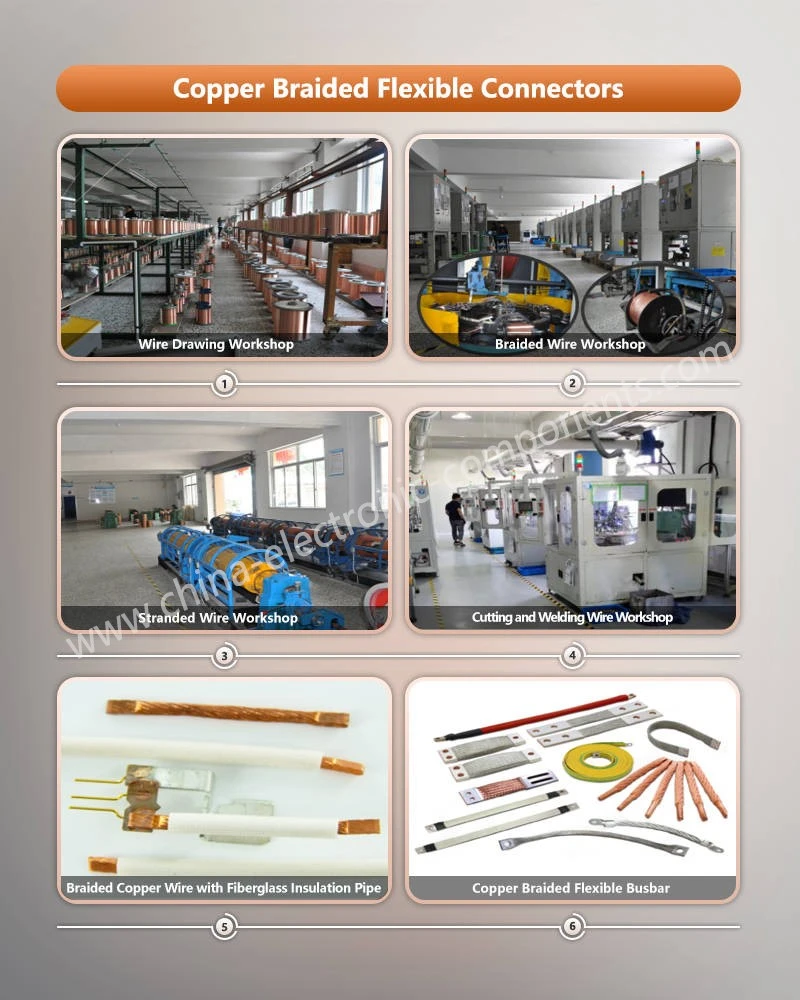
Selection and Quality Control of Flexible Copper Connectors
The selection of flexible copper connectors should not be based solely on product appearance or conductor cross-sectional area. Instead, it requires a comprehensive evaluation of factors including rated current, operating voltage, allowable temperature rise, installation space, mechanical displacement, and environmental conditions.
First, it is essential to define the equipment's operating current and short-circuit fault current requirements, then determine the appropriate product specifications based on conductor cross-sectional area, connection length, and heat dissipation conditions. Furthermore, one must assess whether the connection point will be subject to continuous vibration, repetitive bending, or the need for thermal expansion compensation during operation, in order to select the optimal design-whether a braided structure or a laminated copper foil stack.
Additionally, the quality of the terminal connections is a critical factor affecting overall product reliability. For braided copper connectors, attention must be paid to the distribution of the copper strands and the quality of the crimping or welding at the terminals. For laminated copper foil connectors, the focus should be on the alignment of the layers, the integrity of the welded joints, and the effective contact area.
Moreover, surface treatments and insulation protection should be selected based on the specific operating environment. Since tin plating, nickel plating, and various types of insulating sheath materials offer distinct performance characteristics, procurement specifications should clearly define material grades, coating thicknesses, insulation ratings, and relevant testing requirements.
During mass production, key dimensions, conductor cross-sectional areas, terminal hole positioning, weld quality, and electrical performance must be rigorously inspected. For products with stringent reliability requirements, additional validation tests-such as DC resistance, temperature rise, pull-off force, dielectric withstand voltage, and mechanical fatigue testing-may be incorporated to ensure the product meets all design and operational specifications.
Engineering Procurement: From Connection Design to Customized Manufacturing
For manufacturers of new energy vehicles, energy storage systems, photovoltaic inverters, and industrial electrical equipment, the procurement of flexible copper connectors involves more than just materials and product specifications; it is intrinsically linked to the internal structural design of the equipment, assembly efficiency, and long-term operational reliability.
During the engineering procurement process, it is advisable to provide comprehensive technical documentation-including product drawings, rated current, copper material specifications, dimensions, terminal connection methods, insulation requirements, and the intended operating environment-to allow the manufacturer to evaluate the feasibility of the product structure and the manufacturing process.
For customized projects, we can discuss specific requirements such as copper wire braid density, copper foil thickness and layer count, terminal stamping, diffusion welding, laser welding, surface plating, and insulation jacketing. Through prototype fabrication, dimensional inspection, and electrical performance verification, we ensure that the product is perfectly matched to your equipment before mass production begins.
Partnering with a supplier that possesses expertise in copper processing, precision stamping, flexible interconnects, and welding ensures a seamless transition from structural design to volume delivery. If you are developing battery interconnects for new energy vehicles, power connections for energy storage systems, or high-current conductive components for industrial applications, please share your product drawings and technical specifications so we can discuss material selection, process solutions, and your specific customization needs.
contact us
Send Inquiry