





Differences And Applications Of Brass Busbar And Copper Busbars
Feb 22, 2026
Leave a message
In modern power systems and electronic equipment protection systems, the impact of lightning and transient overvoltages on device reliability cannot be ignored. Lightning strikes, electromagnetic pulses, and power spikes have become significant factors causing equipment failures and insulation damage. Industry practice generally emphasizes a technical approach of "overall defense, graded protection, and multiple shielding," with the rational selection of conductor materials and busbar systems being a fundamental aspect of ensuring stable system operation. Regarding the structural optimization of power distribution and grounding systems, the material properties and application compatibility of bus bar electric components are increasingly becoming a focus of engineering design.

Among common conductor materials, brass busbars are widely used due to their excellent mechanical properties and processing characteristics. As a copper-zinc alloy, brass busbars possess high strength, good plasticity, and excellent machinability, exhibiting good forming stability under both cold and hot working conditions. Their surface quality and dimensional accuracy advantages make them suitable for structural components and various mechanical connections. In some medium conductivity requirements, brass busbars can be used as positive bus bars or auxiliary conductive components, particularly suitable for assembly environments that require a balance between mechanical strength and manufacturing efficiency.
From a materials engineering perspective, the performance of brass is closely related to its zinc content. As the zinc ratio changes, the material's hardness and strength increase, but its ductility and conductivity decrease. Industrial brass typically controls the zinc content within a reasonable range to avoid brittleness risks and maintain stable overall performance. Some special brasses, by introducing elements such as silicon, aluminum, and tin, can further improve corrosion resistance or wear resistance. In busbar and connector manufacturing, these materials are commonly found in bus bar connectors or structural supports, rather than high-current-carrying components.

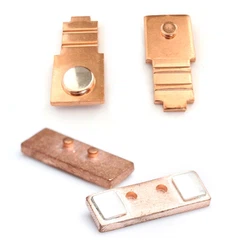
In contrast, pure copper busbars (industrial pure copper) have significant advantages in electrical performance. Based on high-purity copper, pure copper has electrical and thermal conductivity second only to silver, effectively reducing power transmission losses and minimizing heat accumulation effects. Its excellent ductility and weldability make it irreplaceable in complex current path designs and high-reliability connections. Solid copper busbars, as a representative of pure copper conductors, have become the mainstream choice for high-current, high-stability systems.
In terms of corrosion resistance, pure copper busbars also exhibit good environmental adaptability. Copper maintains a stable material structure and surface condition in air, fresh water, and various non-oxidizing media, which is particularly crucial for high-voltage bus bars operating over long periods.
Furthermore, copper's low resistance provides superior temperature rise control under high-frequency and high-current conditions, making it widely used in power distribution, industrial control, and new energy systems, such as the typical industrial power distribution structure, the Copper BusBar for Siemens.
From an engineering application perspective, the core difference between brass and copper bus bars lies primarily in the trade-off between conductivity and mechanical properties. Brass bus bars have higher hardness, better wear resistance, and higher machining efficiency, making them more suitable for mechanical structural components or parts with relatively moderate conductivity requirements; while copper bus bars excel in low resistance, high current carrying capacity, and excellent formability, making them more suitable for main current paths and critical conductive structures. In actual busbar fabrication, material selection often depends on current-carrying requirements, temperature rise limitations, and assembly conditions.
At the manufacturing and processing level, the two materials also exhibit different characteristics. Brass busbars are less prone to tool sticking during machining, resulting in better processing efficiency and dimensional consistency. Copper busbars, on the other hand, are more advantageous in stamping, bending, and press forming due to their higher ductility, but require more precise tooling and process parameters. For high-reliability electrical connection systems, the industry typically prioritizes copper as the primary material, while brass is more commonly used for connectors or auxiliary components. This division of labor is well-established in the product portfolios of bus bar manufacturers and suppliers.

Considering both material performance and system safety requirements, copper busbars remain the mainstream conductor solution in high-power, high-stability, and long-life operating environments. However, brass busbars offer certain advantages in applications that balance cost, strength, and ease of processing. A proper material matching strategy not only affects electrical performance but also directly relates to system temperature rise, contact reliability, and maintenance cycle, making it a crucial factor that cannot be ignored in power distribution design.
Focusing on the manufacturing needs of busbar systems and precision conductor components, our company has long been dedicated to the research, development, and production of Custom BusBars, Negative BusBars, Positive BusBars, and various high-reliability conductive components. Leveraging a mature processing and quality control system, we can provide systematic solutions covering Solid Copper Bus Bars, High Voltage Bus Bars, and various specifications of Bus Bar Connectors to meet the diverse application needs of industrial power distribution, new energy, and high-end equipment.
contact us

Send Inquiry