



Definition And Application Of Bimetal Silver Contacts in Electrical Design
May 07, 2026
Leave a message
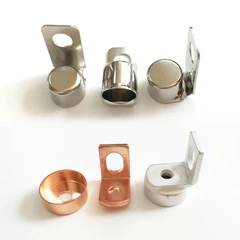
In the field of electrical design, Bimetal Silver Contacts are core components for achieving safe circuit switching and logic interlocking, widely used in various electrical components such as relays, contactors, circuit breakers, and limit switches. Their core logic ensures the safety and reliability of circuit operation through break-before-make or make-before-break timing control.
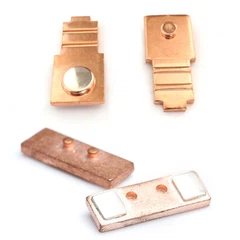
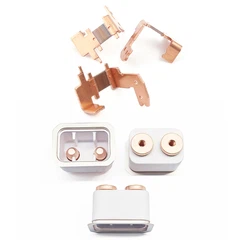
By definition, Bimetal Contact Rivets refer to a contact combination structure that integrates at least one set of normally open (NO) contacts and one set of normally closed (NC) contacts within the same electrical component, with all contacts driven by the same actuator (such as an armature or push rod) to achieve synchronous operation. When the component's actuator operates, all contacts switch states synchronously: normally open contacts close, normally closed contacts open, or vice versa, maintaining a fixed logical connection between the contacts.
Composite buttons are a typical application of Bimetal Rivet Contact. As a manual control element, it integrates both normally open and normally closed contact functions. The operating force is directly applied to the same contact actuator. It is widely used in scenarios such as motor control, interlock protection, and operation mode switching. It is a key component for achieving safe and reliable operation in electrical control systems. The adaptability of this contact allows composite buttons to meet the control requirements of different working conditions.

When pressure is applied to the button cap, the return spring is compressed, driving two sets of contacts to move synchronously via a mechanical linkage-the NC contact is forcibly opened, and the NO contact closes, achieving rapid circuit switching. After the button is released, the return spring rebounds, pushing the button cap back to its original position, and the contacts synchronously return to their initial state, completing a full control operation. The flexible adaptability of Bimetal Electronic Contacts ensures smooth contact switching.
The core advantage of composite buttons lies in their ability to achieve logically linked control of two circuits with a single manual operation. This effectively simplifies circuit design and improves control reliability. Typical applications include motor start/stop control (self-locking + emergency stop linkage), motor forward/reverse control (mechanical and electrical dual interlock protection), and "signal switching + status feedback" in automation systems. The stable performance of Bimetallic Contact Rivets ensures reliable operation in these scenarios.
Besides pushbuttons, Contactor Electrical Silver Contacts for frame circuit breakers are also an important application in electrical design. They integrate at least three pairs of contacts within the circuit breaker, including NO and NC contacts. Driven by the circuit breaker's mechanical operating mechanism (such as the drawer seat screw and energy storage spring), they achieve synchronous contact switching. Their core function is to convert the circuit breaker's mechanical state into electrical signals for interlocking control and status feedback. The structural stability of Bimetallic Rivet Contacts adapts to the high-frequency operation requirements of circuit breakers.
Rotating Electrical Contacts for frame circuit breakers can be further divided into three categories, each performing different functions: Operating position contacts are integrated into the drawer seat of the drawer-type frame circuit breaker and rigidly linked with the mechanical positioning mechanism, providing real-time feedback on the circuit breaker's mechanical position; energy storage auxiliary contacts are linked with the energy storage mechanism, providing feedback on the energy storage motor's operating status and achieving self-protection; and opening/closing auxiliary contacts are linked with the opening/closing operating mechanism, providing feedback on the circuit breaker's operating status and achieving multi-device logic interlocking. The high wear resistance of Bimetallic Silver Contacts extends the service life of this type of Open Contactor Silver Contact.

Based on the functions of three types of Dry Contactor Electrical Silver Contacts, typical applications of circuit breaker contacts include position control circuits, energy storage control circuits, and opening/closing indication circuits. Through synchronous switching of the contacts, precise feedback and control of the circuit breaker's operating status are achieved, ensuring the stable operation of the power system. The superior performance of Bimetallic Silver Contacts further enhances the reliability of circuit control.
In vacuum circuit breakers, the application logic of Breakers Silver Contacts is consistent with that of circuit breaker contacts. Multiple sets of NO and NC contacts are integrated internally, and synchronous switching is driven by a mechanical operating mechanism. The core function remains the conversion of mechanical states into electrical signals for interlocking control and status feedback. The Bimetallic Rivet For Relays adaptation design allows the Schneider Contact Block Point Contact to perfectly match the operating environment of vacuum circuit breakers.
The position interlocking circuit of the vacuum circuit breaker consists of multiple sets of Schneider Mpcb Auxiliary Contact Silver Rivets. The first set of contacts is connected in series with the closing coil circuit; the second set controls the working and test position indicator lights; the third set of closing contacts controls the closing and opening indicator lights; and there is also a separate energy storage contact. These contacts work together to achieve the standardized operating procedure of the vacuum circuit breaker: "energy storage first, position selection, then closing, and finally opening." The precise switching characteristics of the Switch Silver Contact ensure the accuracy of the circuit control.
The gate tripping and alarm system is a typical application of Silver Electrical Contacts' "break-before-close" timing control. Utilizing the characteristics of limit switch contacts, through non-electrical quantity protection and electrical interlocking circuits, it ensures that the transformer is de-energized before personnel can enter the compartment, fundamentally guaranteeing personnel safety. The high precision characteristics of Precision Electrical Contacts make contact timing control even more accurate.
The system operates under two modes: In normal operation with the gate closed, the gate frame presses against the limit switch operating lever, triggering the Contactor Electrical Silver Contacts to disconnect the trip and alarm circuits, allowing the circuit breaker to close normally. When the gate is open, the operating lever resets, the Rotating Electrical Contacts close, connecting the trip and alarm circuits. The high-voltage circuit breaker trips first; if this fails, the low-voltage circuit breaker trips in conjunction, creating redundant power outage protection. The timing control advantages of Composite Contacts are fully demonstrated in this scenario.
In electrical design, the selection and application of Open Contactor Silver Contacts must be tailored to specific scenarios, focusing on contact timing, load-bearing capacity, and reliability. Bimetallic Dry Contactor Electrical Silver Contacts, with their excellent conductivity, wear resistance, and arc resistance, are the preferred choice for various electrical components.

The widespread application of switch silver contacts not only simplifies circuit design and reduces failure rates but also enhances the safety and automation of electrical systems, making them an indispensable core component in modern electrical design.
Overall, precision electrical contacts achieve safe switching and interlocking protection of circuits through synchronized logical connections and precise timing control. High-quality bimetallic silver contact products further enhance the performance of composite contacts, adapting to the operating requirements of various electrical devices and providing strong support for the stable and safe operation of electrical systems.
If you would like to learn more about composite contact selection techniques, application scenario adaptation, or have technical consultation or procurement needs for bimetallic silver contact products, please contact us for professional and comprehensive industry support and customized solutions.
contact us

Send Inquiry