



Analysis Of Relay Temperature Rise Issues And The Application Of Composite Contact Rivets For Relay
Jul 06, 2026
Leave a message
In automated production lines and pulse control circuits, electromagnetic relays experience prolonged high-frequency switching, resulting in their casings becoming extremely hot to the touch – a common high-frequency fault phenomenon. Maintenance personnel must first distinguish whether the heat source is in the coil circuit or the current-carrying area of the contacts. Accurate heat source identification directly determines repair efficiency and rectification solutions, avoiding ineffective disassembly and reassembly. Composite Contact Rivets for Relay, as a core component for relay switching, rely on their materials and bonding process to control abnormal temperature rise on the contact side.

Coils and contacts have distinctly different heating mechanisms. Coil heating is continuous; as long as energization and engagement are maintained, the internal resistance of the copper wire continuously generates Joule heat, accumulating over time. Contact heating, on the other hand, is pulsed; it only heats when the coil is closed and carrying current. The arcing during disconnection adds additional heat, and the temperature rise is proportional to the square of the load current. The quality of the conductive contact surface of Contact Electrical Bi-metal Contact Rivets directly determines the total heat generation in the contact circuit, significantly mitigating overheating issues in high-frequency operating conditions.
On-site, a simple touch method can be used to quickly determine the location of heat sources. After the equipment has been running stably for a period of time, touch the outer casing in sections with the back of your hand. The coils are mostly located on the sides and bottom; if the temperature in these areas is significantly higher, the coil is overheating. High temperatures concentrated around the contact leads are usually due to contact overheating. This method requires no specialized equipment and is suitable for rapid fault screening at the front line. If the manufacturing process of the Bimetal Silver Electrical Rivet is up to standard, the temperature rise in the terminal area will remain within the standard range, and localized high temperatures are unlikely.
Accurate heat source detection requires using an infrared thermometer and thermal imaging equipment to scan the temperature distribution of the outer casing. A significant temperature difference between the coil and contact areas will pinpoint the heat source. A no-load comparison test can also be used: with only the coil energized and the contacts unloaded, a high outer casing indicates the coil is the heat source; a second temperature rise after a load is applied indicates contact overheating. Customized Electrical Bi-Metal Contact can visually demonstrate its heat dissipation and low resistance advantages through no-load and load comparisons.
Common causes of coil overheating include excessive drive voltage, poor heat dissipation due to poor sealing during installation, and current surges caused by frequent switching on and off. Abnormal contact overheating often stems from overload, capacitive surges, and contact oxidation/erosion, increasing contact resistance. The voltage drop across the closed contacts must be kept stable within tens of millivolts. Switch Bimetal Silver Contact employs a silver-copper composite structure, balancing arc resistance and low contact resistance, reducing contact-side overheating faults at their source.
A complete troubleshooting process requires first locating the heat source, then comprehensively assessing load characteristics, drive parameters, and heat dissipation conditions to differentiate between normal temperature rise and over-temperature failure. A standardized diagnostic process avoids misdiagnosis of coil and contact faults, saving significant repair and replacement time. With its stable interface bonding strength, Silver Bimetal Rivet Contacts will not exhibit hidden faults such as continuously increasing contact resistance or gradual overheating even after long-term use.

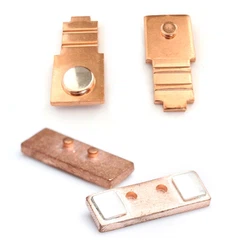
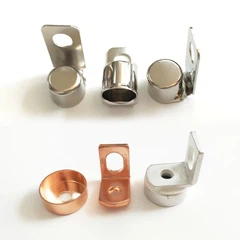
Addressing the high-frequency switching temperature rise issue in various industrial and new energy relays, we offer standardized, customized Composite Contact Rivets for Relays. These features include a silver alloy working surface with arc resistance, a copper substrate for excellent thermal conductivity and heat dissipation, and a tightly bonded, non-delaminating composite interface. This allows for stable control of contact voltage drop, effectively reducing continuous contact heating and making them suitable for demanding conditions such as high current and pulse loads, significantly extending the overall lifespan of the relay.
If you require Button Bimetal Rivet Electrical Contact riveting sample testing or bulk procurement, please provide your equipment operating parameters to discuss a customized solution.
contact us

Send Inquiry