



The Screw-Type Terminal Block Technology Analysis: Principles, Structure, and Applications
Apr 04, 2026
Leave a message
Screw-type terminal blocks, as one of the most basic and widely used connection methods in the field of electrical connections, have long held a core position in industrial, power, and building electrical systems. Whether in traditional power distribution systems or emerging automated equipment, their stability and reliability depend on high-quality connection methods. Among these, the structure represented by Screw Clamp Terminals and Screw Terminal Blocks has become an important component of standardized electrical connections.

Working Principle
The core principle of screw-type terminal blocks is to achieve a stable conductive connection through mechanical tightening force. After the wire is inserted into the terminal, tightening the screw creates a high-voltage contact interface between the wire and the internal conductor, thereby reducing contact resistance and ensuring continuous current transmission. In this process, structures like Screw Terminals and Terminal Screws play a crucial role in force transmission, forming a reliable metal-to-metal contact surface between the conductors.
In practical applications, this structure effectively avoids problems such as incomplete connections and loosening, and is therefore widely used in electrical systems requiring long-term stable operation. Meanwhile, for different application scenarios, subdivided structures such as the Screw Clamp for Fuse Terminal have emerged to meet specific electrical connection requirements.

Structural Composition
Screw-type terminal blocks typically consist of three core parts: an insulating base, conductive components, and fastening parts. Their structural design directly affects connection performance and safety levels.
First, the base is usually made of high-strength insulating material, providing mechanical support and electrical isolation. Common forms include Electrical Screw Terminal Blocks and Terminal Screw Blocks. This part not only needs good heat resistance and flame retardancy but also must meet dimensional stability requirements under long-term use.
Second, the conductive parts are mostly made of copper or copper alloys to ensure low resistance and high conductivity. In some functional applications, special structures, such as Ground Terminal Blocks or Fuse Terminal Blocks, are used to achieve grounding protection or circuit protection functions.
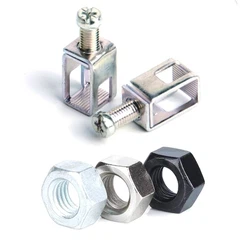
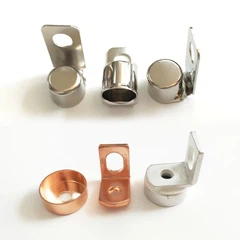
Finally, the fastening parts typically consist of screws and crimping structures. Different specifications of products will be matched with different sizes of threaded parts, such as an M4 Screw Terminal or a Double Cage Terminal with an M5 screw. In some high-current-carrying or structurally reinforced applications, iron column joint fasteners are also used to enhance overall mechanical strength.
Advantages and Disadvantages Analysis
From a performance perspective, screw-type terminal blocks offer significant engineering advantages. First, the stable mechanical clamping force creates a low-contact-resistance connection, making current transmission more stable and reliable, suitable for long-term operating environments. Second, these terminals are highly compatible, adaptable to various wire types and specifications, including single-strand and multi-strand wires, as exemplified by Screw Terminal Wire Connectors and Screw Type Terminal Blocks. Furthermore, their detachable structure provides good maintainability and reusability.
However, this structure also has certain limitations. First, the installation process relies on manual tightening, which is less efficient than spring-loaded terminals, increasing the construction period in large-scale cabling scenarios. Second, it requires precise torque control; insufficient tightening may lead to poor contact, while over-tightening may damage conductors or structural components. Furthermore, in specific applications, such as power metering or protection systems, higher-strength connection structures are required, such as the M10 Screw Electric Meter Iron Terminal or Leakage Protection Switch Terminal, to ensure system stability.
Application Scenarios
Screw-type terminal blocks are used in multiple key industrial sectors. In industrial automation systems, they are widely used in PLC control cabinets, sensor connections, and equipment interfaces to ensure stable signal and power transmission. In power systems, they are used in distribution cabinets, transformers, and motor terminals, especially in high-current scenarios, where structures like Block Terminal Electrical provide higher connection reliability.
In the fields of new energy and electrical equipment, screw structures are also common in fuse connection systems, such as the Screw Clamp for Fuse Holder Terminal, for quick replacement and safe disconnection. In building electrical systems, from lighting systems to wiring inside distribution boxes, these terminals also play a fundamental but crucial connection role.

Conclusion and Product Integration
As electrical systems evolve towards higher reliability, higher power density, and modularity, the design of screw-type terminal blocks is also continuously optimized, evolving from traditional single structures towards high strength, multi-functionality, and standardization. The rational selection of the terminal block structure and material configuration is a crucial prerequisite for ensuring the long-term stable operation of the system.
In practical engineering applications, matching connection solutions must be selected for different current ratings, installation environments, and structural requirements. We focus on the research and development, and manufacturing of high-performance electrical connection components, providing a comprehensive range of screw-type terminal blocks, fuse connection structures, and customized fastening solutions to meet the diverse needs of industrial automation, power systems, and new energy fields, helping customers achieve more reliable electrical connection designs.
contact us

Send Inquiry