




Bimetallic Rivet Contacts: Cold Heading Process, Material Structure and Manufacturing Quality Control
Nov 19, 2026
Leave a message
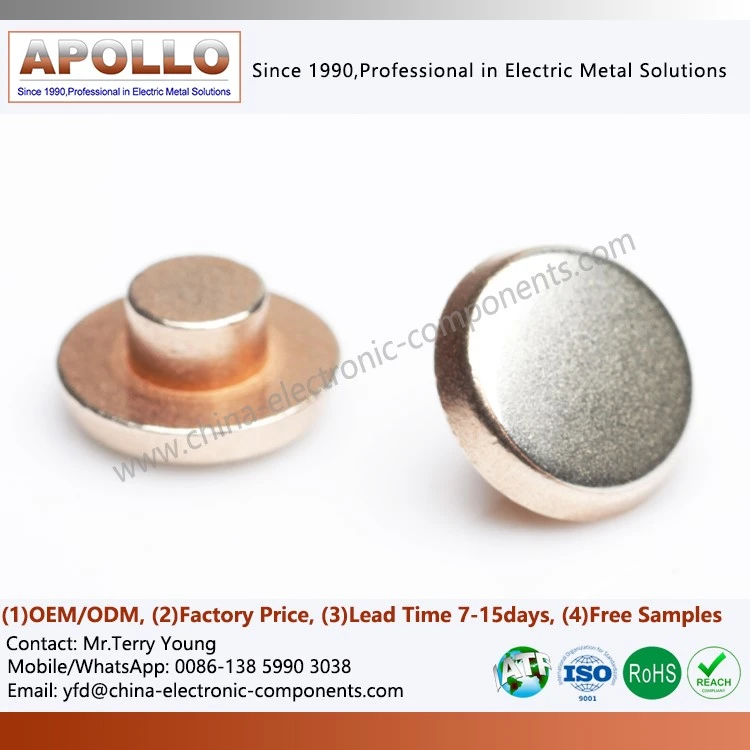
Bimetallic rivet contacts are manufactured by combining a silver-based contact head with a copper or copper-alloy base through controlled cold heading and metal forming processes. This composite structure places the contact material where electrical switching occurs while using a conductive copper base for current transfer and mechanical attachment. Cold heading is particularly suitable for producing high-volume electrical contact rivets with controlled dimensions, consistent bonding interfaces and reduced silver consumption.
What Is the Cold Heading Process for Electrical Contacts?
Cold heading is a metal forming process that uses mechanical pressure to deform metal at room temperature without melting or heating the material. In electrical contact manufacturing, it is used to form the head, shank and composite structure of rivet-type contacts.
Unlike conventional machining, which removes material to achieve the required geometry, cold heading redistributes the original metal volume through plastic deformation.
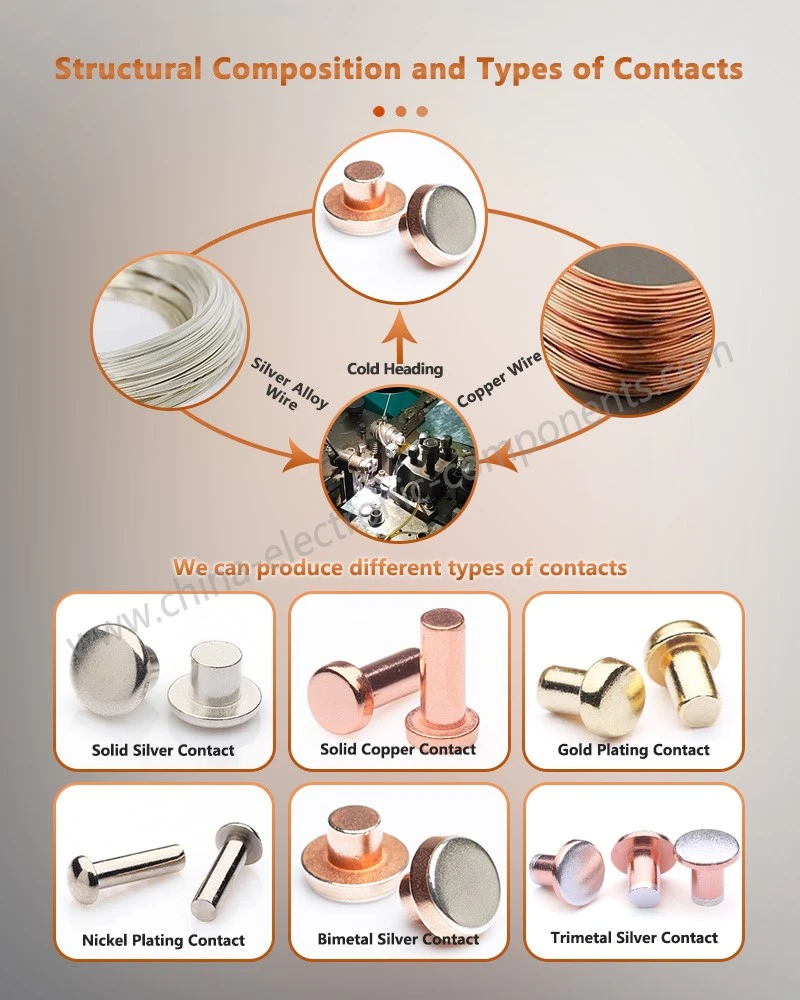
For Bimetal Silver Composite Contact Rivets, the process generally involves combining two different metallic materials:
- Contact head: Silver or silver alloy, such as AgNi or AgSnO₂, selected according to switching current, arc erosion and contact resistance requirements.
- Base material: Copper or copper alloy, providing electrical conductivity, mechanical support and a suitable attachment structure.
The two materials are formed into an integrated component through controlled deformation. The objective is to maintain a stable metallurgical interface while achieving the specified contact-head thickness, shank diameter and overall dimensions.
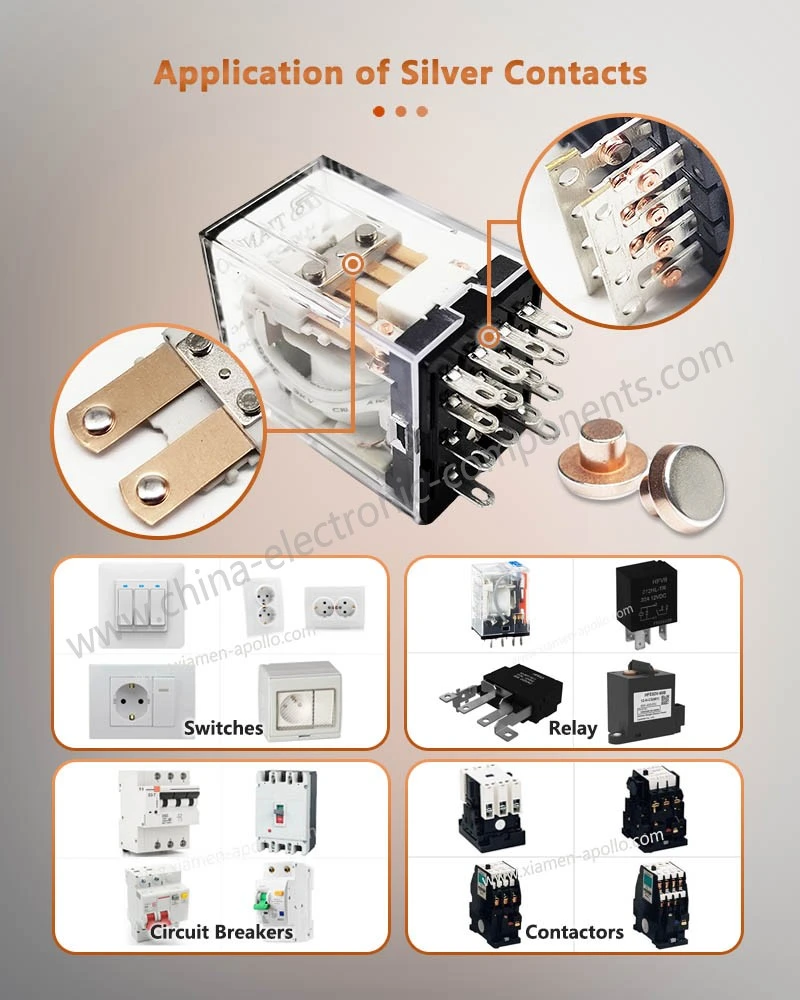
This structure is widely used in relays, circuit breakers, contactors and other electrical switching devices.
Basic Working Principle of Cold Heading
Cold heading relies on the plastic deformation characteristics of metals. When sufficient compressive force is applied, the material undergoes permanent deformation without fracture, provided that its ductility and forming conditions are appropriate.
The process follows the principle of approximate volume conservation: the metal displaced during forming is redistributed within the die cavity rather than removed as machining chips.
Three main deformation mechanisms are involved:
1. Upsetting
The metal blank is compressed axially, increasing its cross-sectional area and forming the enlarged rivet head.
2. Extrusion
Material flows through a restricted die opening to form the shank or other cylindrical sections.
3. Coining and sizing
Additional pressure is applied to control the head profile, thickness, diameter and dimensional tolerances.
For a Round Silver Bimetal Rivet, the die geometry and forming sequence must account for the different deformation characteristics of silver and copper. Inadequate material distribution may cause an uneven silver layer, interface defects or dimensional deviations.
Download Contact Material Spec Sheet
Materials Used in Bimetallic Rivet Contact Manufacturing
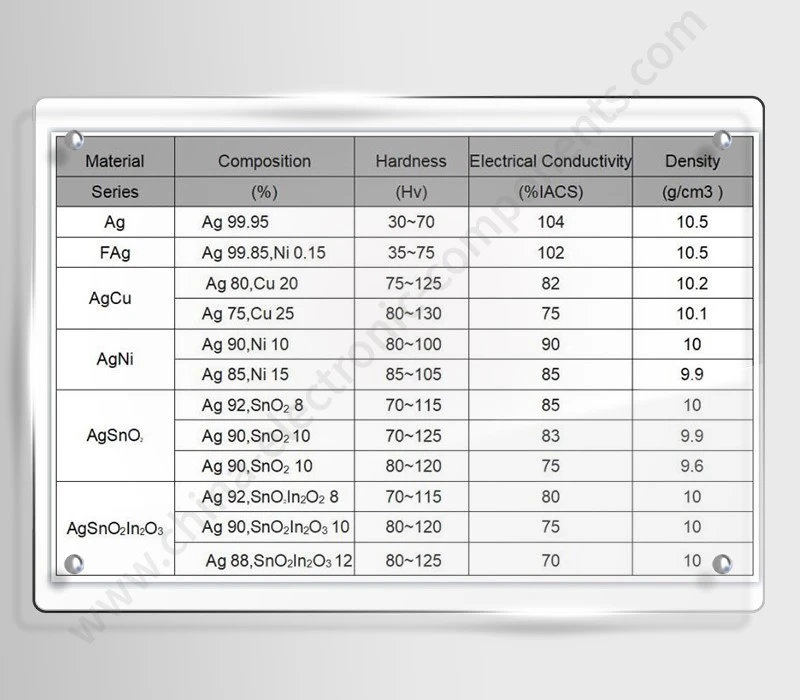
Material selection directly affects contact resistance, arc erosion, mechanical strength and service life. The silver alloy and copper base must be selected according to the electrical and mechanical requirements of the switching application.
Silver-Based Contact Materials
Common silver contact materials include:
| Material | Main characteristics | Typical applications |
|---|---|---|
| Ag99.99 | High electrical and thermal conductivity | Low-resistance electrical connections |
| AgNi | Good resistance to welding and arc erosion | Relays and switching devices |
| AgSnO₂ | Good arc erosion resistance and anti-welding characteristics | Contactors and circuit breakers |
| AgSnO₂In₂O₃ | Modified oxide dispersion characteristics | Electrical switching applications |
AgNi Bimetal Contact Rivets are commonly selected where contact welding resistance and switching stability are important.
AgSnO₂-based materials are used in applications requiring resistance to repeated electrical arcing. Their performance depends on the silver matrix, oxide distribution, contact geometry and actual switching conditions.
Copper-Based Base Materials
Copper provides the conductive foundation of a composite contact rivet.
Common options include:
- T2 copper: High electrical conductivity and good cold-forming characteristics.
- C11000 copper: Widely used for electrical components requiring high conductivity.
- Copper alloys: Selected when additional mechanical strength or forming characteristics are required.
The copper base must maintain adequate conductivity while providing sufficient mechanical strength for riveting, welding or other assembly operations.
Material Compatibility
For Bimetal Contacts Ag/Cu, the silver contact head and copper base must be compatible with the selected forming process.
Important considerations include:
- Material hardness and elongation.
- Surface cleanliness before forming.
- Deformation compatibility between the two metals.
- Interface bonding strength.
- Silver-layer thickness and distribution.
- Electrical resistance across the composite interface.
Differences in hardness and plastic flow can result in interface displacement during cold heading. Therefore, material preparation and die design must be evaluated together.
Cold Heading Manufacturing Process for Bimetal Contact Rivets
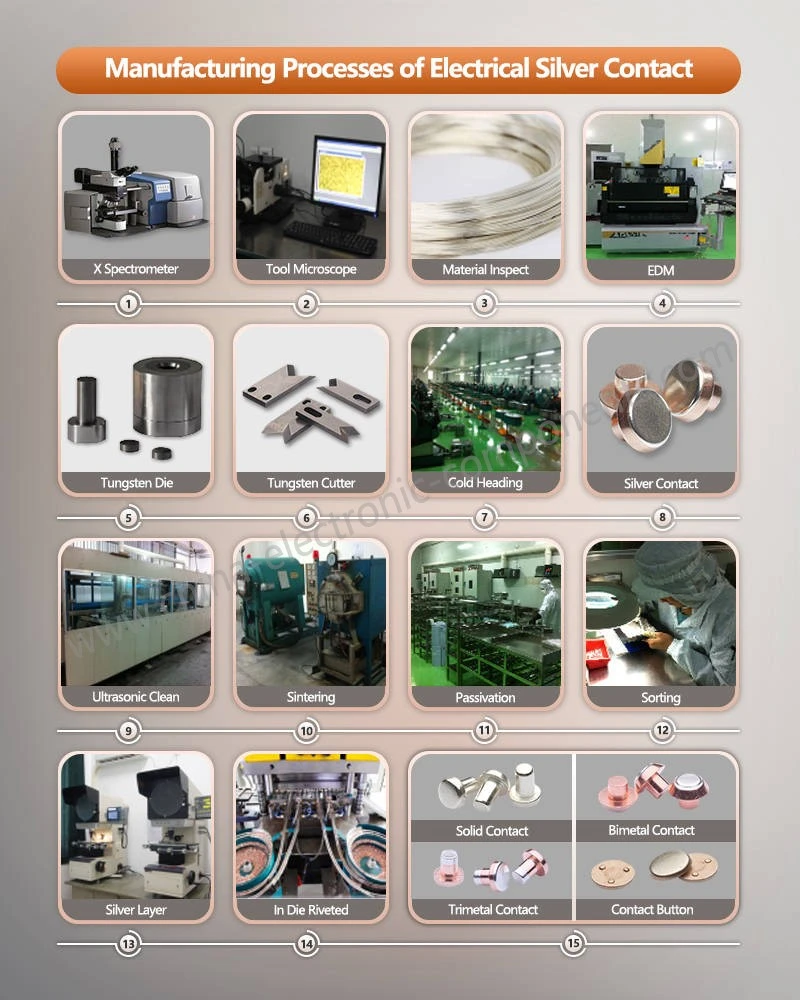
The production of Bimetal Contact Rivets involves several controlled manufacturing stages.
Raw Material Preparation
Silver alloy and copper materials are selected according to the product drawing and electrical specifications.
Incoming inspection generally includes:
- Chemical composition verification.
- Material hardness testing.
- Wire or strip diameter measurement.
- Surface defect inspection.
- Material condition and batch traceability.
Oxidation, surface contamination and dimensional variations can affect subsequent forming and bonding quality.
Material Feeding and Cutting
The metal wire or composite feedstock is straightened and delivered into the forming equipment.
A cutting mechanism separates the material into blanks with controlled lengths.
For a Round Bi Metal Electrical Contact Rivet, blank dimensions must provide sufficient material volume for both the contact head and the rivet shank.
Incorrect blank length can result in insufficient head thickness, excessive flash or dimensional deviations.
Composite Forming and Cold Heading
The silver contact material and copper base are positioned and formed according to the selected manufacturing method.
Depending on the equipment and product design, the process may involve:
- Positioning the silver and copper materials.
- Applying axial compression.
- Forming the silver contact head.
- Shaping the copper shank.
- Controlling the composite interface through deformation.
The forming pressure, die clearance, material dimensions and deformation sequence determine the final geometry and interface condition.
A bimetal rivet-type contact must maintain a consistent contact-head profile without exposing the copper base at the working contact surface.
Trimming and Dimensional Sizing
After initial forming, additional sizing or finishing operations may be used to achieve the required dimensions.
Inspection points include:
- Rivet-head diameter.
- Head thickness.
- Shank diameter.
- Overall length.
- Concentricity.
- Surface flatness.
These dimensions directly affect the fit between the contact rivet and the conductive spring or terminal during assembly.
Cleaning and Surface Treatment
Depending on the material and application, cleaning may be required to remove forming lubricants and surface contaminants.
Surface treatment is selected according to the electrical contact design. The silver working surface must remain free from contamination that could increase contact resistance or interfere with switching performance.
Final Inspection and Packaging
Finished components undergo dimensional and visual inspection. Mechanical bonding and electrical characteristics are evaluated according to the product specification.
Batch identification and protective packaging help prevent surface damage, oxidation and mixing of different material specifications during storage and transportation.
Technical Characteristics of Cold-Formed Schneider Electric Contact
Cold heading provides several manufacturing advantages for composite electrical contacts.
High Material Utilization
Cold heading redistributes metal instead of removing large quantities through cutting.
For silver-containing electrical contacts, this is particularly important because silver represents a significant proportion of raw material cost.
Compared with manufacturing an entire rivet from solid silver, a composite structure uses silver only in the functional contact region, reducing silver consumption while retaining a conductive copper base.
Actual material savings depend on contact-head dimensions, silver thickness and product geometry.
Work Hardening and Mechanical Strength
Cold deformation increases dislocation density within the metal, producing work hardening.
This can increase the hardness and strength of the formed component. However, excessive deformation may reduce ductility and introduce residual stresses.
The forming sequence must therefore balance dimensional stability with the mechanical properties required for subsequent assembly.
Dimensional Consistency
Precision dies and controlled feeding systems allow manufacturers to maintain consistent rivet dimensions during mass production.
This is particularly important for Bimetal Electronic Contacts used in automated relay and circuit-breaker assembly lines.
Production Efficiency
Multi-station cold heading machines can complete several forming operations in sequence.
Once the tooling and process parameters are established, automated production supports high-volume manufacturing with consistent cycle times.
Composite Material Utilization
The silver head and copper base perform different functions within the same component.
The silver alloy provides the electrical switching interface, while the copper base supports current conduction and mechanical attachment.
This division of material functions is the fundamental engineering advantage of Bi-Metal Rivets.
Quality Control Requirements for Bimetal Rivet Contact Manufacturing
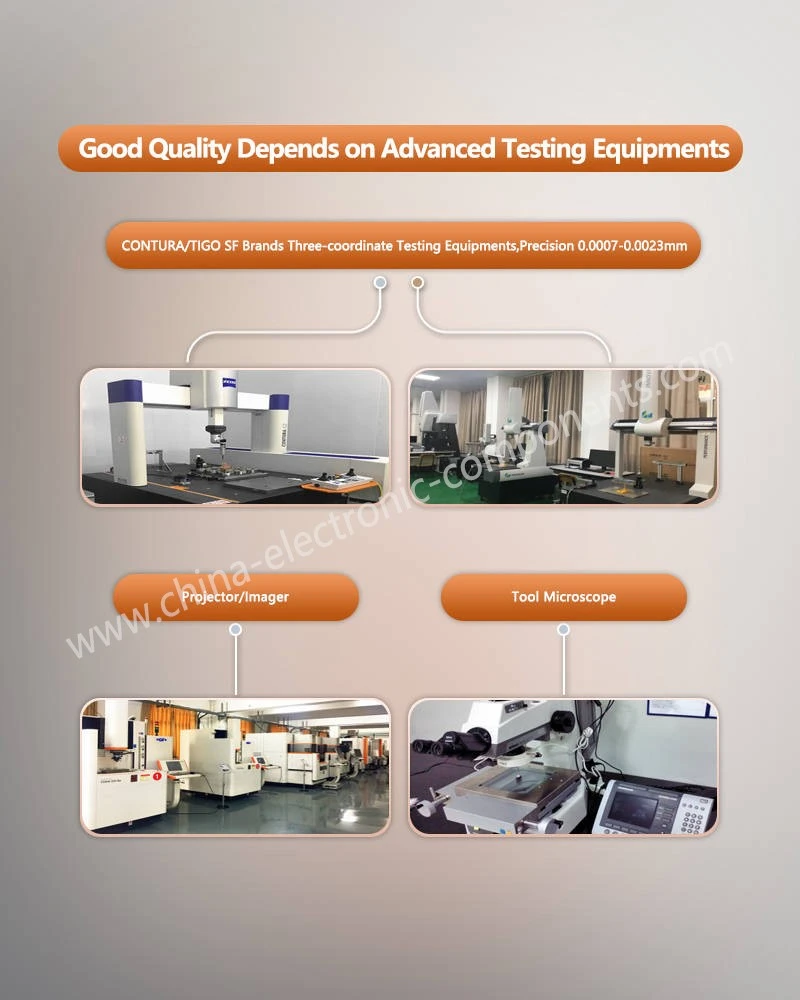
Quality control must cover the raw materials, forming process, composite interface and finished dimensions.
| Inspection item | Testing method | Quality objective |
|---|---|---|
| Silver alloy composition | Chemical analysis | Verify material grade |
| Copper base composition | Material certification and analysis | Verify conductivity requirements |
| Head diameter | Optical measuring instrument | Control contact geometry |
| Head thickness | Micrometer or optical measurement | Maintain silver material distribution |
| Shank dimensions | Precision measuring equipment | Ensure assembly compatibility |
| Interface bonding | Metallographic inspection and mechanical testing | Identify bonding defects |
| Electrical resistance | Four-wire resistance measurement | Evaluate electrical continuity |
| Surface condition | Visual and microscopic inspection | Identify cracks and contamination |
Interface Bonding Inspection
The interface between silver alloy and copper is one of the most important quality-control areas.
Insufficient bonding can cause separation during riveting, welding or repeated mechanical loading.
Cross-sectional metallographic inspection can reveal:
- Interface discontinuities.
- Voids and inclusions.
- Uneven silver distribution.
- Local deformation defects.
- Cracks near the bonding interface.
Mechanical testing should be conducted using a defined test method and acceptance criteria rather than relying solely on visual inspection.
Electrical Resistance Testing
Contact resistance affects heat generation during current transmission.
The resistance of a composite rivet depends on material conductivity, contact geometry, interface condition and measurement configuration.
Four-wire measurement is useful for evaluating low-resistance electrical components because it reduces the influence of test-lead resistance.
Dimensional and Assembly Inspection
The head and shank dimensions must match the assembly drawing.
For example, an oversized shank may interfere with the mounting hole, while an undersized shank may reduce the mechanical retention force after riveting.
Dimensional inspection should therefore be connected to the actual assembly requirements.
Common Manufacturing Defects and Corrective Measures
During the production of Bimetal Contact Rivets, several defects may occur if material preparation, tooling or forming parameters are not properly controlled.
| Common defect | Possible cause | Corrective measure |
|---|---|---|
| Silver-layer displacement | Uneven material flow | Optimize die geometry and forming sequence |
| Interface separation | Insufficient bonding or contamination | Improve surface preparation and forming conditions |
| Rivet-head cracks | Excessive deformation or poor material ductility | Adjust reduction ratio and material condition |
| Uneven head thickness | Inaccurate blank volume or die alignment | Improve feeding and tooling accuracy |
| Shank dimensional deviation | Die wear or unstable feeding | Monitor tooling and feeding systems |
| Surface scratches | Poor lubrication or material contamination | Optimize lubrication and cleaning |
For AgNi Bimetal Contact Rivets, maintaining consistent silver-alloy distribution is especially important because the contact head is exposed to repeated electrical switching and arc erosion.
Process corrections should be based on defect analysis, material inspection and trial production rather than adjusting machine pressure alone.
Consult Our Electrical Engineers Today
Applications of Spring Loaded Electrical Contacts
Switch Electrical Contact are used in electrical equipment where conductive performance, switching durability and controlled material costs must be considered together.
Electromagnetic Relays
Relay contacts repeatedly open and close electrical circuits. Contact materials must withstand electrical arcing, contact heating and mechanical impact.
Silver-based composite rivets are used in relay contact assemblies where the silver head provides the switching surface and the copper base supports electrical connection and mechanical fastening.
Circuit Breakers
In low-voltage circuit breakers, contact materials are exposed to switching loads and, depending on the design, short-circuit interruption conditions.
The selection of silver alloy, contact dimensions and interface structure must correspond to the rated current, switching duty and arc-control design.
AC Contactors
Contactors operate under repeated switching conditions in motor control and industrial electrical systems.
Composite silver contacts can provide a functional balance between electrical contact properties, mechanical attachment and material consumption.
Micro Switches and Control Switches
Compact switching devices require accurately formed contact components.
Round Bi Metal Electrical Contact Rivets are suitable for designs requiring controlled head dimensions and compatibility with small conductive terminals.
contact us
For OEM projects requiring precision Bimetal Rivet Contact components, submit your drawings and annual volume requirements now for factory-direct material engineering, custom tooling, cold heading, interface inspection and high-volume production evaluation.
Send Inquiry