










The Scientific Principles And Modern Industrial Applications Of Quenching Processes: Performance Leap From Cutting Tools To Fasteners
Mar 16, 2026
Leave a message
Quenching, a metal heat treatment process with a history of over two thousand years, remains a core technology for improving the hardness and strength of steel materials. From bronze swords of the Warring States period to modern kitchen knives, from automotive gears to high-end fasteners, quenching, through the physical process of "heating-rapid cooling," profoundly alters the microstructure of metals, endowing them with superior mechanical properties. This article will delve into the scientific mechanism of quenching and explore its crucial role in contemporary manufacturing, especially in the field of stainless steel deck screws.
The Essence of Quenching: "Atomic-Level Reshaping" of Martensitic Phase Transformation
Steel is essentially an alloy of iron and carbon. When steel is heated to its critical temperature (usually above 727°C, the austenitizing temperature), its crystal structure transforms from body-centered cubic (BCC) to face-centered cubic (FCC). Carbon atoms are uniformly dissolved in the interstitial spaces of the crystal lattice, forming soft and highly ductile austenite.
The key to quenching lies in rapid cooling (usually using water, oil, polymer solutions, or gases). This process prevents the diffusion and precipitation of carbon atoms, forcing the crystal lattice to undergo shear-like reconstruction during cooling, forming a supersaturated body-centered tetragonal (BCT) structure-martensite. The martensitic lattice is severely distorted due to the "positioning" of carbon atoms, generating enormous internal stress, thus significantly increasing the material's hardness. For example, the hardness of ordinary low-carbon steel can increase from HB 120 to over HRC 50 after quenching.
However, while martensite is hard, it is brittle, like a taut spring. Therefore, after quenching, tempering (low-temperature heating and holding) is usually required to release some internal stress and precipitate fine carbides, so as to restore a certain degree of toughness while maintaining high hardness and achieve a balance between hardness and flexibility.
The Key Value of Quenching in Fastener Manufacturing
In the field of stainless steel fasteners, although austenitic stainless steels (such as 304 and 316) are widely favored for their non-magnetic and corrosion-resistant properties, their strength is relatively low (tensile strength approximately 520 MPa). For applications requiring higher strength, martensitic stainless steels (such as 410 and 420) become the preferred choice-these materials can achieve a balance between high strength and moderate corrosion resistance through quenching and tempering.
Typical applications include:
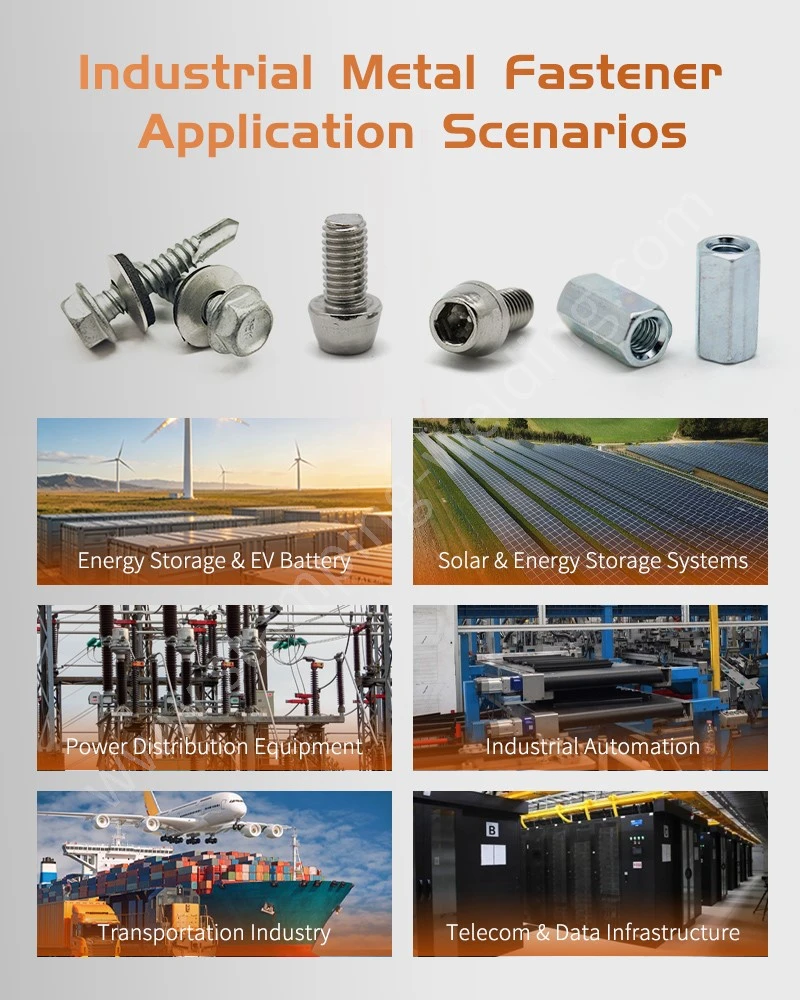
Stainless steel set screws: Used for axial fixing in precision machinery, requiring high surface hardness to resist stripping.
Stainless steel self-drilling screws: The drill tip is quenched to ensure efficient drilling in metal plates.
Stainless steel lag screws: To withstand high shear loads, quenching improves core strength.
Stainless steel hex head screws: In harsh environments such as building facades and shipbuilding, high-strength versions rely on heat treatment to ensure connection reliability.
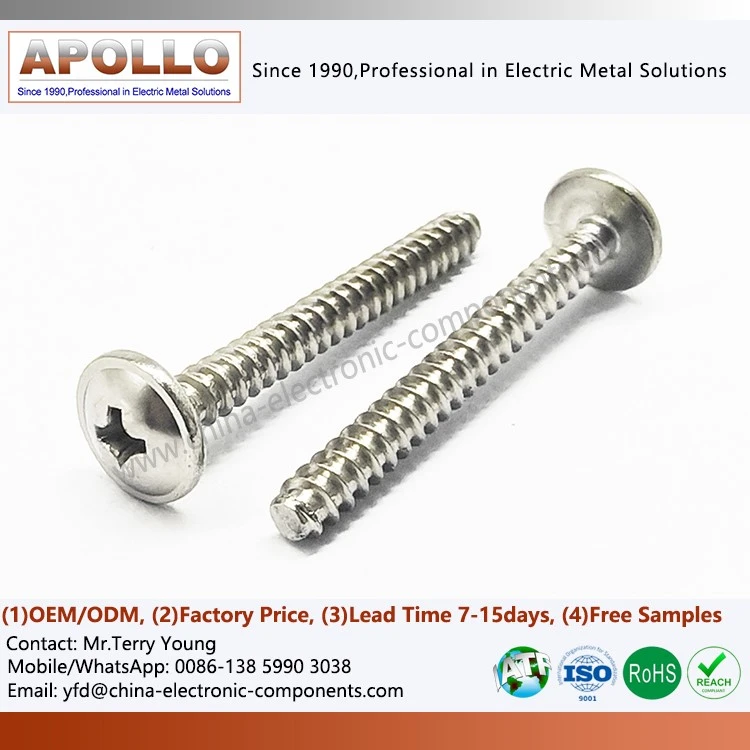
It is worth noting that not all stainless steel fasteners are suitable for quenching. Austenitic stainless steel (such as common SS screws and stainless steel pan head screws) cannot be strengthened by heat treatment; its strength improvement mainly relies on cold work hardening. However, if stainless steel tapcon is made of martensitic material, it must undergo quenching and tempering to meet the tensile and shear strength requirements.
Risks and Control of Quenching Failure
Quenching is a double-edged sword. Improper cooling rates can easily lead to defects:
- Too slow cooling: Pearlite or bainite forms, resulting in insufficient hardness.
- Too fast or uneven cooling: Excessive thermal stress generates, causing deformation or even cracking.
- Not tempered in time: Excessive residual stress leads to sudden brittle fracture of the part during use.
Therefore, in modern fastener production, quenching process parameters (heating temperature, holding time, cooling medium flow rate, tempering temperature, etc.) are precisely controlled by computer, supplemented by metallographic analysis, hardness testing, and non-destructive testing to ensure the performance consistency of each batch of 100mm stainless steel screws or stainless steel roofing screws.
contact us
If you would like to learn more about the quenching process of stainless steel trim screws, please contact us-we will provide you with professional material and process technology support.

Send Inquiry