










Technological Development of High-Voltage Fuses for New Energy Vehicles: An Analysis of Fusing Principles, Key Parameters, and End-Cap Contact Structures
Nov 12, 2026
Leave a message
With the ongoing development of new energy vehicles (NEVs), power batteries, and high-voltage power distribution systems, circuit protection components have become increasingly critical to overall vehicle electrical safety. As a vital overcurrent protection device, a fuse can interrupt fault currents by melting its internal element when an overload or short circuit occurs, thereby reducing the risks of overheating, damage to electrical equipment, and the escalation of faults. In NEV applications, fuses must not only meet specific requirements for rated voltage, current, and breaking capacity, but their internal conductive structures, terminal connection methods, and material properties also directly influence their electrical reliability.
For power batteries, high-voltage power distribution units, and charging systems, fuse design must comprehensively account for current-carrying capacity, short-circuit interruption performance, temperature rise control, and the stability of mechanical connections. The fuse element (melt) provides overcurrent protection, while the end caps, contacts, and terminal structures facilitate current transmission and external electrical connections. The effective integration of these various components is fundamental to ensuring the stable operation of high-voltage fuses.
Basic Structure and Function of a Fuse
A fuse is an electrical component that provides circuit protection by utilizing the thermal effect of electric current. It typically consists of a fuse element, a fuse tube or housing, conductive end structures, and mounting/connection components. The fuse element is connected in series within the circuit being protected. When the current exceeds a specified range for a certain duration, the heat generated by the element increases until the material reaches its melting point; the element then melts, breaking the current path.
The fuse element is the core component responsible for the fuse's protective function. Common materials include silver, copper, zinc, and various alloys, each with distinct characteristics regarding electrical conductivity, melting point, thermal stability, and fusing behavior. Designers must select the appropriate material and geometric dimensions for the fuse element based on the circuit's rated current, prospective short-circuit current, and required protection curve.
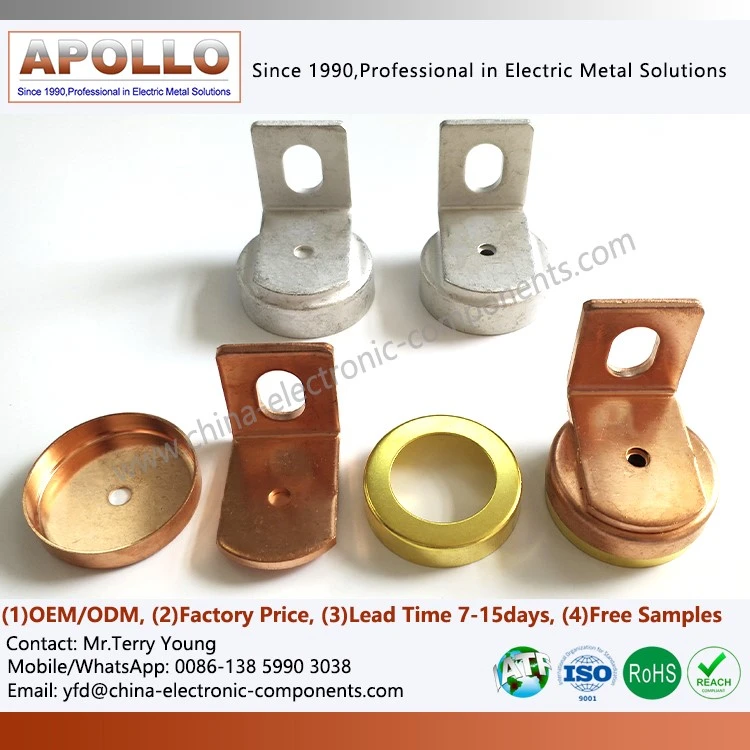
The terminal structure of a fuse is equally significant. End caps and contacts are used to establish a conductive connection between the fuse and the external circuit; they must satisfy requirements for current transmission while ensuring stable contact and reliable assembly. For products utilizing a metal end-cap structure, the design of the end cap and terminal must balance factors such as end dimensions, contact area, material conductivity, and connection processes to prevent localized temperature rises caused by excessive contact resistance.
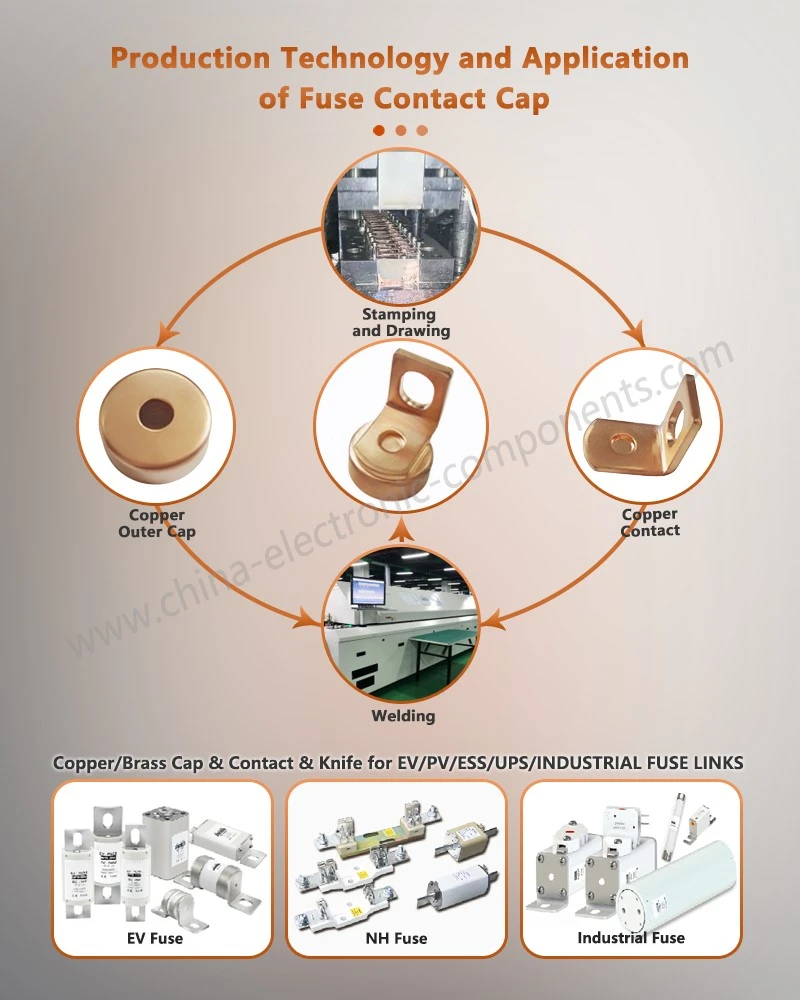
In high-voltage fuses, the conductive end components must also integrate effectively with the fuse tube, insulating structures, and the internal fusible element. The dimensional precision, surface condition, and assembly positioning of structural components-such as the outer cap and contact-directly influence the overall connection quality. Consequently, the manufacturing of fuses encompasses not only the processing of the fusible element but also a range of techniques, including metal stamping, forming, welding, riveting, and surface treatment.
Principles and Key Parameters for Fuse Selection
Selecting a fuse requires more than just considering the equipment's rated operating current; it necessitates a comprehensive evaluation based on system voltage, short-circuit current levels, load characteristics, and the coordination between upstream and downstream protection.
First, the fuse's rated voltage must align with the operating voltage of the circuit being protected. For high-voltage DC systems, particular attention must be paid to the characteristics of DC arcs. Unlike AC circuits, DC lacks a natural zero-crossing point, which imposes distinct requirements on the arc-extinguishing mechanism and the system's ability to restore insulation following a fault interruption.
Second, the fuse's rated current should be determined based on actual load conditions. Factors such as continuous operating current, short-term overloads, equipment inrush (starting) currents, and ambient temperature all affect the fuse's performance. During selection, one should consult the manufacturer's time-current characteristic curves to ensure the fuse can withstand normal operation and permissible transient currents, while still triggering promptly under fault conditions.
Third, the breaking capacity must exceed the maximum prospective short-circuit current that could occur at the installation point. If a fuse's breaking capacity is insufficient, it may fail to safely interrupt the current during a fault, potentially leading to sustained arcing, damage to the fuse housing, or harm to surrounding components. Therefore, engineering design must verify the fuse's rated breaking capacity-and the corresponding test conditions-against the results of system short-circuit calculations.
In multi-stage power distribution systems, protection selectivity must also be taken into account. Upstream and downstream fuses must be coordinated based on their rated current, time-current characteristics, and current-limiting properties. This ensures that faults are cleared by the protection device closest to the fault location, thereby minimizing power interruptions in unaffected areas. For loads with high inrush currents-such as electric motors-fuses must be selected by considering both the starting duration and the starting current to prevent nuisance tripping during normal startup.
Selecting fuses for the high-voltage systems of new energy vehicles (NEVs) is more complex. Components such as traction batteries, inverters, on-board chargers, DC power distribution units, and charging interfaces impose distinct requirements on protection devices regarding voltage ratings, breaking capacity, temperature rise, and available installation space. For instance, the end-connection structure-such as a "copper cap contact" for a high-voltage, low-current EV fuse-requires the conductive material, contact dimensions, and connection method to be determined based on the specific fuse specifications and operating current; one cannot rely solely on the product name to gauge its suitability.
Structural Classification of Low-Voltage and High-Voltage Fuses
Based on their structural design and arc-extinguishing mechanisms, fuses are categorized into open, semi-enclosed, and enclosed types. These structures differ in terms of arc containment, insulation, mounting methods, and intended applications.
Open-type fuses typically feature a simple design where the fusible element is exposed to the external environment. Because the arc and metal particles generated during operation are not adequately contained, their range of application is limited. Semi-enclosed fuses provide a degree of containment for the fusing process via an outer casing or tube, though the level of protection depends on the specific structural design.
Enclosed fuses house the fusible element within a sealed casing or tube, utilizing filler materials, arc-extinguishing structures, and insulation designs to manage the electric arc. Certain high-breaking-capacity fuses incorporate filler materials, such as quartz sand, which help absorb arc energy, cool the arc, and facilitate the restoration of insulation, thereby enhancing the device's ability to interrupt fault currents.
In the context of automotive applications, fuses must be capable of withstanding the vibrations, temperature fluctuations, spatial constraints, and complex electrical environments inherent to a vehicle. For components such as copper cap contacts used in electric vehicle (EV) fuses, key design considerations include the stability of the terminal connection, vibration resistance, and temperature rise performance during long-term current-carrying operation. Depending on the vehicle model and electrical architecture, the structural dimensions, terminal configurations, and mounting interfaces of these fuses may vary.
In the traction battery systems of new energy vehicles, fuses typically provide fault protection for the main circuit or branch circuits of the battery pack. The design of a copper cap contact for an EV fuse must align with the fuse's rated parameters, internal architecture, and mounting method, ensuring that the terminal connection does not become a weak point in the current transmission path.
Materials and Manufacturing Processes for Fuse End Caps and Contacts
Fuse end caps and contacts are critical metal components that bridge the internal fusing element with the external circuit. The choice of material directly influences electrical conductivity, contact resistance, mechanical strength, and long-term operational stability.
Copper and copper alloys are commonly used for these conductive terminal components. Pure copper offers high electrical conductivity, making it suitable for applications that demand high current-transmission efficiency. Copper alloys, such as brass, provide superior formability and mechanical strength and can be utilized for terminal connectors based on specific structural requirements. The selection of a specific material depends on factors such as current-carrying capacity, processing methods, cost, and the operating environment.
In EV fuses, end caps must form a reliable mechanical fit with the fuse tube (or other insulating components) while establishing a stable connection with the internal conductive elements. The manufacturing process for these copper cap contacts may involve steps such as blanking, precision stamping, deep drawing, trimming, sizing, and surface treatment. If the component assembly consists of multiple metal parts, additional joining techniques-such as riveting, brazing, or other suitable methods-may be required.
During production, critical parameters such as the inner and outer diameters, wall thickness, flatness, concentricity, and the dimensions of the contact area must be strictly controlled. Excessive dimensional deviation can hinder the assembly of the fuse tube, while an uneven contact surface may lead to insufficient local contact pressure, resulting in increased contact resistance and higher operating temperatures.
Surface treatment is another significant factor that influences the performance of the terminal connection. Surface treatments such as tin plating, silver plating, or other appropriate finishes may be selected based on requirements for electrical contact, oxidation resistance, and environmental adaptability. For connection structures intended to carry current over long periods, attention must be paid to coating thickness, adhesion, coverage integrity, and the surface quality of the contact interface.
End-cap structures are not universally interchangeable across different fuse series. When addressing the requirements for specific product lines-such as copper cap contacts for Eaton Bussmann Series EV fuses-engineering development must be guided by actual product drawings, interface dimensions, and technical specifications to ensure assembly compatibility between the end-cap structure and the corresponding fuse. For fuses designed to protect semiconductors, the copper cap contacts must also be validated with consideration for the fuse's fast-acting protection characteristics and specific structural requirements.
Application Requirements for High-Voltage Fuses in New Energy Vehicles (NEVs)
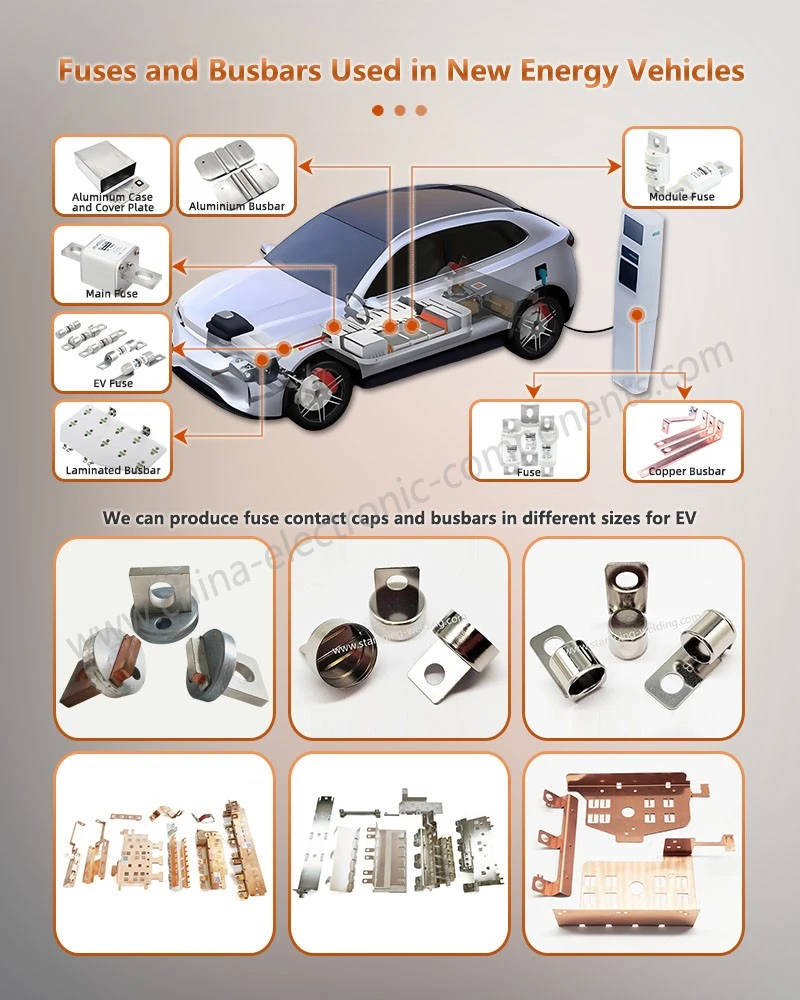
The high-voltage electrical systems of new energy vehicles typically comprise modules such as the traction battery, drive motor controller, on-board charger (OBC), DC-DC converter, high-voltage power distribution unit (PDU), and charging interface. Electrical power is transmitted between these modules via high-voltage wiring harnesses and conductive connectors, with fuses protecting in the event of abnormal overcurrent conditions.
Within a traction battery system, a fuse must be capable of handling the high fault currents that may arise during a battery short circuit. Selection must account for the battery pack's rated voltage and continuous operating current, while also incorporating factors such as internal battery resistance, system short-circuit characteristics, and fault-clearing requirements. The end-cap and contact structure for a battery pack fuse must be coordinated with the internal installation space, busbar interfaces, and insulation/protection design of the battery pack to prevent connection instability from compromising the reliability of the protection system.
In NEV charging systems, fuses must accommodate the current fluctuations that occur during the charging process, as well as the specific operating environment. The design of end-caps and contacts for EV charging fuses should factor in rated current-carrying capacity, connection methods, temperature rise control, and available installation space, while ensuring alignment with the voltage levels and protection requirements of the specific charging system.
For hybrid electric vehicles (HEVs) and battery electric vehicles (BEVs), different electrical architectures impose varying requirements regarding fuse protection speed, rated parameters, and mounting configurations. The selection of end caps and contacts for hybrid electric vehicle (HEV) fuses must account for the operational characteristics of the battery, electric motor, and power electronics within the hybrid system. For fast-acting EV fuses-designed for rapid protection-the focus should be on the coordination between time-current characteristics, current-limiting performance, and breaking capacity.
In the context of a vehicle's high-voltage circuit, the reliability of fuse end caps and terminals directly impacts the integrity of the entire protection chain. These outer caps and automotive fuse terminals must meet specific requirements for mechanical connection, electrical contact, and environmental adaptability. Such components should be validated as part of an integrated system-including the fuse body, busbars, or wiring harness connections-rather than being evaluated solely based on their individual physical appearance or dimensions.
Fuse Usage, Maintenance, and Quality Control
During installation and operation, it is essential to verify that the fuse's rated voltage, rated current, breaking capacity, and mounting interfaces align with the system design specifications. For high-voltage DC applications, one must confirm the product's DC-specific ratings and applicable standards; AC-rated values cannot be directly applied to DC systems.
Before installation, inspect the fuse housing for cracks, deformation, or other damage. Ensure that the contact surfaces at the ends are clean and free from oxidation, contamination, or mechanical looseness. During installation, adhere to the specified tightening torque; insufficient torque can lead to increased contact resistance, while excessive torque may cause deformation of the end caps or damage to the insulation structure.
If a fuse element blows, first ensure that the circuit is reliably de-energized and identify the root cause-such as an overload, short circuit, or other fault-before replacing the fuse with one that meets the original specifications. Never attempt to address frequent fuse failures by increasing the rated current of the fuse element, using incompatible parts, or modifying the end-cap structure. For enclosed fuses, the entire fuse assembly should be replaced in accordance with the manufacturer's instructions; do not attempt to disassemble the unit or replace the internal fuse element.
From a manufacturing quality perspective, the production of fuse end caps and contacts requires a comprehensive quality control process covering raw materials, forming, joining, surface treatment, and final inspection. Key inspection items include material composition, dimensional tolerances, wall thickness, forming integrity, the condition of contact surfaces, plating quality, and connection strength. For mass-produced items, process inspections and sampling verifications should also be implemented to minimize the impact of dimensional variations and assembly inconsistencies on product performance.
For products referred to by various names-such as "Copper Cap Contact for Electric Car Fuse" or "Copper Cap Contact for Electric Vehicle Fuse"-manufacturers must verify structural differences based on specific technical drawings, technical agreements, and validation requirements. Parts with similar names should not be automatically assumed to be interchangeable. Ultimately, quality control for fuse end components must ensure the electrical performance, mechanical reliability, and operational safety of the complete assembly.
Trends in the Custom Development of Metal End Caps and Contacts for Fuses
As high-voltage architectures in new energy vehicles (NEVs) evolve toward higher voltage levels and greater power capacities, the design of fuses and their associated metal components is increasingly focused on structural integration, dimensional precision, and connection reliability. End caps and contacts are no longer merely simple conductive connectors; they now require collaborative design that accounts for the fuse body, busbars, insulation structures, and vehicle-level mounting interfaces.
Depending on the voltage platform, fuse specifications, and vehicle layout, end components may require specific dimensions, material thicknesses, contact configurations, and surface treatments. The development of caps and contacts for electric vehicle (EV) fuses necessitates a comprehensive evaluation of electrical conductivity, structural strength, manufacturability, and assembly tolerances, with designs validated through prototype fabrication and performance testing.
When procuring custom fuse end caps, copper contacts, or automotive fuse terminals, engineering procurement personnel should provide the following information during the inquiry process: product drawings, material grades, critical dimensions, tolerance requirements, surface treatment specifications, the model of the corresponding fuse, and the anticipated procurement volume.
Based on this data, manufacturers can assess the suitability of various processes-such as precision stamping, deep drawing, riveting, welding, and surface finishing-while also defining tooling strategies, prototyping timelines, and quality control requirements for mass production. Through preliminary structural reviews, sample dimensional inspections, contact performance verification, and process control during mass production, the fit precision and production consistency between fuse metal end caps and their corresponding contacts can be enhanced. For projects involving new energy vehicles, power batteries, or high-voltage power distribution systems, please feel free to provide specific technical drawings and application requirements to further discuss the engineering development and mass production plans for customized metal end components.
contact us

Send Inquiry