



Manufacturing Technology for Tri-composite Rivet-type Silver Contacts: Material Compositing, Cold Pressure Welding, and Quality Control
Oct 06, 2026
Leave a message
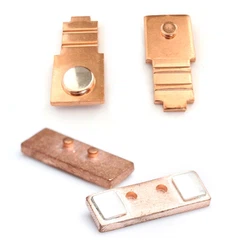
Trimetal rivet-type silver contacts are a class of composite electrical contacts used in relays, thermostats, microswitches, contactors, and other low-voltage electrical appliances. Their typical structure consists of three layers: silver alloy, a copper base, and silver alloy. Compared to contacts made entirely of silver alloy, the trimetal structure allows for the strategic allocation of precious metal materials based on functional zones; the silver alloy handles critical functions such as electrical and thermal conduction, arc resistance, and wear resistance, while the copper base provides mechanical support and a conductive path. This approach reduces precious metal consumption while still meeting electrical performance requirements.
Structurally, trimetal contacts usually feature a symmetrical composite design, with silver alloy layers on both working faces and a copper base connecting them. Since these contacts must withstand frequent make-and-break operations, current surges, and mechanical pressure during service, the bond strength at the interface, material continuity, and dimensional consistency are key factors influencing product reliability. Depending on the specific electrical application and load type, various silver-based material systems can be selected-such as silver-nickel, silver-tin oxide, silver-copper oxide, or other silver alloys suited to specific operating conditions.

Material Structure of Trimetal Rivet-Type Contacts
The core characteristic of trimetal contacts is the functional differentiation of the materials used. The surface silver alloy layers directly facilitate electrical contact and must exhibit low, stable contact resistance, as well as good resistance to arc erosion and welding. The intermediate copper layer serves primarily to reduce material costs while providing excellent electrical conductivity and plasticity. Meanwhile, the composite layers on either side must form a stable, continuous metallurgical bond with the copper base.
This structure differs significantly from conventional solid (monolithic) contacts. While solid silver contacts have a simple structure, the entire cross-section consists of relatively expensive contact material. By adopting a composite structure, the thickness of the silver alloy can be tailored to actual working zones, concentrating precious metals where contact functionality is truly required. Consequently, the design focus for trimetal silver contacts is not merely on increasing the number of material layers, but on achieving a balance between electrical performance, mechanical properties, and material utilization efficiency through the strategic division of material roles.
In practical production, the specific combination of materials is determined by factors such as rated current, operating voltage, load type, operating frequency, and contact lifespan. For instance, contacts in relays and thermostats may prioritize arc resistance under conditions of frequent switching, whereas certain low-voltage switches prioritize contact resistance stability and mechanical durability. Consequently, there is no single material combination for trimetal structures that is suitable for every application scenario.

Cold pressure welding is a key method for joining trimetal contacts
Cold pressure welding is a form of pressure welding. Its fundamental principle involves applying significant mechanical pressure-without the traditional application of heat for melting-to induce plastic deformation in the metals being joined. This process extrudes surface oxide films and contaminants, bringing the fresh, treated metal surfaces into sufficiently close proximity to form a stable interatomic bond.
Cold pressure welding offers distinct process advantages for copper and silver-based materials. Because there is no significant melting phase during the joining process, no pronounced heat-affected zone (HAZ) is formed, and material microstructural changes caused by localized high temperatures are minimized. For electrical contacts, these characteristics help preserve the electrical conductivity and mechanical integrity of the bonded interface.
The ability of cold pressure welding to form a stable bond depends heavily on factors such as surface condition, the degree of plastic deformation, contact pressure, material hardness, and the cleanliness of the mating surfaces. This is particularly critical when bonding silver alloys to copper; the welding interfaces must be kept as clean as possible to prevent oxide films, organic contaminants, or other impurities from interfering with effective metal-to-metal contact.
Therefore, the manufacturing of trimetal electrical contacts is not achieved simply by applying pressure to join the materials; rather, it requires the precise coordination of a series of processes, including material preparation, shearing, interface condition control, pre-heading, and final cold-heading formation.
The composite forming process for trimetal components
The production of trimetal rivet-type contacts typically involves a sequence of operations: material feeding, cutting to length, pre-bonding, cold-heading formation, and final dimensional trimming. During production, the copper substrate is first cut to a preset length and then combined with a corresponding length of silver alloy material; pressure is applied to the end faces of the different materials to form an initial bond.
During the forming of the contact head, the composite material is subjected to axial pressure from the cold-heading die, causing it to flow plastically in a radial direction. The material gradually expands within the die cavity to fill the forming space, ultimately achieving the specified head diameter, thickness, and external dimensions. Because the contact head offers ample space for lateral deformation, it is generally easier to meet the plastic deformation requirements at the composite interface.
The shank structure presents different processing challenges. Since the shank is typically cylindrical, radial expansion space is limited; if the same forming method used for the head were applied directly, the composite interface might not undergo sufficient plastic deformation. Consequently, some designs require a combination of localized expansion and material removal to ensure the composite zone achieves adequate bonding area before the final dimensions are formed.
This process places high demands on die design. Precise alignment must be maintained among the die cavity, punch, ejector pin, and feeding mechanism; otherwise, issues such as material misalignment, uneven composite layer thickness, end deformation, or dimensional deviations may occur.

Key Process Controls for Trimetal Contact Rivets
The production precision of trimetal contact rivets depends not only on the materials themselves but also on the interaction between the equipment's motion mechanisms and the die system. During high-speed continuous production, the timing of feeding, cutting, bonding, transfer, and cold-heading operations must be precisely synchronized. Any deviation in the timing between mechanisms can prevent the composite material from entering the die center accurately, thereby compromising the consistency of the final product.
For high-speed cold-heading equipment, the design of the cam motion profile is particularly critical. Stable contact must be maintained between the driving cam and the driven mechanism to avoid significant lead or lag during operation. If the motion profile is mismatched with the production cycle, it can result in impact loads, mechanical noise, and localized stress concentrations, all of which negatively affect the quality of the formed contact.
Modern equipment design often integrates 3D modeling and motion simulation to verify cam profiles, feeding paths, mold actions, and material movement trajectories. Analyzing potential interference between different motions beforehand helps reduce trial-and-error costs during the equipment commissioning phase and enhances stability during continuous production.
Composite Interface Quality Directly Affects Contact Reliability
For tri-metal rivet contacts, the composite interface is a critical area for quality inspection. Even if the contact's external dimensions meet specifications, the presence of cracks, unbonded areas, or significant delamination between the silver alloy layer and the copper substrate can lead to progressive degradation during long-term switching operations, thereby compromising the product's mechanical stability and electrical performance.
Common methods for testing bond strength include flattening tests, cross-sectional examination, and microscopic analysis. By flattening the contact head and shank to a specified degree, inspectors can observe whether significant cracking or delamination occurs at the composite interface. For products requiring detailed quality assessment, metallographic cross-section analysis allows for the evaluation of the continuity of the silver layer, copper layer, and the interface region.
In addition to bond strength, the thickness and uniformity of the silver layer are key indicators. An excessively thin silver layer may fail to withstand long-term arc erosion or meet contact service life requirements, whereas an excessively thick layer increases material consumption. Therefore, while ensuring electrical performance, the final silver layer thickness must be controlled through a combination of material dimensions, feed length, and the degree of cold-heading deformation.
For electrical tri-metal rivet contacts, quality control must also encompass parameters such as head diameter, shank diameter, total length, silver layer thickness, concentricity, and surface defects. Combining in-process inspections with final inspections helps minimize dimensional variations during mass production.
Selection and Application of Silver Alloy Materials
Different silver alloys offer varying levels of electrical conductivity, hardness, arc erosion resistance, and resistance to contact welding; consequently, material selection for tri-metal contacts must align with actual load conditions. Common material systems include pure silver, silver-nickel (AgNi), silver-tin oxide (AgSnO₂), silver-copper oxide (AgCuO), and other silver-based electrical contact materials.
In applications such as low-to-medium power relays, materials generally need to balance low contact resistance with good wear resistance; for switching devices handling higher currents, issues such as arc erosion and material transfer require particular attention. In operating environments with high inrush currents, material selection must also take into account factors such as contact closing speed, load characteristics, and arc-extinguishing structures.
The advantage of multi-layer silver contacts lies in the ability to achieve functional zoning through the combination of multiple materials; however, this necessitates accounting for differences in thermal expansion, hardness, and plasticity between the materials during process design. Since different materials exhibit varying rates of plastic flow during cold heading, improper deformation parameters can lead to interface displacement or localized material accumulation.
Impact of Automated Production on Consistency
Tri-metallic contacts are typical small, precision electrical components often required in high volumes; consequently, both production efficiency and consistency must be prioritized. Integrating steps such as automatic feeding, fixed-length cutting, composite welding, cold heading, and automatic unloading into a continuous production flow helps minimize dimensional variations associated with manual intervention.
Automated production also enables stable control over feed lengths, cycle times, and forming actions. For contacts of varying specifications, product series with different dimensions and material combinations can be produced simply by adjusting parameters based on material size and mold structure.
Equipment stability is equally critical during mass production. Prolonged operation can lead to issues such as tool wear, changes in mold clearances, and reduced precision in feeding mechanisms, all of which can affect product quality. Therefore, production management must incorporate mechanisms for mold life management, tool inspection, first-article verification, and in-process sampling.
Key Application Areas for Tri-metallic Contacts
Tri-metallic rivet contacts are primarily used in low-voltage electrical appliances that require stable electrical contact and a long mechanical service life. Relays, thermostats, microswitches, contactors, and certain control switches often utilize this type of composite contact structure.
In the case of relays, the specific tri-metallic contact used must be selected based on the relay's rated load and operating frequency to ensure the appropriate silver alloy system is employed. For control circuits involving frequent operation, the wear and arc resistance of contact materials directly impact the relay's service life.
In microswitches and control components, contacts are typically small, demanding high precision in manufacturing and uniformity in the silver layer. Given the limited travel distance of the contacts, the surface condition of the material and the contact pressure significantly influence contact resistance.
As the number of relays, contactors, and control switches increases in modern electrical equipment-such as new energy vehicles, energy storage systems, power control units, and smart home appliances-there is a growing demand for miniaturization, high reliability, and efficient material utilization. Tri-metal composite structures offer significant potential for engineering applications, as they allow for optimized material distribution to meet diverse electrical connection requirements.

Technological Development Trends for Tri-metal Contact Rivets
Future development of tri-metal contacts will focus on composite material technology, precision forming, and automated quality control. As electrical products evolve toward high-frequency operation, miniaturization, and high reliability, contact materials must not only meet basic conductivity requirements but also maintain balanced performance regarding arc erosion resistance, weld resistance, mechanical wear resistance, and environmental stability.
Material utilization efficiency is another key area for the continued development of composite contacts. Precisely controlling the thickness and placement of the silver alloy layer reduces unnecessary consumption of precious metals while maintaining the performance required in the active contact area. Such optimization of material structure offers significant engineering value for mass-produced electrical products.
Regarding manufacturing processes, combining cold pressure welding with precision cold heading minimizes microstructural changes associated with traditional thermal processing and facilitates continuous production. Advances in high-speed forming equipment, precision tooling, in-line inspection, and digital production management technologies will further enhance the dimensional consistency and batch-to-batch stability of tri-metal contact rivets.
The design of tri-metal contact rivets allows for tailored material combinations and structural adjustments based on specific application scenarios. By varying the silver alloy type, composite layer thickness, and the geometry of the contact head and shank, performance can be optimized to suit specific load conditions. For contact structures requiring frequent movement or repeated making and breaking-such as "trimetal" moving contacts-subsequent designs must comprehensively consider the interplay between mechanical action, contact pressure, material wear, and arcing effects to establish a more robust service-life evaluation system.
Overall, the core value of trimetal rivet-type silver contacts lies not merely in reducing precious metal consumption through the use of a copper base, but in integrating electrical conductivity, mechanical strength, arc resistance, and high material utilization into a single structure by leveraging multi-material compositing, cold pressure welding, and precision cold heading technologies. From an engineering procurement perspective, selection should focus on verifying the silver alloy system, composite structure, silver layer thickness, dimensional tolerances, bonding strength, and actual load conditions to ensure the contact solution aligns with the performance and service-life requirements of the end-use electrical device.
contact us

Send Inquiry