










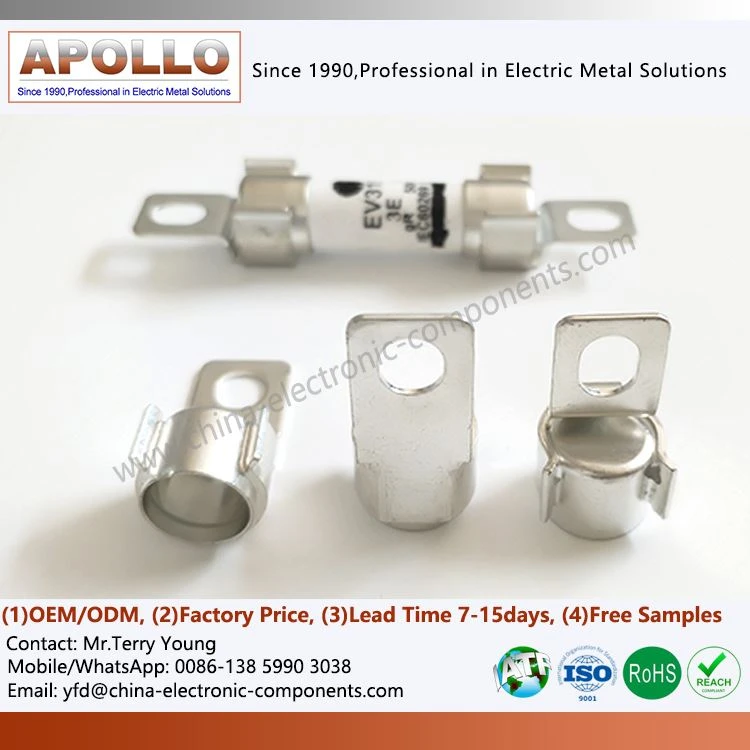
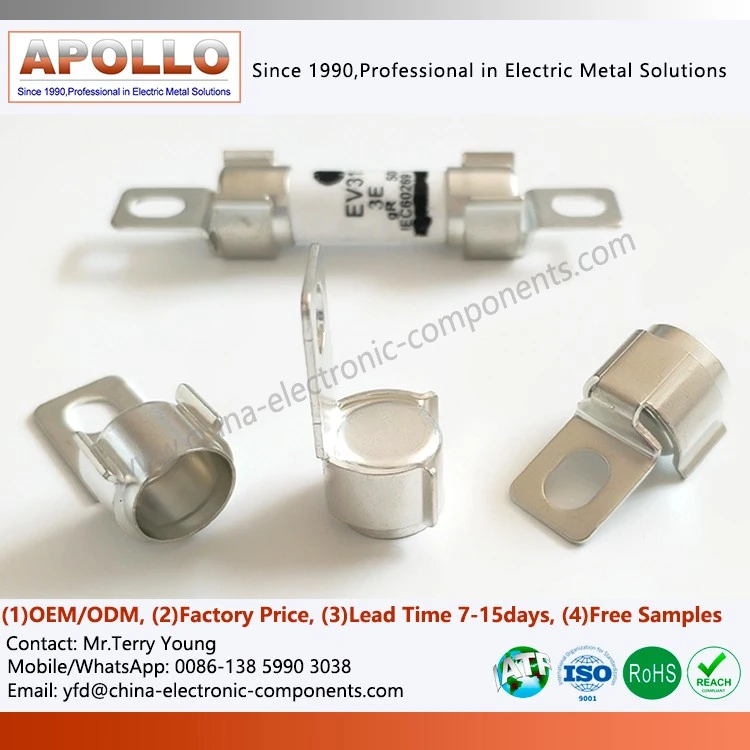
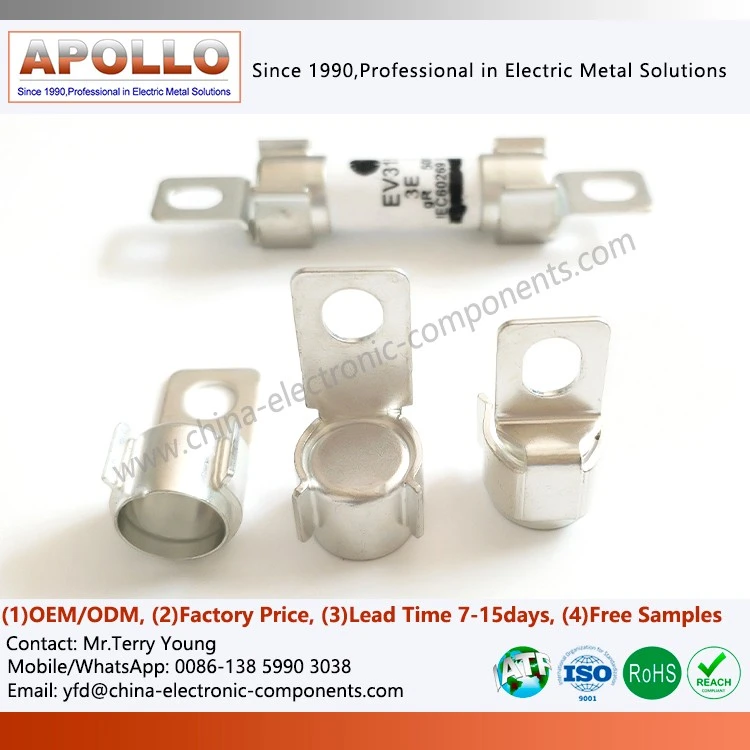

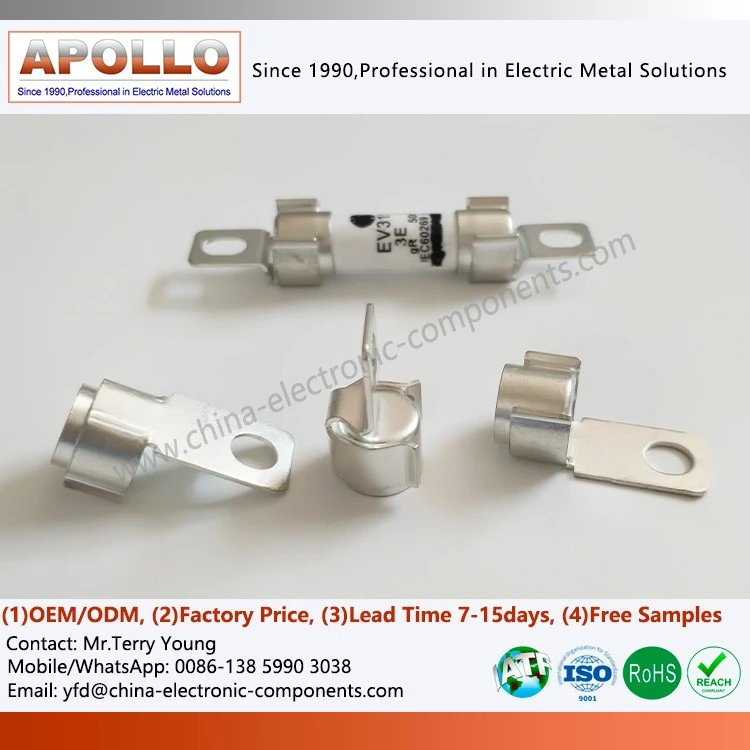
Copper Cap And Fuse Link Contact
Products Description

The copper cap and fuse link contact is core conductive component within a fuse, typically formed by welding or integrating a copper cap and a contact blade. This structure not only carries current but is also a crucial node for the fuse to quickly disconnect under short-circuit or overload conditions. Unlike ordinary connectors, this component must maintain structural integrity and electrical stability under high temperature, arc, and impact conditions; therefore, its design focuses on balancing conductivity, thermal stability, and connection reliability.
Design Advantages:
Thermal Matching Design: Considers the matching of thermal expansion coefficients of the end cap, melt, and solder to reduce thermal cycling stress for Fuse Cap and Contact High Temperature Soldering.
Stress Relief Structure: Incorporates flexible structures (such as wavy weld lines) at the end cap or melt connection to absorb thermal stress and vibration for Copper Cap and L-Type Terminal.
Internal Geometry Optimization: The internal shape of the end cap cavity can be designed to store solder, guide melt position, or assist arc movement for Copper End Caps and Fuse Contact.

Key Advantages
Controllable and Consistent Thermo-Electro-Mechanical Characteristics
Precise control over the end cap material condition (hardness, grain size), melt pretension, and welding heat input ensures consistent initial resistance, thermal capacity, and mechanical fixation strength for each Copper End Cap and Fuse Terminal Contact. This directly determines the dispersion of the fuse's time-current characteristic curve, crucial for selective protection.
Optimized Fault Energy Management
The copper end cap acts as a highly efficient heat sink, rapidly absorbing and dissipating heat in the early stages of a fault, aiding in stabilizing the fusing process. Its geometry (such as the internal cavity design) helps guide arc expansion and plasma cooling, working in conjunction with the arc-extinguishing medium to achieve complete interruption and limit arc voltage peaks for Copper Metal End Cap and Fuse Link Contact.
Superior Environmental Tolerance and Lifespan
Reliable weld seals prevent moisture, oxygen, or arc-extinguishing media from intruding into the connection interface, avoiding slow resistance increases caused by internal oxidation or corrosion. High-strength mechanical bonding withstands transportation, installation vibrations, and long-term thermal cycling stress, preventing contact degradation due to fatigue for Fuse Cap and Contact High Temperature Soldering.

Detailed Display
Soldering Marks on the Inner Wall of the End Cap
Slight solder marks or resistance welding indentations of Copper End Caps and Fuse Contact are often left on the inner side of the end cap where it is welded to the molten metal. This is a normal production characteristic, indicating that the end cap has undergone the connection process with the molten metal. However, there should be no solder flowing to the outer surface of the end cap.
Touch Blade Plating Uniformity
The surface of the Copper Cap and L-Type Termial after tin or silver plating should have a uniform color, without obvious color difference, peeling, incomplete plating, or black spots. The edges of the touch blade and the inner walls of the punch holes should also be covered by the plating. Exposed copper at the edges indicates obstruction by the plating fixture or uneven current distribution during electroplating.
Appearance of the Weld Joint between the Touch Blade and the End Cap
Resistance welding joints of Fuse Cap and Contact High Temperature Soldering usually appear as two or more circular indentations, which should be complete and symmetrical. Silver brazing joints should have a uniform ring of filler metal filling marks, without incomplete filling or filler metal accumulation forming nodules.

contact us
For customized Copper Cap and Fuse Link Contacts suitable for photovoltaic/energy storage/automotive scenarios, material and welding strength reports, bulk quotations, or technical selection solutions, please contact us. Our professional team provides full technical support.

Hot Tags: copper cap and fuse link contact, China copper cap and fuse link contact manufacturers, suppliers, factory, fuse contact and cap, EV Fuse Contact With Bolt Mount, End Cap and Terminal, Copper Cap Contact For Electric Cars, Welding Joints For Fuse, Outer Cap and Contact
You Might Also Like


Send Inquiry