











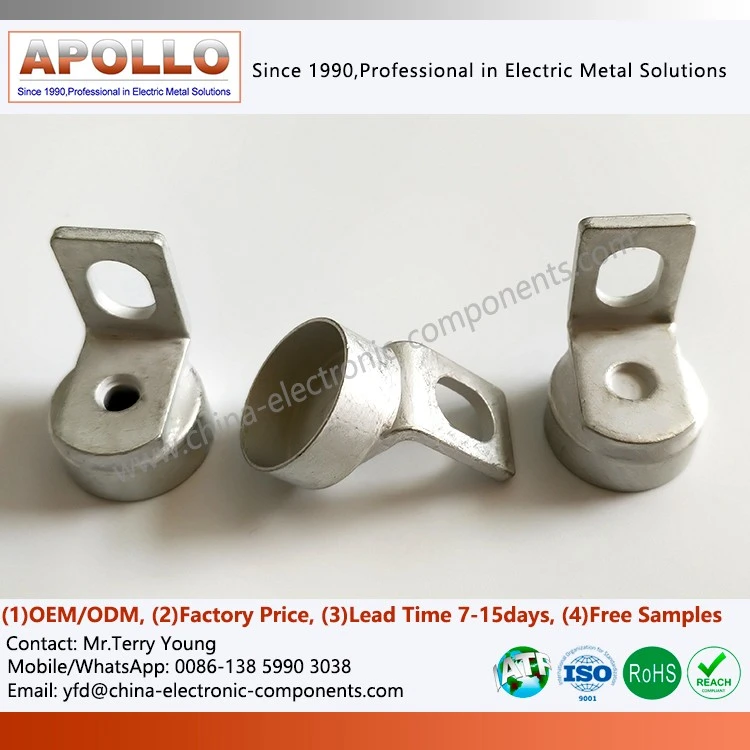
Fuse End Cap And Contact
Products Description

Unlike stamped parts made from a single material, our Fuse End Cap and Contact is a precision electrical connection system.
Dissimilar Material Integration Architecture: The outer cap is made of T2Y2 copper (high conductivity), the inner cap is made of H65 brass (high-strength structural support), and the contact blade is customized according to the specific current-carrying capacity.
Physical Connection Depth: The assembly is not merely a physical stack, but a metallic bond achieved at the atomic level through resistance brazing and high-temperature soldering.
Low-Ohmic Contact Design: Every connection point is optimized for contact resistance, ensuring that the internal temperature rise of the assembly is kept extremely low even when high currents are continuously flowing through it.
Core Functions
High-Current Electrical Interface
The copper contact blade acts as an electrical bridge between the fuse and the external busbar/cable, carrying the full operating current (up to hundreds to thousands of amperes). The extremely low resistance of the T2Y2 ensures minimal power loss and temperature rise.
Mechanical Anchoring at the Fuse End
The brass inner cap forms an interference fit with the ceramic tube through a flange or thread, providing axial and radial mechanical constraints for the entire fuse assembly, resisting vibration, impact, and thermal cycling displacement.
Overvoltage and Impact Load Bearing
When the fuse operates, the internal arc pressure and the vaporization expansion of the molten material generate axial impact force. The riveted-brazed composite structure of the Fuse Cap and Contact Soldering disperses the impact load to the elastic deformation of the copper contact blade and the plastic deformation of the brass inner cap, preventing instantaneous breakage.
Heat Conduction and Dissipation
The large-area Fuse Cap and Contact Resistance welding surface of the copper outer cap forms the main heat dissipation path of the fuse, conducting the heat of the molten material to the external busbar or radiator, maintaining the long-term operating temperature rise within a safe range.

Application Scenarios: Comprehensive Coverage of the Clean Energy Chain
EV/PHEV Battery Packs
Serving as critical contacts in the main circuit and maintenance switch (MSD).
BESS (Battery Energy Storage Station)
Acting as a current hub in high-voltage DC containerized energy storage systems.
DC Fast Charging Stations
Withstanding frequent current loading and unloading while maintaining long-term thermal stability.

Detailed Demonstration: Quality Imprints Intertwined by Micro and Macro Perspectives
| Full and Smooth Weld Corner | Visually inspecting the joint between the Fuse Cap and Contact Tin welding, the solder forms a continuous, full, and smoothly transitioned arc-shaped weld corner, without any sharpening, dripping, or repair weld marks. This represents perfect capillary flow and temperature control. |
| No Oxidation Discoloration Area | Due to the use of a localized rapid brazing process, the copper outer cap substrate, only millimeters away from the weld, retains its metallic color, without large-area oxidation, blackening, or peeling, proving that the grain size of the substrate material has not been damaged. |
| Absolute Coplanarity | When the component is placed on a marble inspection platform, the mounting planes of the two Outer End Cap and Terminal Welded Assembly Set are perfectly aligned on the same horizontal plane. This micron-level coplanarity ensures that during PDU assembly in the vehicle, the bolt tightening force is 100% converted into contact pressure, rather than being used to forcibly correct the dimensional and positional tolerances of the parts. |
| The tightness of the internal hidden weld | When observed with an endoscope on the inner side of the overlap between the inner and outer caps, the weld material penetrates evenly along the gap without any breaks or voids, achieving true "full circumference sealing welding". |

contact us
If you are evaluating a high-reliability fuse connection component solution, we can provide customized structural and process matching support based on application conditions. You are welcome to submit your engineering requirements to obtain technical support for the Copper Cap and Fuse Terminal Contact.

Hot Tags: fuse end cap and contact, China fuse end cap and contact manufacturers, suppliers, factory, Fuse Cap Contact Resistance Welding, End Cap and Terminal, Fuse Cap Contact Tin Welding, Welding Joints For Fuse, Outer Cap and Contact, EV Fuse Contact With Bolt Mount
You Might Also Like


Send Inquiry