


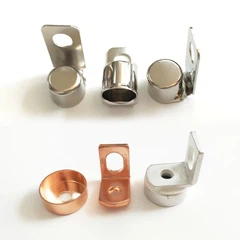


Copper Cap And Fuse Terminal
Products Description
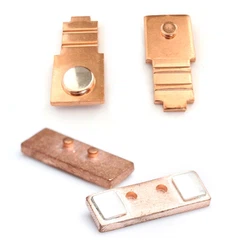
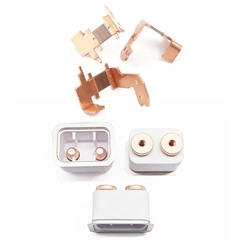
This Copper Cap and Fuse Terminal uses:
Outer cap material: Copper T2Y2 (purple copper)
Inner cap material: Brass H65 (brass)
The bimetallic structure achieves complementary properties of the different materials.
The copper outer cap possesses excellent electrical and thermal conductivity, effectively reducing on-resistance and improving heat dissipation efficiency under instantaneous overload; the brass inner cap offers better structural support, processing stability, and deformation resistance, maintaining good dimensional consistency during long-term mechanical fixing and welding.
Compared to a single copper structure, this composite design, while ensuring conductivity, effectively improves the overall mechanical stability and welding reliability of the component, making it more suitable for complex operating conditions such as high-voltage fuses in new energy vehicles.

Application Advantages: Adaptable to Multiple Scenarios
High-voltage power distribution
Transformer and line protection in traditional power grids.
Industrial automation
Front-end current limiting protection for large frequency converters and soft starters.
Railway transportation
High vibration resistance protection requirements for locomotive traction systems.
Communication power supply
High current density protection for data center UPS systems.

Material Advantages: The "Golden Pairing" Logic of T2Y2 Copper and H65 Brass
| The Ultimate Resistance Reduction Logic of T2Y2 Copper | The Fuse Cap and Contact Resistance Brazing uses T2Y2 copper (annealed copper with a purity >99.9%). The Y2 state (semi-hard state) is key; it retains extremely high conductivity (IACS>100%) while possessing sufficient mechanical rigidity, making it less prone to springback deformation after stamping. Its extremely low resistivity ensures that the cap itself will not become a heat source under continuous high current. |
| The Anchoring and Processing Advantages of H65 Brass | The Copper Cap and L-Type Terminal or connecting sleeve uses H65 brass (high-precision copper-zinc alloy). H65 exhibits excellent machinability and deep drawing performance, making it ideal for machining complex internal threads, grooves, or deep cylindrical structures. Its high yield strength allows it to act as a robust "foundation" within fuses, withstanding the expansion stress of the silica sand and the immense radial pressure during end-face rolling. |
| Compatibility of dissimilar material interface potentials | Copper and brass are both copper-based alloys with extremely small potential differences in their electrochemical sequences. Even with trace amounts of condensation in the operating environment, severe galvanic corrosion will not occur, ensuring interface stability of the component over a lifespan of more than 10 years. |

Technical Features and Design Advantages
Dual-material composite structure
The outer layer of T2Y2 copper provides high conductivity (≥97% IACS), while the inner layer of H65 brass enhances structural rigidity and resistance to deformation, achieving a perfect synergy between conductivity and strength.
01
Precision riveting + brazing combination
Multi-point riveting positioning followed by high-temperature tin brazing or resistance brazing ensures a metallurgical bond at the interface, eliminating incomplete welds and oxide inclusions, significantly improving tensile strength and electrical stability.
02
Optimized surface treatment
Copper End Caps and Fuse Contact Supports various solutions, such as silver plating, bright tin plating, matte tin plating, or nickel plating, effectively reducing contact resistance, improving oxidation resistance, and enhancing weld compatibility.
03
Geometric accuracy and compatible design
End face parallelism, inner diameter tolerance, and blade-shaped interface are precisely controlled, perfectly adapting to mainstream ceramic bodies and molten components; optional reinforcing ribs or flange designs further enhance vibration and impact resistance.
04

contact us
If you are looking for highly reliable Copper End Cap and Fuse Terminal Contact welding components that can be used stably in new energy vehicles, energy storage systems, and high-voltage protection equipment over the long term, we are more concerned with the engineering implementation of structural reliability, process stability, and batch consistency than just the product itself.

Hot Tags: copper cap and fuse terminal, China copper cap and fuse terminal manufacturers, suppliers, factory, Fuse Cap and Contact, End Cap and Contact, EV Fuse Copper Contact, Copper Cap Contact For Vehicle Fuse, fuse contact and cap, Copper Cap Contact For Electric Cars
You Might Also Like


Send Inquiry