










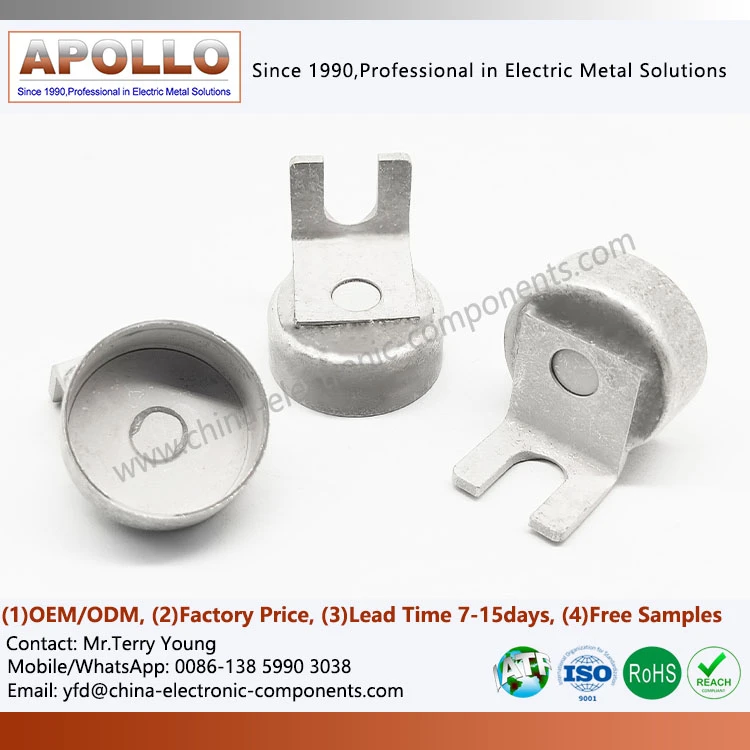
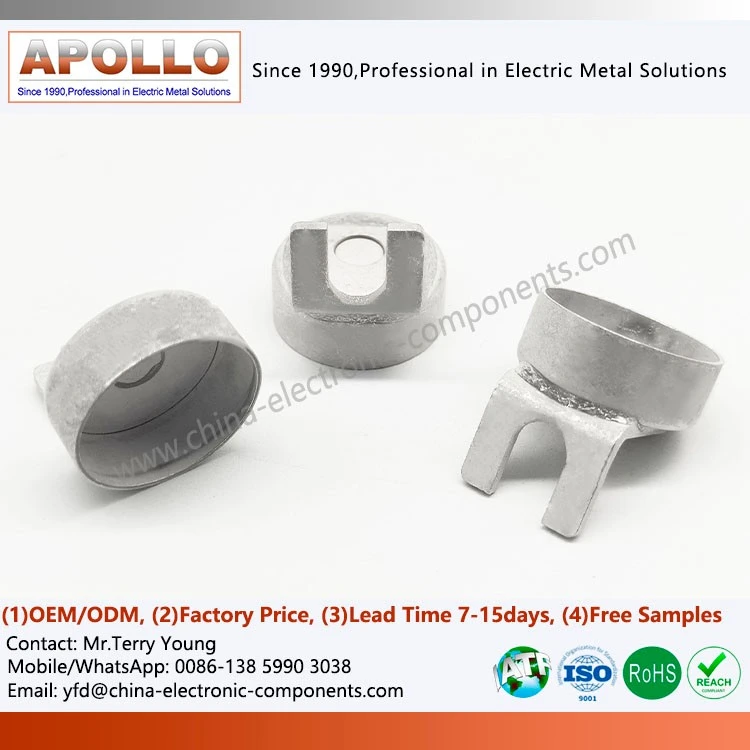

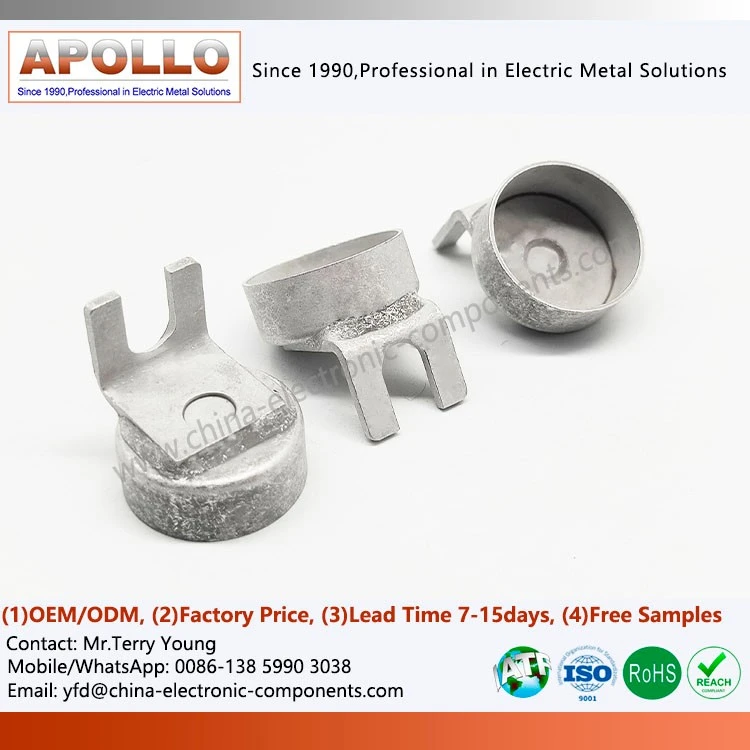

Copper Cap And Fuse Terminal Contact
Products Description
This series of Copper Cap and Fuse Terminal Contact is not a simple metal stamping part, but a composite electrical connection unit integrating precision cold stamping, multi-point riveting, and high-temperature brazing processes. As the core mechanical support and conductive interface of the fuse link, it bears the crucial responsibility of electrically interconnecting the internal fusible element with the external circuitry.
Its physical characteristics are:
High mechanical strength: Capable of withstanding the powerful electrodynamic stress and internal pressure generated at the moment of fuse breaking.
Thermal stability: Extremely low temperature rise at rated current and able to withstand the thermal shock of instantaneous high-temperature electric arcs.
Interface bonding strength: Molecular-level metallurgical bonding is achieved between the inner and outer caps, and between the contact blade and the cap body.

Differentiated Material Advantages: Synergistic Effect of T2Y2 and H65 (Material Science)
We refuse to use recycled copper, and all raw materials are traceable:
1. Copper Outer Cap (Copper T2Y2): The outer cap is directly exposed to the electrical connection interface and is made of T2Y2 (electrolytic copper, semi-hard state).
Superconductivity: Copper content ≥ 99.90% ensures minimal power loss, effectively reducing the overall power consumption level.
Ductility and Density: The Y2 state provides excellent cold working performance, ensuring uniform cap wall thickness after stamping, free of micro-cracks, and effectively locking internal fillers (such as silica sand).
2. Brass Inner Cap (Brass H65): Internal structural components are made of H65 brass.
Structural Support: H65 possesses higher strength and hardness, providing a solid physical support for the positioning of the Copper Cap Contact for High Voltage Low Current EV Fuse blade, preventing displacement during frequent vibration or thermal expansion and contraction.
Welding compatibility: Brass and copper have good affinity during the brazing process. With the help of specific filler metals, a uniform and pore-free alloy layer can be formed.

Precision Manufacturing: A Comprehensive Quality Control System
High-Speed Precision Progressive Stamping Technology
The production of both inner and outer caps utilizes imported Japanese high-speed stamping presses combined with multi-station progressive dies. Die precision reaches the micron level, ensuring consistent deep hole drawing dimensions for each inner cap and precisely controllable curvature radius for each Copper Cap Contact for Electric Cars. This precision stamping process guarantees part interchangeability, laying the foundation for subsequent automated assembly.
Automated Welding and Online Monitoring
Our production line is equipped with fully automated welding robot workstations. The system integrates visual positioning and infrared temperature measurement functions, monitoring welding temperature and position in real time. Welding parameters for each Copper Cap Contact for Vehicle Fuse are recorded in real time and uploaded to the MES system, enabling full traceability of quality data. If abnormal welding energy is detected, the system automatically rejects defective products, ensuring "zero defects" in outgoing products.
Post-Weld Treatment and Stress Relief
After welding, Copper Cap Contact for Electric Vehicle Fuses undergo ultrasonic cleaning to remove flux residue and then enter a dedicated aging treatment line for stress relief. This step is crucial for maintaining the elasticity of T2Y2 copper. It eliminates residual stress generated in the heat-affected zone of the weld, preventing the product from warping or deforming during storage or use.

Application Advantages: Multi-domain Adaptability, Enhanced Efficiency
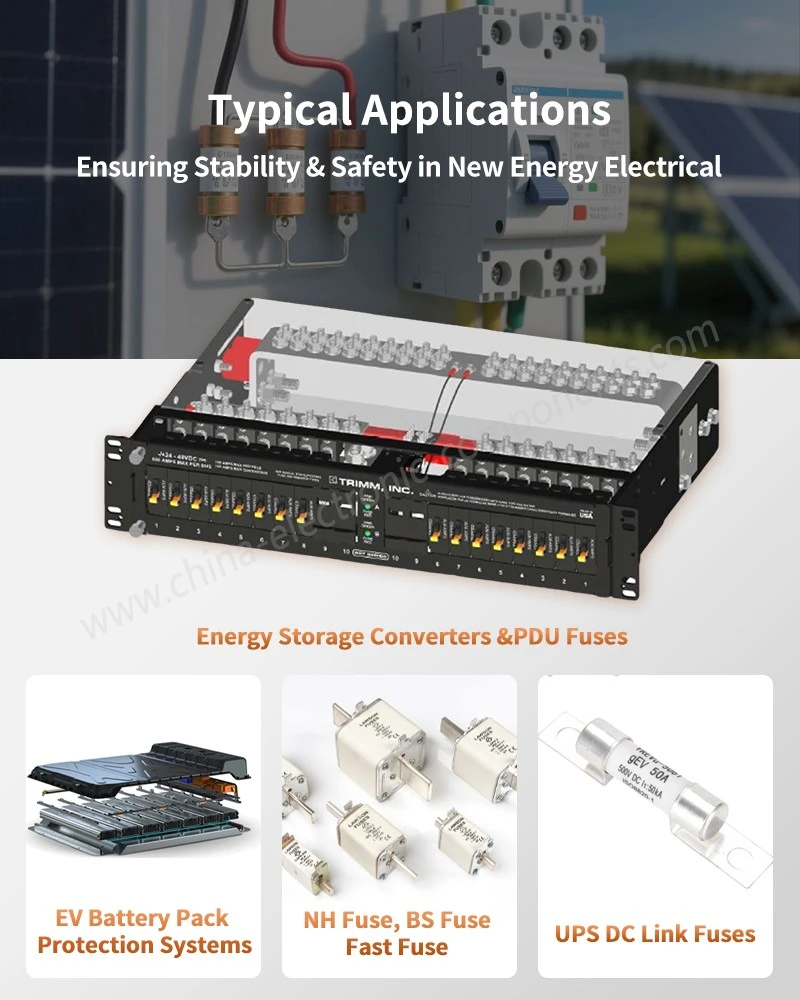
The application advantage of the Copper Cap Contact for Semiconductor Fuses lies in its cross-domain adaptability. In heavy industries such as steel mills, it protects high-voltage motor circuits, ensuring continuous production; in new energy sources such as wind farms, it handles fluctuating currents and prevents inverter failures; in precision instruments such as medical equipment, it provides low-noise connections and maintains signal integrity.
This advantage stems from its versatility in manufacturing processes, adapting to different environmental requirements. For example, high-temperature soldering is suitable for high-temperature applications, while resistance soldering optimizes vibration environments. These applications help purchasers optimize electrical infrastructure, achieving upgrades from traditional to intelligent systems.
contact us
If you are evaluating long-term reliability solutions for critical conductive components of fuses, our engineering team can provide matching optimization suggestions based on actual current, temperature rise, and structural requirements to help reduce the risk of later failures during the design phase of your project.

Hot Tags: copper cap and fuse terminal contact, China copper cap and fuse terminal contact manufacturers, suppliers, factory, Copper Cap Contact For Electric Cars, Fuse Cap Contact Resistance Welding, Outer Cap and Contact, Fuse Cap and Contact, Fuse Cap Contact Tin Welding, End Cap and Contact
You Might Also Like


Send Inquiry