



Research On Characteristic Analysis And Engineering Applications Of Film Capacitors in Power Electronic Systems
Jul 11, 2026
Leave a message
In modern power electronics systems, capacitors serve as core components for energy buffering and power regulation across various converters and energy storage systems. Particularly in architectures involving electric vehicle (EV) busbars and power capacitor busbars, their role extends beyond mere filtering and energy storage to directly influencing system efficiency and reliability. Driven by trends toward higher power density and higher operating frequencies, the co-design of capacitors and busbar structures has become increasingly vital; controlling conductive paths and parasitic parameters within the system is now a critical design metric.

Regarding capacitor selection, engineers often face a trade-off between electrolytic and film capacitors. The structural design of the capacitor busbar and the insulation performance of the busbar materials directly impact the overall system's electrical safety and thermal stability. While electrolytic capacitors offer higher volumetric energy density, film capacitors excel in handling high-frequency ripple currents and maintaining long-term stability, necessitating application-specific choices.
From the perspective of power electronics topologies, IGBT busbars and EV laminated busbars typically form the core current paths in high-frequency switching systems; the ability to control parasitic inductance within these components directly affects switching losses and the suppression of voltage spikes. Furthermore, the connection method between the busbar and the DC-link capacitor-such as the specific busbar configuration for the DC-link capacitor-determines the DC bus's ripple characteristics and transient response capabilities.

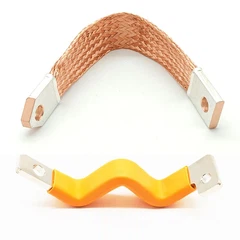
Film capacitors typically utilize a metallized polypropylene film structure, which exhibits excellent self-healing properties in high-frequency, high-voltage environments. In practical engineering, EV film capacitor busbars and insulated busbars for EV capacitors are frequently employed in new energy systems to enhance stability under high dv/dt (rapid voltage change) conditions. Additionally, insulated copper busbars are widely used in EV powertrains to ensure safe isolation and efficient current conduction during high-current transmission.
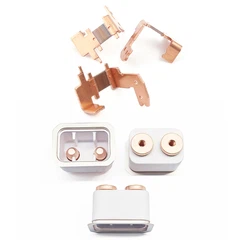
Regarding partial discharge and insulation design, capacitor systems often require optimization through highly reliable packaging structures. For instance, the integrated design of EV battery busbars and busbars for film capacitors can effectively mitigate electric field concentration in high-voltage DC environments, thereby extending the system's overall lifespan and reliability.
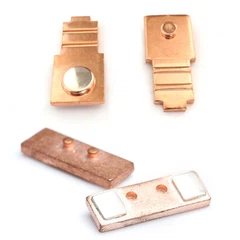
In power conversion and energy storage applications, EV capacitor connector bars and power distribution bars are frequently used to establish low-impedance connections between capacitor modules, while copper busbars for automotive power systems provide stable conductive support for high-current transmission, ensuring reliable operation of power modules under heavy loads.
Within the architectures of new energy vehicles and high-voltage DC systems, automotive busbars serve as fundamental conductive elements; combined with custom busbars designed for efficient power distribution, they create flexible power allocation networks. Furthermore, customized conductive copper busbars optimize current path distribution through structural design, thereby reducing overall system losses.
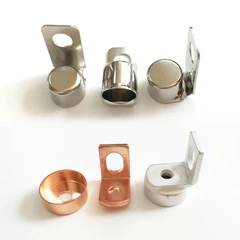
Regarding manufacturing processes and material systems, tin-plated copper busbars for EVs utilize surface treatments to enhance oxidation resistance and soldering reliability, enabling them to meet the demands of long-term operation under complex conditions. Such components are vital for high-reliability power modules.

At the system integration level, busbar systems within electric vehicle high-voltage platforms require a multidimensional approach-balancing thermal management, electromagnetic compatibility, and mechanical structural integrity-to ensure stable performance amidst dynamic load fluctuations.
In summary, the synergistic design of film capacitors and busbar systems has become a pivotal focus in the optimization of modern power electronics.
By strategically configuring conductive structures and capacitor topologies, Automotive BusBar PET Insulation makes it possible to reduce system losses while simultaneously enhancing power density and reliability, thereby providing essential technical support for the future development of high-voltage, high-frequency power electronic systems.
contact us

Send Inquiry