




Report On The Development Analysis And Technological Evolution Of China's Stainless Steel Fastener Industry (2026)
Jul 02, 2026
Leave a message
By 2026, China's stainless steel fastener industry will have entered a critical phase of transitioning from scale expansion to structural optimization and upgrading. While production capacity for standardized products is ample, a supply gap remains for high-end fastening solutions designed for complex operating conditions; industry competition is gradually shifting from price-driven models to a contest of comprehensive capabilities involving material performance, machining precision, and end-to-end quality management systems.

Industry Structure and Demand Evolution
Conventional fastening products-such as standard stainless steel and steel screws commonly used in general machinery and structural construction-still hold the majority market share. However, the growth of new energy, chemical processing, and high-end equipment manufacturing has significantly boosted demand for high-performance fasteners, driving the product portfolio toward greater diversity in specifications and suitability for varied operating environments.
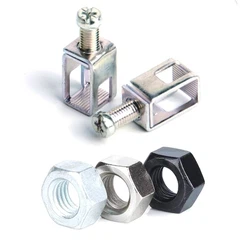
In the realms of electrical connection and precision assembly, structural fasteners-such as M10 wire clamp terminals and M8 socket head cap screws with spacers-are widely used in electronic control systems and modular assemblies, necessitating higher standards for dimensional consistency and electrical conductivity stability.
Product Types and Structural Classification
In terms of structural design, fasteners have evolved into a multi-dimensional, specialized system:
Regarding head styles, countersunk flat head screws are utilized for assembly interfaces requiring high surface flatness, whereas stainless steel pan head screws are commonly employed in general-purpose connections where load distribution is uniform.
For high-strength connections, flat-head hexagon socket stainless steel screws and hex bolts serve as primary load-bearing components, playing a crucial role in securing mechanical assembly systems.
Additionally, Phillips-head machine screws are widely used in electronics and lightweight equipment due to their high assembly efficiency.
Material Performance and Process Development
In high-strength connection systems, the M10 304 stainless steel hex bolt, nut, and flat washer combination represents a typical integrated fastening solution, enhancing connection stability through the combined use of these components.
In certain high-precision applications, hollow-head set screws are used for axial positioning and anti-loosening designs, while M6 304 stainless steel hexagon socket head screws feature knurled surfaces to improve slip resistance. In heavy-load and complex-environment applications, flanged hexagon head bolts offer superior load distribution, making them ideal for structural connections subject to vibration.

Expanded Application Scenarios and Industry Penetration
As infrastructure and energy systems undergo upgrades, the scope of stainless steel fastener applications continues to widen. In construction and building envelope systems, stainless steel sheet metal screws and roofing screws are utilized to secure metal roofing and curtain wall structures.
In the power and industrial equipment sectors, stainless steel cladding screws are used to assemble equipment casings and protective structures, while stainless steel set screws are frequently employed in mechanical adjustment and positioning mechanisms.
For concrete and anchoring applications, stainless steel masonry screws (such as Tapcon-style fasteners) are commonly used to secure lightweight structures and reinforce installation systems.
Long-format fasteners-such as 100mm stainless steel screws-are often required for deep structural connections and specialized installation needs. Meanwhile, stainless steel trim screws are commonly found in decorative applications and precision finishing work.
Key Technological Trends in the Industry
Current technological advancements in the industry are focused on three main areas:
First, the optimization of high-strength structural designs; for example, 304 stainless steel hexagon head machine screws (featuring metric threads and flat spring lock washers) utilize combined anti-loosening structures to enhance stability under dynamic loads.
Second, the establishment of high-precision manufacturing control systems ensures consistent dimensions and thread accuracy in stainless steel screws during mass production.
Third, the trend toward lightweight and modular designs is driving fastening systems toward greater integration to meet the assembly efficiency requirements of modern equipment manufacturing.

Summary of Development Trends
The stainless steel fastener industry will continue to evolve toward the use of high-performance materials and precision manufacturing. Driven by the advancement of smart manufacturing and the localization of high-end equipment production, product portfolios will become increasingly specialized, with enhanced capabilities for handling complex operating conditions. Beyond their primary role in connecting components, these fasteners will expand into functions such as electrical and thermal conduction and system integration, serving as fundamental functional units within equipment systems.
contact us

Send Inquiry