




Key Elements Of Brass Sheet Deep Drawing Process
Jul 13, 2026
Leave a message
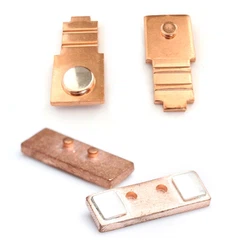
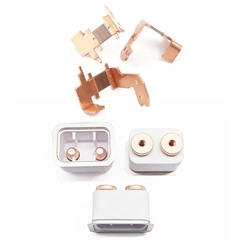
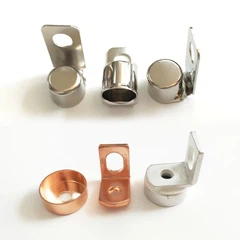
Brass sheets, with their excellent ductility, electrical and thermal conductivity, and corrosion resistance, are widely used in electronics, hardware, and machinery manufacturing. Deep drawing is a key processing technology that allows flat blanks to be processed into complex hollow parts. This process requires careful consideration of materials, molds, and parameter control to avoid defects and ensure precision. Cold Stamped Brass Components are core parts manufactured using this process, suitable for precision assembly needs in various fields.

The essence of deep drawing is the plastic flow process of the material. The core is to use a punch to press the blank into the die cavity, causing the material to deform under radial tensile stress and tangential compressive stress. The complete process consists of four stages: initial drawing, forming, final drawing, and demolding. Complex parts require multiple deep drawings combined with intermediate annealing. The forming of Cold Stamped Brass Components often requires flexible adjustment of the number of stampings and annealing processes based on the structural complexity.
The properties of brass directly affect the deep-drawing effect. Commonly used H68 and H65 brass have moderate zinc content and excellent cold-working plasticity, making them the preferred base material for cold-stamped brass components. Soft brass sheets have uniform grains, low yield strength, and high elongation, making them more suitable for complex deformations. Higher strain hardening index and thickness anisotropy coefficients in the material can delay necking, reduce thickness reduction, and ensure forming quality.
Die design is the core of the process; reasonable parameters directly determine the precision of the cold-stamped brass component. A punch-die clearance of 1.07 to 1.1 times the plate thickness and a corner radius of 5 to 10 times the plate thickness can reduce friction and stress concentration. Simultaneously, the die must be made of a high-hardness, wear-resistant material with surface treatment, and equipped with an elastic edge clamping device to effectively prevent wrinkling and cracking of parts.
Process parameter control must balance efficiency and quality. Medium stamping speeds and lubrication with special copper alloy stamping oil can reduce friction and prevent a decrease in material plasticity. The blank dimensions are calculated based on the principle of constant volume. Recrystallization annealing is required between multiple deep-drawing passes to eliminate work hardening and provide stable material properties for the continuous forming of cold-stamped brass components.
Common defects in deep-drawing, such as cracking, wrinkling, and scratches, can be resolved by optimizing die parameters, adjusting blank holder force, and improving lubrication. Cracking is often caused by excessively small corner radii and excessive blank holder force, while wrinkling is related to insufficient blank holder force and excessively large die corner radii. Targeted adjustments can significantly improve the yield rate of cold-stamped brass components.

We specialize in high-precision cold-stamped brass component production. Leveraging mature brass sheet deep-drawing technology, we use high-quality H68 and H65 brass base materials and optimize die design and parameter control. We can customize deep-drawn brass parts of different specifications and complex structures to effectively avoid various forming defects, ensuring product precision and durability, and meeting the assembly needs of various fields such as electronics and machinery.
If you have any needs for customizing, prototyping, or bulk purchasing of Cold Stamped Brass Components, please feel free to contact us. We will provide you with professional process solutions and high-quality products to help your project be implemented efficiently.
contact us

Send Inquiry