



Why are brass materials not typically used for busbars?
Jan 31, 2026
Leave a message
In power systems and new energy equipment, busbars are core conductor components that continuously carry high currents. Their material selection directly affects system safety, temperature rise levels, and long-term operational reliability. From an engineering practice and material properties perspective, brass is not suitable as the primary material for busbars, mainly for the following reasons:

Significant Electrochemical Corrosion Risk
Brass is a copper-zinc alloy with a complex composition, and the zinc content varies considerably depending on the grade. When a brass busbar is connected to a copper or aluminum conductor in the same system and is in a humid or corrosive gas environment, a micro-battery effect can easily form, leading to electrochemical corrosion.
This corrosion directly causes contact interface degradation, increased contact resistance, and consequently, abnormal temperature rises. Long-term operation may result in insulation aging, shortened equipment lifespan, and even the risk of electrical fires. In high-reliability Power Busbar or High Voltage Busbar applications, this is an unacceptable hazard.
Mechanical Properties Incompatible with High-Current Connection Requirements
Brass is harder and less ductile than copper. This characteristic becomes a disadvantage in busbar overlapping scenarios.
Busbar connections emphasize a large area, low contact resistance, and a long-term stable interface. Higher hardness weakens the adhesion of the overlapping surface, affecting the actual contact area and leading to increased local current density. In high-current contacts and busbar electric systems, this phenomenon can easily cause localized overheating.
Insufficient Conductivity for High-Efficiency Transmission
From the perspective of intrinsic material properties, brass has a significantly higher resistivity than copper. When current flows, the heat loss per unit length is higher, which is detrimental to energy efficiency control.
The core value of a busbar as an electrical copper busbar lies in its low resistance, low loss, and low temperature rise. Brass is inherently deficient in these core indicators, making it unsuitable for distribution busbars or high-power DC systems.
Differences in Thermal Expansion Affect Connection Stability
Due to the introduction of zinc, the coefficient of thermal expansion of brass is generally higher than that of copper. Under conditions of load fluctuations or large ambient temperature differences, brass busbars are more prone to stress concentration or loosening due to thermal expansion and contraction.
For large, continuous busbar systems, this thermomechanical mismatch directly affects BusBar Voltage stability and long-term safety.
Industry Conclusion
While busbars and terminals are both conductive components, their roles in a system are distinctly different.
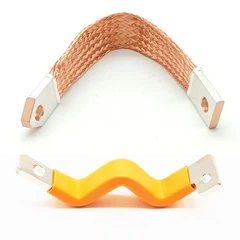
Buses handle continuous, high-current, low-loss transmission, requiring the priority of high-purity copper to ensure stable electrical and thermal performance throughout the copper busbar's lifespan.
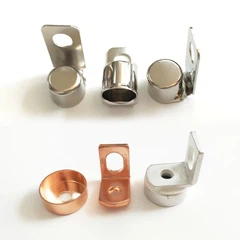
Terminals, on the other hand, are primarily structural and connecting components. While meeting current-carrying requirements, brass or copper can be selected based on the operating conditions.
Application and Connection Instructions for Our Products
Based on the aforementioned material mechanisms and engineering practices, we have long focused on the development and manufacturing of Custom Busbars and high-reliability conductive connection solutions, covering copper ground busbars, positive and negative busbars, and customized solutions for different system platforms.
In the fields of new energy, power distribution, and industrial control, we provide customers with busbar systems that meet the requirements of high current, high voltage, and long-term stable operation. Our services cover a variety of mainstream equipment platforms and application scenarios. We are committed to becoming a trustworthy Copper Busbar Manufacturer and a professional Busbar Manufacturer partner.

contact us

Send Inquiry