










What are the application scenarios for magnetic latching relays?
Apr 17, 2026
Leave a message
A magnetic latching relay is a switching device driven by a pulse signal and maintained by a permanent magnet. Its typical characteristic is a bistable structure: the coil only engages or disengages momentarily when energized, and retains its current state after power is cut off until a reverse pulse signal is received. This zero-static-power-consumption mechanism gives it significant advantages in systems sensitive to energy consumption, requiring state memory, and demanding high interference resistance. Complementary current sensing components, such as the Manganin Shunt Resistor for Current Measurement and the Electricity Meter Shunt, are commonly used to improve the accuracy of system-level energy consumption monitoring and control.

In practical applications, the most mature use cases for magnetic latching relays are in smart meters and energy management systems. By remotely controlling pulse signals to manage the on/off of the power supply to the user side, it can be widely used in prepaid meters and remote fee control systems.
In such systems, the Manganin Shunt for Electricity Meter and Shunt Terminal can be used to accurately acquire current signals, achieving coordinated optimization of metering and control. Simultaneously, since the relay does not consume energy when not in operation, it significantly reduces the energy burden of long-term meter operation. In smart home and building automation systems, magnetic latching relays are primarily used in smart switches, lighting control, and motor drives. Their power-off memory feature ensures the system maintains its original state after a power outage, improving user experience and system stability. In related control modules, shunt structures made of shunt assembly and copper manganese materials are often used for current detection and load monitoring, enabling more refined energy management.
Industrial control and automation are also important applications for magnetic latching relays. In power management of large equipment, backup power switching, and safety interlocking systems, these relays can maintain a predetermined state under grid fluctuations or sudden power outages, avoiding the risk of system malfunctions or restarts. Customizable copper manganese shunt relays and static copper plates with manganese can be used for high-precision current sampling, meeting the stringent stability and reliability requirements of industrial applications.
In automotive electronics, especially in new energy vehicle systems, magnetic latching relays are widely used in battery management systems (BMS) and high-voltage circuit control. Their low-power characteristics help reduce standby power consumption and improve system energy efficiency. In related current monitoring modules, shunt devices manufactured using Manganese Copper Stamping technology provide stable resistance characteristics, ensuring accurate current detection. Furthermore, shunt terminals for magnetic latching relays are commonly used to integrate relay control and current sensing.
In communication equipment and base station systems, magnetic latching relays are primarily used for signal path switching and redundant system control. Since communication equipment typically requires continuous operation for extended periods, its low heat generation, long lifespan, and anti-interference capabilities are key advantages. Combining a shunt terminal with a shunt resistor structure enables real-time monitoring of the equipment's operating current, thereby improving the reliability and predictability of system maintenance.
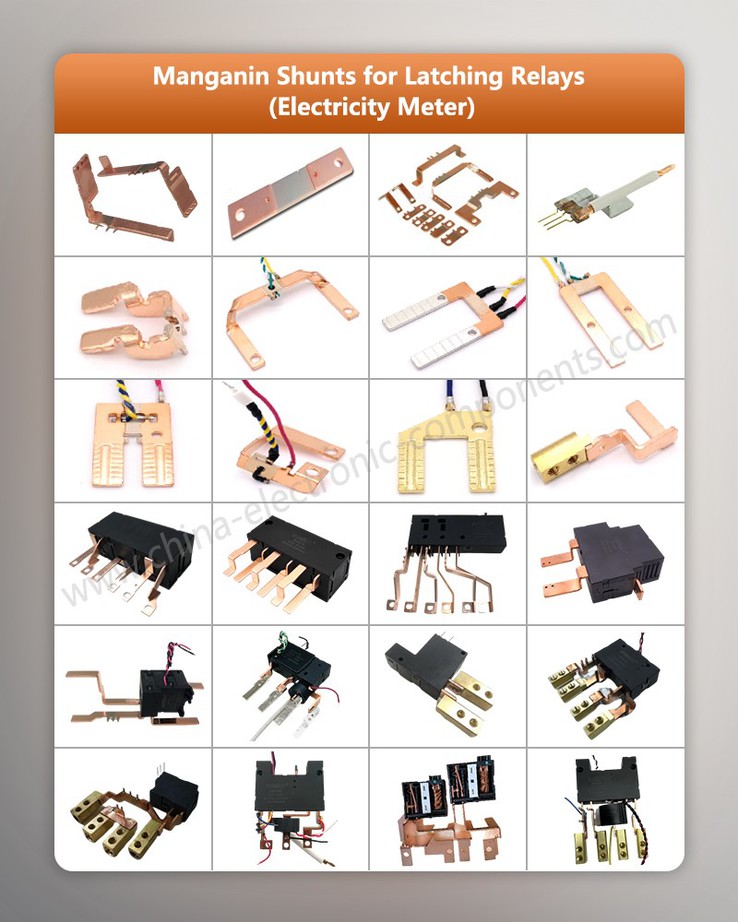
Overall, magnetic latching relays, with their low power consumption, state retention, and strong anti-interference capabilities, hold an irreplaceable position in many high-reliability application scenarios. However, during design and application, it is important to note that their driving method typically employs bidirectional pulse control, placing higher demands on the drive circuitry. Additionally, since the contact position cannot be determined from the coil state after a power failure, external detection circuits or shunt sampling elements are usually required to provide state feedback. Taking into account system energy consumption, control logic, and cost factors, magnetic latching relays remain one of the key basic components in modern power electronics and intelligent control systems.
contact us

Send Inquiry