





Functions and types of busbars
Jan 05, 2026
Leave a message
Definition and Function of Busbars
A busbar is a current-carrying conductor used in power plants, substations, and various power distribution systems to connect generators, transformers, and various electrical equipment. It is a crucial basic conductive unit in a power system, typically taking the form of an Electrical Busbar or Power Busbar.
The core function of a busbar is to collect, distribute, and transmit electrical energy. Through the busbar system, centralized access, flexible distribution, and stable output of multiple power sources can be achieved, making it an important component for ensuring the safe operation and efficient dispatch of the power system.
From a functional structural perspective, a busbar system typically includes primary equipment main busbars, equipment connection busbars, station service AC busbars, DC system busbars, and small busbars in secondary systems. In high-current applications, busbars also serve as important carriers of High Current Connectors and High Current Contacts.
Overview of Busbar Structural Types
From an overall structural perspective, busbars can be divided into three main categories: exposed busbars, enclosed busbars, and insulated busbars. Different structural forms exhibit significant differences in safety, current-carrying capacity, space utilization, and maintenance methods.
Types and Characteristics of Exposed Busbars
Exposed busbars refer to busbars that are directly exposed to the air, secured by air insulation and supporting insulators. They are widely used in traditional power distribution systems.
1. Classification by Material
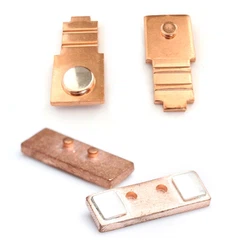
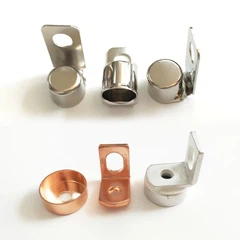
Copper busbars possess excellent conductivity, high mechanical strength, and good corrosion resistance. Typical forms include Copper Busbars and Copper Solid Busbars. Due to the high cost of copper resources, copper busbars are typically used in corrosive environments or locations requiring high current-carrying capacity, such as coastal areas or chemical industrial zones.
Aluminum busbars are lightweight, low-cost, and abundant in resources. Their conductivity is second only to copper, making them widely used in indoor and outdoor power distribution systems. They are one of the most frequently used busbar copper types.
Aluminum alloy busbars mainly include two types: aluminum-manganese alloys and aluminum-magnesium alloys. The former has high current-carrying capacity but relatively low mechanical strength, while the latter has high mechanical strength but poor weldability, limiting its application range. Steel busbars have high mechanical strength but poor conductivity, and are typically used only in low-current, high-voltage, or grounding circuits, such as ground bus bars.
2. Classification by Cross-sectional Shape
Rectangular cross-section busbars are mainly used in 35kV and below power distribution systems. They offer good heat dissipation, low skin effect, and simple installation and connection, making them a common bus bar structure in low- and medium-voltage systems.
Circular cross-section busbars are mostly used in 110kV and above high-voltage outdoor systems. Their main purpose is to suppress corona discharge and improve system stability; they are a typical high-voltage bus bar structure.
Slot-shaped cross-section busbars are suitable for high-current applications, offering uniform current distribution and high metal utilization, making them suitable for systems with high continuous operating current.
Tube-shaped cross-section busbars are mostly used in ultra-high-current systems, possessing good heat dissipation capabilities and high mechanical strength, making them an important form in high-current-carrying bus bar voltage systems.
Stranded flexible busbars are typically composed of multi-strand aluminum wire or steel-cored aluminum stranded wire. Suitable for outdoor high-voltage applications, they can absorb mechanical stress caused by thermal expansion and contraction and are commonly used for connections between generators and substation equipment.

Structural Forms and Characteristics of Enclosed Busbars
Enclosed busbars are busbar systems that completely enclose conductors within a casing. They are widely used in large-capacity generator sets and important power transmission and distribution nodes, and represent an important development direction for modern Busbar Electrical systems.
1. Classification of Enclosed Busbars
Based on the casing material, they can be divided into plastic-cased busbars and metal-cased busbars.
Based on the phase-to-phase structure, they can be divided into non-phase-separated, phase-separated, and phase-separated enclosed busbars. Among these, phase-separated enclosed busbars have an independent metal casing for each phase conductor, offering the highest safety and reliability.
2. Structural Composition of Phase-Separated Enclosed Busbars
Phase-separated enclosed busbars typically consist of current-carrying conductors, supporting insulators, a protective casing, sealing isolation devices, expansion joints, and connecting hardware. Hollow aluminum structures are commonly used for current-carrying conductors to reduce the skin effect; water cooling can be used to enhance current-carrying capacity under ultra-high current conditions.
3. Technical Characteristics of Phase-Separated Enclosed Busbars
Phase-separated enclosed structures significantly reduce the risk of phase-to-phase short circuits and improve operational safety. Simultaneously, the shielding effect of the metal casing greatly reduces external magnetic fields and heat generation from steel components, lowering system losses. This structure is ideally suited for high-power, high-reliability Power Bar BusBar applications.
Its disadvantages include higher material consumption and manufacturing costs, and the potential limitation of current-carrying capacity if the heat dissipation design is inadequate.
Structure and Advantages of Insulated Busbars
Insulated busbars consist of conductors, an integral insulation layer, and a shielding structure. The conductors are completely encased in insulating material, representing a highly integrated busbar system.
Insulated busbars possess full insulation characteristics, and the phase-to-phase distance is no longer limited by voltage levels, significantly reducing installation space. This makes them ideal for compact substations, underground substations, and rail transit systems.
Its modular connection method makes installation more flexible, allowing for adjustments based on site conditions and avoiding current unevenness issues caused by multiple parallel cables. This represents a significant development direction in modern 3-phase busbar systems.
Engineering Significance of Busbars in Modern Power Systems
With the development of new energy sources, electric vehicles, energy storage, and large data centers, higher demands are placed on the current-carrying capacity, safety, and reliability of busbar systems. Whether traditional Electrical Copper Busbars or highly integrated enclosed and insulated busbars, they have become indispensable key components in high-current systems.
From a system integration perspective, busbars are not only conductive units but also crucial structural carriers for connecting equipment, optimizing layout, and improving system efficiency. They possess irreplaceable engineering value in the fields of high-current connections and power distribution.
contact us

Send Inquiry