



Applications and Performance Analysis of Braided Copper Wire in Electrical Systems
May 20, 2026
Leave a message
Braided copper wire is a flexible conductive connector made of multiple strands of fine copper wires woven together using a special process. It is widely used in power systems, new energy equipment, rail transportation, and industrial automation. Due to its excellent conductivity, flexibility, and vibration resistance, braided flexible copper wire has gradually become an important component of modern electrical connection systems, especially suitable for scenarios requiring flexible current conduction and high current transmission.

Braided copper wire typically uses high-purity electrolytic copper as its base material, with a copper content generally reaching over 99.95% to ensure stable conductivity and low resistance loss. In some demanding environments, oxygen-free copper is also used to further reduce impurities and oxidation risks. Depending on the actual application requirements, the product surface can also be tin-plated or silver-plated to improve oxidation resistance, corrosion resistance, and weldability. Common braided copper flexible wire connectors effectively reduce contact heating during long-term operation, improving equipment reliability.
Structurally, braided copper wire mainly forms a mesh conductor structure by cross-weaving multiple strands of copper wire. Compared to traditional rigid copper busbars, copper braided flexible connections offer greater flexibility, adapting to installation requirements in various directions and spatial locations. Under conditions of equipment vibration, thermal expansion, or frequent movement, they effectively buffer mechanical stress, reducing fatigue-induced fractures at connection points. Therefore, they have significant application value in switchgear, circuit breakers, energy storage systems, and power batteries.
Based on the braiding structure, copper braided wires can be divided into two types: plain braid and twill braid. Plain braid structures are generally tighter and suitable for conventional conductive scenarios; twill braid structures offer better flexibility and bending resistance, making them more suitable for connection areas in equipment subject to mechanical vibration or frequent movement. In some large power systems, copper power braids are used as high-current flexible conductors to improve equipment operational stability and conductivity.
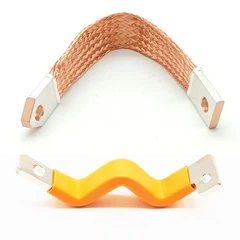
Based on cross-sectional shape, products can also be divided into round and flat structures. Round braided flexible cords offer better bending performance and are suitable for environments with limited space or complex wiring, such as new energy vehicle battery module connections and rail transit onboard systems. Flat structures offer a larger contact area and higher heat dissipation efficiency, making Flat Copper Braided Flexible Connectors commonly used for high-current busbar connections, transformer current conduction systems, and internal conductive connections in power distribution equipment.
Regarding surface treatment, bare copper products offer high cost-effectiveness, but are prone to oxidation when exposed to humid environments for extended periods. Tin-plated products effectively improve oxidation resistance and solderability; therefore, Braided Tin Coated Copper Flexible Wire Connectors are widely used in new energy equipment, outdoor electrical systems, and internal connections in energy storage devices. For applications requiring high frequency, high precision, or high reliability, silver plating is employed to further enhance conductivity stability and corrosion resistance.
One of the key advantages of copper braided wires is their excellent conductivity. The multi-strand fine copper wire structure effectively reduces the skin effect at high frequencies, resulting in more uniform current distribution, thus reducing energy loss and temperature rise. Simultaneously, the mesh structure of Flexible Copper Braided Electrical Connectors facilitates airflow, further improving heat dissipation efficiency and preventing performance degradation due to prolonged high-load operation.
Flexibility is another key characteristic that distinguishes copper braided wires from traditional rigid connectors. Compared to fixed copper busbars, flexible copper braided connectors can adapt to micro-displacements, vibrations, and thermal expansion and contraction during equipment operation, making them widely used in energy storage systems, battery packs, motor connections, and high and low-voltage switchgear. Especially in new energy vehicles and charging systems, flexible copper braided connectors can improve the safety and stability of the connection system while ensuring high current transmission capacity.
In the modern new energy industry, copper braided wires have become one of the key conductive components. For example, the positive and negative terminal connections inside energy storage battery packs, the connections of high-power charging pile modules, and the current conduction systems of power batteries all require connection solutions with high flexibility and high current-carrying capacity. Some systems adopt a flexible busbar and copper jumper structure to achieve flexible high-current conduction between devices while reducing installation stress and maintenance difficulty.
Furthermore, copper braided wires also play an important role in industrial welding equipment, rail transportation, power transmission and distribution systems, and medical equipment. Round braided straight flexible cords are commonly used for flexible wiring inside complex equipment, while braided copper flexible connectors are suitable for high-current connections inside transformers, generators, and high and low voltage cabinets. Due to their excellent fatigue resistance, they maintain stable conductivity even under long-term vibration and frequent operation.

In practical selection, key factors to consider include current carrying capacity, operating environment, flexibility requirements, and connection method. Different cross-sectional areas determine the range of operating currents they can handle, while tin-plated or specially insulated products should be prioritized for humid, high-temperature, or corrosive environments. For applications involving prolonged bending or vibration, products with higher braid density are recommended to improve overall mechanical life and operational reliability.
With the development of new energy, power automation, and high-end equipment manufacturing industries, the importance of flexible conductive connection technology continues to increase. With its high conductivity, good flexibility, excellent heat dissipation, and stable vibration resistance, copper braided wire has become an irreplaceable and essential component of modern electrical connection systems and will continue to play a crucial role in high-power, high-reliability conductive scenarios.
contact us

Send Inquiry