



Analysis of the structural features, performance advantages and applications of copper braided wire connectors
Jun 22, 2026
Leave a message
In modern power systems, new energy equipment, and industrial automation, flexible conductive connectors play an increasingly important role. Among them, copper braided wire connectors, with their excellent conductivity, good flexibility, and reliable mechanical strength, have become indispensable key conductive components in many electrical devices.

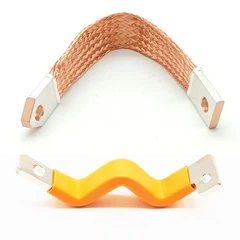
Copper braided wire connectors are typically made of multiple strands of fine copper wire processed using a special braiding technique. Depending on the application requirements, they can be manufactured using bare copper, tin-plated copper, or silver-plated copper materials. In the industry, they are often referred to as Braided Wire Flexible Copper, Braided Copper Flexible Wire Connectors, or Flexible Copper Braided Connectors. Compared to traditional rigid conductors, these products combine excellent current-carrying capacity with flexible connection characteristics, effectively solving problems such as equipment vibration, thermal expansion, and limited installation space.
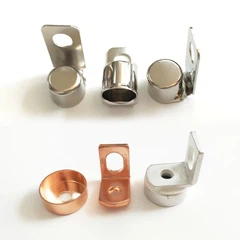
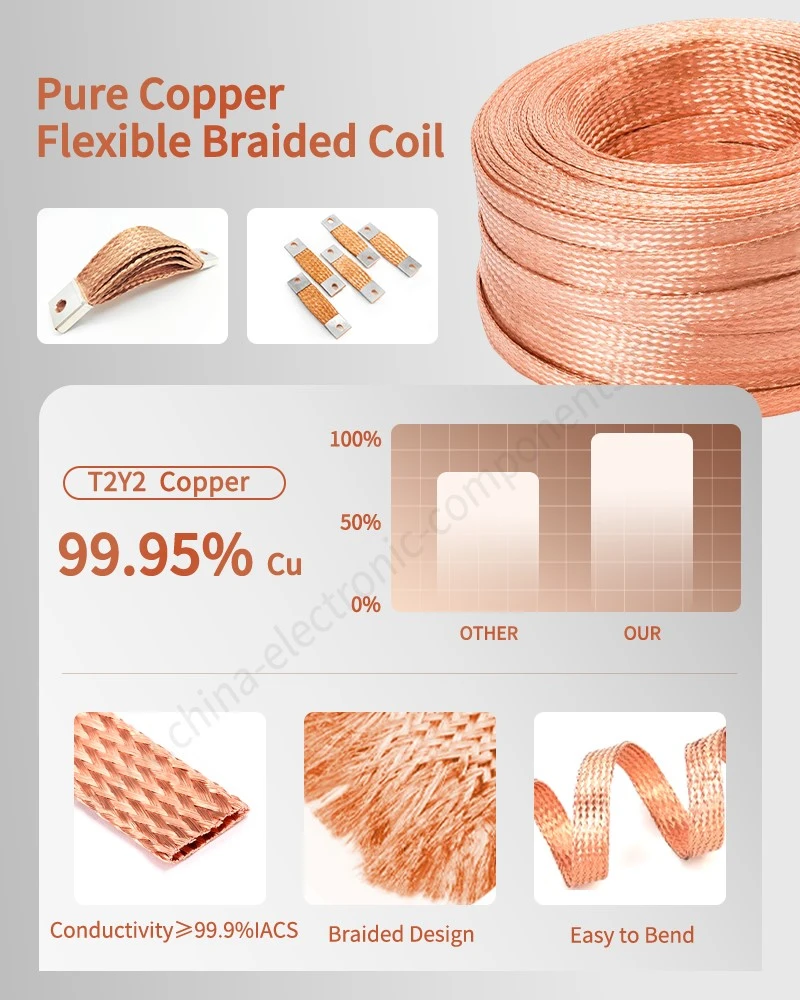
Structurally, copper braided wire consists of a large number of fine copper wires interwoven to form a mesh structure. Both ends are usually crimped with copper terminals or copper tubes to achieve a reliable connection with busbars, circuit breakers, switchgear, or conductive components in power systems. Depending on installation requirements, they can be designed in circular, flat, or irregular shapes. Among them, round structure products are often referred to as Round Braided Flexible Cords or Round Stranded Flexible Cords, while flat structures are widely used in high-current connection scenarios and are called Flat Copper Braided Flexible Connectors.
Conductivity is one of the important indicators for evaluating copper braided wires. Copper itself has extremely high conductivity, second only to silver, so copper-based copper-stranded flexible connections can meet current transmission requirements ranging from tens to thousands of amperes. For high-power equipment, stable conductivity not only reduces line losses but also effectively reduces system heat generation, improving overall operating efficiency.
In addition to excellent conductivity, flexibility is also a significant advantage of copper braided wires. Compared to traditional copper busbars or rigid conductors, braided structures can withstand repeated bending, torsion, and vibration without easily breaking. Therefore, in generators, transformers, motor control systems, and new energy battery systems, Flexible Copper Braided Electrical Connectors are often used to absorb mechanical displacement and vibration stress during equipment operation, thereby extending the service life of the connection system.
In special environments, tin-plated copper braided wires are particularly widely used. By forming a uniform tin layer on the surface of the copper wire, oxidation resistance and corrosion resistance can be significantly improved. These products are often referred to as Braided Tin Coated Copper Flexible Wire Connectors or Braided Tin Coated Copper Flexible Connectors, and are suitable for industrial environments with high humidity, salt spray, or the presence of slightly corrosive gases.

Heat dissipation is also a crucial characteristic of copper braided wires. Due to the numerous airflow channels formed within the braided structure, its heat dissipation area is much larger than that of a solid conductor of the same cross-sectional area. When a large current passes through, heat can be released more quickly, thereby reducing conductor temperature rise and improving system safety. Therefore, many high-current conductive systems use copper power braids as critical connection components.
In terms of application areas, copper braided wire connectors are widely used in power transmission and distribution equipment, switchgear, control cabinets, new energy vehicles, battery energy storage systems, charging equipment, and rail transportation industries. In busbar systems, flexible busbars and copper jumpers enable flexible transition connections between rigid conductors, effectively compensating for the effects of installation errors and thermal expansion and contraction.
The new energy industry is one of the fastest-growing application areas for copper braided wires. Braided copper flexible connectors and flexible copper braid connectors are widely used as positive and negative conductive connections within power batteries, battery pack busbar systems, and energy storage cabinets. These flexible connectors can withstand continuous high-current surges and adapt to vibrations generated during vehicle operation or equipment operation.
In industrial automation equipment, the frequently moving mechanical structures place higher demands on conductive connectors. Compared to ordinary wires, flexible conductors with a round, braided, straight flexible cord structure have better fatigue resistance and can maintain stable conductivity under long-term repeated bending conditions. Therefore, they are widely used in welding equipment, lifting equipment, and automated production lines.
Proper selection is crucial for ensuring the safe operation of the system. When selecting copper braided connectors, factors such as current-carrying capacity, operating temperature, installation space, vibration frequency, and environmental corrosion level need to be comprehensively considered. Key parameters such as braiding density, copper wire diameter, terminal structure, and connection process should also be considered to ensure that the product meets long-term operational requirements.
Overall, copper braided connectors combine multiple advantages, including high conductivity, excellent flexibility, good heat dissipation, and strong fatigue resistance. With the continuous development of new energy, power electronics, and intelligent manufacturing industries, the importance of flexible conductive connection technology will be further enhanced, and copper braided wire products will play a more critical role in the field of high-reliability electrical connections.
contact us
Send Inquiry