



Analysis of High-Voltage Contact Systems in New Energy Vehicles: The Critical Role of DC Contactors
Jul 02, 2026
Leave a message
As new energy vehicles (NEVs) continue to evolve toward high-voltage platforms-ranging from 400V and 800V to even 1000V-the requirements for the safety and reliability of the vehicle's electrical system have risen significantly. Against this backdrop, high-voltage DC contactors serve as core control components; they perform the critical functions of switching high-voltage circuits and ensuring safety isolation, effectively operating as a key element of high-reliability electrical contact systems.

Nature and Function of High-Voltage DC Contactors
High-voltage DC contactors can be understood as electromagnetic switching devices designed to operate under conditions of high voltage and high current; their primary task is to safely connect and disconnect power circuits. While standard relays suffice for low-voltage systems, high-voltage NEV systems require specialized devices featuring reinforced insulation structures and arc-extinguishing capabilities.
From a system perspective, their operational logic represents an extension of solid contact control principles-specifically, achieving low-loss, highly stable current switching through the synergy of highly conductive materials and mechanical structures.
Furthermore, within the circuit design, these devices act as critical nodes in the electrical contact system, directly influencing the vehicle's energy transmission efficiency and safety limits.
Internal Structure and Operating Mechanism
High-voltage DC contactors primarily consist of a coil, an armature, a contact system, and an arc-extinguishing structure. Their operation relies on electromagnetic actuation principles:
Energizing the coil generates a magnetic field that drives the mechanical structure.
The armature moves to close or open the contacts.
The arc-extinguishing system suppresses the electric arc the moment the circuit is broken.
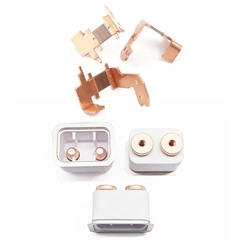
Contact system designs often incorporate various structural forms to accommodate different current ratings and service life requirements.
For instance, standard solid contact structures prioritize mechanical strength and conductivity stability, whereas high-reliability applications often rely on composite contact designs.
Contact Materials and Conductivity
In high-voltage DC systems, contact materials directly determine the device's service life and breaking capacity. Common material systems include silver-based and copper-based alloys, with the primary goal of balancing electrical conductivity against resistance to arc erosion.
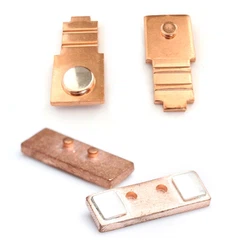
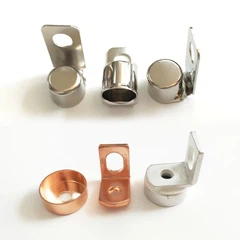
In high-end applications, pure silver contacts are widely used at critical conductive interfaces due to their excellent conductivity, while silver alloy contacts utilize alloying to enhance wear resistance and resistance to contact welding. In precision structures, solid silver contact rivets are employed to enhance mechanical connection stability, ensuring reliability during frequent, long-term operation.
Additionally, silver contact points are typically used in critical conductive contact areas to minimize contact resistance and improve energy transmission efficiency.

Arc Control and Safety Design
High-voltage DC systems generate intense arcs at the moment of disconnection-a critical factor affecting safety. Consequently, the arc-extinguishing system serves as a core design module.
In this process, silver electrical contact materials are utilized to enhance arc resistance and conductivity stability, minimizing material loss due to ablation through material optimization.
Meanwhile, under high-frequency switching conditions, electrical spring contact structures provide stable contact pressure, ensuring consistent contact resistance over the long term.
In complex operating environments, the application of silver contact systems significantly improves the system's thermal stability and electrical lifespan.
Performance Metrics and Engineering Requirements
The performance of high-voltage DC contactors is primarily determined by the following parameters:
Rated voltage and current capacity
Short-term overload capacity
Breaking the current capacity
Electrical and mechanical lifespan
Regarding system protection, the stability of the electrical contacts directly determines the high-voltage safety boundaries of the vehicle.
Furthermore, silver alloy contacts demonstrate superior resistance to contact welding in scenarios involving high surge currents, thereby enhancing overall system reliability.
Application Systems and Typical Scenarios
In the high-voltage systems of new energy vehicles, these components are widely used in traction battery circuits, charging systems, and auxiliary energy management systems.
Within battery management systems, they handle main circuit control and pre-charge protection; in charging systems, they manage the switching of charge/discharge paths and fault isolation.
In these complex applications, electrical contacts serve not only as conductive elements but also as critical execution points for system safety strategies.
Additionally, electrical contact switch structures facilitate logic switching across multiple circuits within system-level controls, enhancing energy management flexibility.

Development Trends
With the widespread adoption of 800V and higher voltage platforms, high-voltage DC contactors, Solid Silver Contacts are evolving toward miniaturization, higher reliability, and extended service life. Continuous optimization of material systems, arc-extinguishing structures, and contact manufacturing processes ensures stable performance even under extreme operating conditions.
Looking ahead, high-voltage contact technology will continue to evolve around high energy density and robust safety redundancy, establishing itself as an indispensable core component of electric drive systems for new energy vehicles.
contact us

Send Inquiry