



Advantages and Applications of Aluminum Wire in Automotive Systems
Feb 06, 2026
Leave a message
Automotive wiring harnesses are often referred to as the "blood vessels and nervous system" of a vehicle, covering functions such as power transmission, signal control, and system communication. They are indispensable and high-value key components in a vehicle. With the continuous improvement of vehicle electrification and intelligence, the quantity, length, and complexity of wiring harness systems in vehicles are constantly increasing, and their weight proportion has reached nearly 5% of the total vehicle weight, showing a further upward trend. Against the backdrop of carbon neutrality and lightweighting, weight reduction and cost reduction of wiring harness systems have become one of the important directions in vehicle development, which provides a practical basis for the application of aluminum wires in the automotive field.

Driving Forces for the Application of Aluminum Wires in Automotive Systems
Traditionally, automotive wiring harnesses have long used copper wires as the standard conductor material. Copper possesses good electrical conductivity, thermal conductivity, and mechanical properties, and its processing technology is mature. However, in recent years, copper prices have fluctuated continuously and remained at a high level, significantly increasing the cost pressure on wiring harness systems. At the same time, the high dependence on imported copper resources and the significant influence of international market prices are detrimental to long-term stable cost control.
In comparison, aluminum, as a metal with conductivity second only to copper, boasts advantages such as low density, abundant resources, and relatively stable prices. Through proper wire diameter design, aluminum wires can achieve significant weight reduction while meeting the overall vehicle electrical performance requirements. Even after effectively increasing the cross-sectional area, aluminum wires can still achieve an overall weight reduction of approximately 30%, resulting in a comprehensive cost reduction of about 30%–35% in material costs. This characteristic makes aluminum wires a growing alternative to copper wires in low-voltage wiring harnesses and some high-power circuits, aligning perfectly with the goal of vehicle lightweighting.
Selection Principles for Aluminum Wires in Automotive Wiring Harnesses
The selection of aluminum wires is not simply a material replacement for copper wires; it must be based on the principle of equivalent electrical performance. During the design phase, key parameters such as conductivity, current carrying capacity, temperature rise characteristics, and derating curves must be carefully considered to ensure that the protection strategy and safety boundaries of the vehicle's circuitry remain unchanged after the conductor material is replaced.
In the current industry standard system, copper wires are mainly based on ISO 6722-1, while aluminum wires follow ISO 6722-2. In practical applications, aluminum wires typically compensate for their higher resistivity by increasing the cross-sectional area, and combined with system-level verification, ensure their long-term stability under different operating conditions. This selection logic also laid the engineering foundation for the subsequent introduction of aluminum busbars in power distribution systems.

Major Problems Faced in the Application of Aluminum Wires
Introducing aluminum wires into automotive wiring harness systems first requires addressing the material compatibility issue between different metals. The difference in electrochemical activity between aluminum and copper can create an electrochemical corrosion environment when electricity is applied and moisture or impurities are present, leading to increased contact resistance, overheating at the connection points, and reliability risks.
Secondly, aluminum and copper have significant differences in their coefficients of thermal expansion. Under vehicle thermal cycling and long-term vibration conditions, micro-gaps may gradually form in the connection area, affecting electrical performance and weakening mechanical strength.
Furthermore, a dense oxide film easily forms on the aluminum surface. While this oxide layer protects the substrate, its conductivity is poor. Improper handling will directly affect the reliability of the contact between the terminal and the wire.
Engineering Solutions for Aluminum Wire Connection Problems
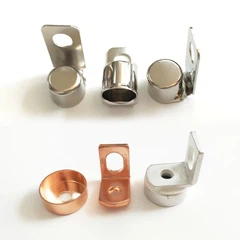
To address the above problems, the industry has gradually formed a solution path centered on the synergy of structure and process. Among them, copper-aluminum composite terminals manufactured using friction welding have become one of the mainstream solutions. This structure forms a stable copper-aluminum transition layer inside the terminal, effectively isolating the electrochemical reaction path and significantly reducing the risk of metal creep.
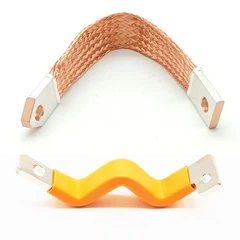
At the wire end, the aluminum wire is usually connected to the aluminum end of the terminal via hydraulic crimping. Under high pressure, the surface oxide film is destroyed, forming a reliable cold weld structure between metals, thus simultaneously meeting the requirements of electrical performance and mechanical holding force. This type of connection method has been widely used in the low-voltage wiring harness field and is gradually expanding to some high-power circuits, which is highly consistent with the engineering concept of Aluminum Flexible Connections.
Development Trends of Mainstream Connection Processes
In the application of large-section aluminum wires, the two main technical routes currently used are four-sided crimping and ultrasonic welding. Four-way crimping achieves material consistency through an aluminum-to-aluminum structural design, balancing low contact resistance and long-term stability. Ultrasonic welding, on the other hand, utilizes high-frequency vibration to break down the oxide layer, creating a dense alloy transition zone between the aluminum conductor and the copper terminal, suitable for scenarios with higher space and reliability requirements.
As vehicle layout space becomes increasingly limited, simply increasing wire diameter also carries the risk of wiring interference. Therefore, the industry has begun exploring copper-aluminum hybrid application solutions, using copper conductors in space-constrained areas and introducing aluminum conductors in space-allowed sections, achieving a balance between performance and lightweighting at the system level.

Application Directions of New Structures and Materials
In addition to traditional round wire structures, soft aluminum flat cables and flat conductor designs are gradually entering the engineering verification stage. Solid aluminum flat wire structures can significantly reduce height occupation while maintaining current carrying capacity, better conforming to the vehicle body structure, and providing greater freedom for wiring harness layout. This type of structure shares the design logic of aluminum flat busbars and also provides a new direction for the modularization and integration of future wiring harness systems.
In the field of new energy vehicles, high-voltage systems are more sensitive to conductor weight and efficiency. If high-voltage wiring harnesses rely on copper conductors in the long term, it will significantly constrain the overall vehicle quality and cost. Therefore, research on high-voltage applications using high-conductivity aluminum alloys such as 6101 and 6061 aluminum bus bars is becoming a key focus of the industry.

Industry Development Trends and Application Prospects
With the increasing penetration rate of new energy vehicles, the trends of high voltage and electrification are becoming increasingly clear. Weight reduction and cost reduction in wiring harness systems will directly affect the energy efficiency and range performance of the entire vehicle. The mature application of aluminum conductors in low-voltage wiring harnesses has laid an engineering foundation for its extension to high-voltage systems. In the future, through material optimization, connection process upgrades, and system-level design collaboration, aluminum conductors and aluminum bus bar structures will play a more central role in the vehicle's electrical architecture.
Conclusion
In summary, aluminum conductors in the automotive industry have gradually moved from the proof-of-concept stage to large-scale application. Their advantages in weight reduction, cost reduction, and resource sustainability are highly compatible with the development direction of new energy vehicles. With the continuous maturation of connection technologies and structural designs, aluminum conductors and related conductor solutions will play an increasingly important role in the vehicle's electrical system.
About Our Product Connections
Based on the development needs of automotive electrification and high-power electrical systems, we focus on the design and manufacturing of highly reliable conductors and connection solutions, covering Aluminum Busbars, Customized Aluminium Busbars, and various Flexible Aluminium Connections. We provide customized support according to different current levels and installation space, helping vehicle wiring harnesses and power distribution systems achieve a better balance between lightweight design and safety.
contact us

Send Inquiry