







Upgrades in Laminated Busbar Technology Are Driving Solar-plus-storage And Power Electronics Systems Toward Higher Reliability.
Oct 13, 2026
Leave a message
With the rapid development of new energy applications-such as photovoltaic (PV) power generation, energy storage systems, and new energy vehicles-power electronic equipment is evolving toward higher power density, higher switching frequencies, and greater reliability. Amidst this evolution, the laminated busbar-a critical component connecting power devices to the power system-has increasingly become a key factor influencing overall system performance.
Historically, industry attention focused primarily on core equipment aspects such as PV module conversion efficiency, battery cycle life, and inverter topology design, while the busbar systems connecting electrical circuits were often overlooked. However, in environments characterized by high-frequency switching and high-current transmission, busbars do more than just transmit electrical energy; they directly impact system losses, electromagnetic compatibility (EMC), and the operational stability of power devices.

Laminated Busbars: A Key Interconnect Solution for High-Power Electronic Systems
Traditional copper busbars rely on simple metal conductors for current transmission, which suffices for low-frequency applications. However, the advent of power semiconductor devices like IGBTs and SiC has driven up switching speeds, causing parasitic parameters inherent in traditional structures to interfere with system operation.
During high-speed switching, the busbar's inherent stray inductance can generate transient voltage spikes as the current changes. If these spikes exceed the voltage rating of the power devices, they can cause device damage or compromise system reliability.
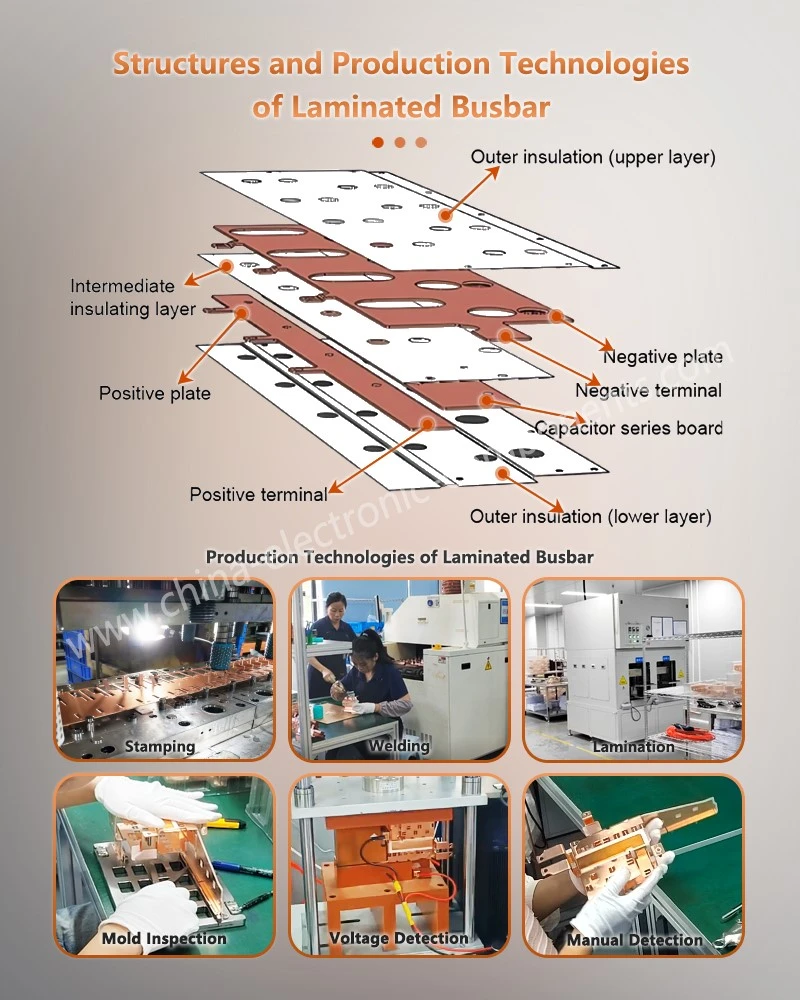
Laminated busbars address this by layering positive and negative conductors in a specific configuration, utilizing the magnetic field cancellation effect between adjacent conductors to effectively reduce loop inductance. Consequently, laminated busbars have become vital interconnect components in energy storage converters, industrial power supplies, and new energy power equipment.
Compared to traditional busbars, the laminated structure shortens the current loop and optimizes current path distribution, resulting in lower parasitic inductance and more stable electrical performance.
Low Stray Inductance Enhances Power System Operational Stability
In high-power electronic equipment, stray inductance is a critical factor affecting the safe operation of switching devices. While traditional parallel busbars typically exhibit high stray inductance, optimized laminated busbar designs can keep stray inductance at significantly lower levels. Low-inductance designs effectively mitigate voltage overshoot during the turn-off phase of power devices, thereby reducing voltage stress and extending the service life of IGBTs, MOSFETs, and wide-bandgap semiconductor devices.
Additionally, by optimizing conductor layout, laminated busbars ensure more uniform current distribution, mitigating temperature rises caused by localized current concentration. In continuous-operation scenarios-such as energy storage systems, industrial inverters, and charging equipment-this structural advantage helps maintain stable thermal performance.
For instance, in high-power conversion equipment, a motor controller busbar featuring a low-inductance design can minimize interconnection losses between power modules, enhance energy conversion efficiency, and meet the demands of long-term operation.
Multilayer composite structures improve electromagnetic compatibility (EMC)
Beyond reducing inductance, laminated busbars offer significant advantages regarding electromagnetic compatibility.
High-speed switching in power electronics generates substantial di/dt and dv/dt transients, which can easily trigger electromagnetic interference (EMI). Poor busbar design can increase system noise and compromise the stability of control signals.
By tightly stacking positive and negative conductors, laminated busbars reduce the current loop area and minimize magnetic field radiation, thereby improving the system's EMI performance. This is particularly critical for telecommunications equipment, power modules, and precision electronics.
In sectors such as data centers, telecommunications base stations, and industrial control, a stable power distribution system is vital for continuous equipment operation. Consequently, specialized products-such as laminated busbars for telecom power distribution-are increasingly being adopted in high-reliability power systems.
Laminated busbar design requires a holistic approach to materials and manufacturing processes
While laminated busbars are characterized by low inductance and high reliability, their design and manufacturing necessitate a comprehensive evaluation of electrical performance, mechanical structure, and thermal management requirements.
First, the design of the insulation layer is a crucial factor influencing busbar performance. Precisely controlling the spacing between layers allows for a reduction in electrical loop length while maintaining insulation safety. Common insulation materials include PET, PI, PVC, epoxy resins, and other high-temperature-resistant materials; the specific choice depends on operating voltage and ambient temperature conditions. Secondly, conductor materials typically feature high-conductivity copper-such as T2 oxygen-free copper or C1100-to meet the demands of high-current transmission. Additionally, depending on the operating environment, tin, nickel, or silver plating may be applied to enhance corrosion resistance and connection reliability.
Furthermore, the manufacturing quality of the connection zones directly impacts system performance. Connections between the busbar and components such as power modules, capacitors, and other electrical units require strict control over contact resistance, mechanical strength, and long-term reliability.
For applications such as industrial power supplies, energy storage systems, and rail transit, specialized busbars-including those designed for train power supplies and four-quadrant power modules-must meet rigorous standards regarding vibration resistance, thermal stability, and electrical performance.
New Energy and Industrial Equipment Drive the Evolution of Laminated Busbar Technology
As the new energy sector expands, demand for high-performance busbars continues to rise across energy storage systems, photovoltaic inverters, electric vehicles, and industrial automation equipment.
Looking ahead, laminated busbar technology will increasingly evolve toward higher levels of integration, lightweight design, and intelligent functionality.
On one hand, the growing adoption of wide-bandgap semiconductor devices (such as SiC and GaN) and rising operating frequencies necessitate busbar designs with lower inductance. On the other hand, optimizing structural designs to integrate functions like capacitance, current sensing, and temperature monitoring directly into the busbar system facilitates smarter power management.
In servers, power electronics, and high-density power systems, space utilization and thermal dissipation are critical metrics. Consequently, highly integrated products-such as laminated busbars for rack-mount power distribution-are becoming a preferred choice for compact power architectures.

Laminated Busbars Enable the Construction of Highly Reliable Future Energy Systems
From solar-plus-storage systems and electric vehicles to industrial inverters and telecommunications power supplies, laminated busbars play a vital role in energy transmission and secure connectivity, even if they are not the system's core functional components.
As power electronics technology advances toward higher frequencies, voltages, and currents, busbar design has evolved beyond simple conductive interconnection; it is now a critical engineering factor that influences system efficiency, stability, and service life. In the future, high-performance laminated busbars will play an increasingly vital role across sectors such as new energy, power equipment, rail transit, data centers, and industrial control, providing stable electrical connection solutions for highly reliable energy systems.
When selecting busbars, manufacturers of new energy equipment, power system integrators, and engineering procurement teams must comprehensively consider factors such as rated current, voltage rating, installation space, insulation requirements, and the application environment.
By providing laminated busbar drawings for telecom power distribution, electrical parameters, and application specifications, specialized busbar manufacturers can assist with structural design optimization, material selection, and the alignment of mass production plans, ensuring that the products meet the performance and delivery requirements of specific projects.
contact us

Send Inquiry