




Technical Analysis Of Prismatic Aluminum-Cased LFP Cells: Structural Advantages And Selection Criteria For Energy Storage And New Energy Vehicle Applications
Oct 12, 2026
Leave a message
With the development of new energy vehicles, industrial and commercial energy storage, and power regulation systems, battery systems face increasingly stringent requirements regarding safety, cycle life, space utilization, and long-term operational stability. Among the various packaging formats for lithium-ion batteries, prismatic aluminum-cased lithium iron phosphate (LFP) cells have emerged as a key technological pathway in the energy storage and new energy vehicle sectors, thanks to their mature material systems, stable structural designs, and superior safety performance.
As the core unit of a battery system, a cell's performance depends not only on its cathode and anode materials and electrolyte system but also on the combined influence of its packaging structure, thermal management design, and manufacturing processes. In engineering applications, capacity is merely a baseline reference; the cell's stable performance under varying discharge rates, temperatures, and cycling conditions is the critical factor determining system reliability.

Working Principles and Structural Characteristics of Prismatic Aluminum-Cased LFP Cells
The operation of lithium iron phosphate (LiFePO₄) cells relies on the reversible migration of lithium ions between the cathode and the anode. During charging, lithium ions de-intercalate from the cathode material, move through the electrolyte to the anode, and intercalate into the graphite structure; during discharging, the ions return to the cathode, releasing electrical energy in the process.
LFP cathode materials feature a stable olivine crystal structure that undergoes minimal change during charge-discharge cycles, resulting in excellent thermal stability and a long cycle life. Compared to certain high-nickel ternary material systems, LFP materials offer greater safety margins under conditions of high temperature, overcharge, and mechanical damage.
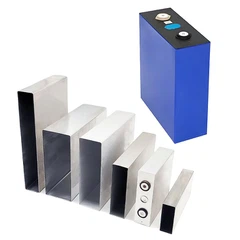
The prismatic aluminum-cased structure is a prominent design format for this type of cell. The aluminum casing provides high mechanical strength to protect the internal electrode assembly while facilitating internal heat transfer and enhancing the cell's overall heat dissipation capability. Many energy storage cells currently on the market utilize this prismatic aluminum-cased LFP structure, achieving a balance among safety, structural integrity, and space utilization by combining the aluminum housing with the internal cell components.
Structurally, a prismatic aluminum-cased cell primarily consists of a cathode, an anode, a separator, an electrolyte, electrode tabs, and the external aluminum casing. Compared to traditional pouch structures, aluminum-cased cells offer superior crush resistance and effectively mitigate the risk of dimensional changes caused by internal gas accumulation during long-term cycling.

Safety and Longevity Advantages of the Lithium Iron Phosphate (LFP) Chemistry
Safety is a critical factor when selecting battery cells for energy storage and new energy vehicle applications. Thanks to the stability of their phosphorus-oxygen bonds and high thermal decomposition temperatures, LFP materials reduce the likelihood of thermal runaway under abnormal conditions.
Furthermore, LFP cells typically demonstrate excellent cycle life. With appropriate charge-discharge strategies and temperature control, their cycle life meets the long-term operational requirements of energy storage systems. Consequently, this chemistry has become the core cell solution for many industrial and commercial energy storage systems, grid-scale storage projects, and certain new energy vehicle platforms.
For energy storage equipment requiring long-term operation, cells must not only meet capacity requirements but also maintain a stable capacity degradation profile. For instance, system designs utilizing LiFePO4 (LFP) cells often prioritize cycle life, safety margins, and total lifecycle costs over simply maximizing initial energy density.
Impact of Aluminum Casing on Cell Performance
The cell packaging structure directly influences mechanical reliability, thermal management capabilities, and system integration methods. Compared to cylindrical cells, prismatic aluminum-cased cells offer higher space utilization, reducing dead space within battery modules and enhancing overall system integration efficiency.
In power batteries for new energy vehicles and energy storage systems, the aluminum casing serves not only as a protective shell but also as an integral component of the thermal management design. Optimized casing thickness, stamping precision, and sealing structures help minimize the impact of the external environment on the internal cells.
Currently, some high-performance battery systems employ aluminum alloy casing solutions-such as those used for prismatic and cylindrical cells-leveraging high-strength materials and precision forming processes to enhance structural stability.
Aluminum casing manufacturing involves multiple processes, including deep drawing, stamping, cleaning, surface treatment, and dimensional inspection. Notably, the deep-drawing process requires precise control over material flow, wall thickness uniformity, and forming stresses; failure to do so can compromise casing strength and sealing reliability. For instance, deep-drawn aluminum battery casings must meet the requirement of withstanding long-term internal pressure fluctuations while maintaining a lightweight profile.
Technical comparison of prismatic aluminum-cased cells versus other packaging formats
Lithium-ion batteries currently come in three main packaging formats: cylindrical, pouch, and prismatic.
Cylindrical cells offer high standardization and manufacturing maturity, yet assembling multiple individual cells requires complex interconnect structures and spatial management.
Pouch cells are lightweight and offer flexible shape design, but they provide relatively weak external protection, necessitating additional structural components for safety.
Prismatic aluminum-cased cells combine structural strength with efficient space utilization, making them particularly suitable for energy storage and new energy vehicle applications that demand high safety, long cycle life, and high system integration.
For large-scale energy storage systems, the use of aluminum casings for individual lithium-ion cells facilitates module design and maintenance, as well as the layout of thermal management systems.

Engineering factors to consider during cell selection
In practical applications, cell selection cannot rely solely on capacity parameters; it requires a comprehensive evaluation of multiple engineering factors.
First, the cell's voltage plateau must match the system architecture. Lithium iron phosphate (LFP) systems typically have a nominal voltage of around 3.2V; in actual applications, series and parallel configurations must be designed based on the battery pack's voltage level.
Second, rate capability is a key consideration. Certain energy storage and motive power applications require high charge/discharge capabilities; however, higher rates increase internal heat generation, necessitating a comprehensive assessment that accounts for heat dissipation structures, internal cell resistance, and the operating environment.
Third, the control strategy of the Battery Management System (BMS) must be considered. Precise monitoring of voltage, current, and temperature is essential for ensuring the long-term, stable operation of the cells.
Furthermore, the cell casing material and manufacturing precision impact overall reliability. For example, aluminum casings for prismatic LFP cells must meet strict requirements regarding dimensional consistency, sealing performance, and mechanical strength to accommodate large-scale automated assembly.
Development trends for prismatic aluminum-cased cells in energy storage and new energy vehicles
As the new energy industry continues to evolve, battery systems are advancing toward higher safety, reliability, and integration. In the energy storage sector, battery cells must withstand years of continuous operation; consequently, long cycle life, low maintenance requirements, and stable performance are critical metrics. Thanks to their high safety profile and mature manufacturing ecosystems, prismatic aluminum-cased LFP (Lithium Iron Phosphate) cells are well-suited for applications such as industrial and commercial energy storage, grid peak shaving, and backup power for telecommunications.
In the new energy vehicle (NEV) sector, battery systems prioritize energy efficiency, spatial layout, and structural safety. As battery pack integration technology evolves, the combination of aluminum-cased cells with lightweight structural designs will further enhance vehicle range and reliability.
Looking ahead, as battery manufacturing processes continue to improve, various packaging technologies-such as pouch cells and aluminum-cased cells-will continue to complement one another in the NEV market, while the prismatic aluminum-cased LFP system will maintain a pivotal role in safety-critical applications.
Simultaneously, driven by trends toward lightweighting, high-precision forming, and automated manufacturing, aluminum shell components for lithium-ion cells will undergo continuous optimization to meet the demands for reliable connectivity and long-term operation in next-generation power batteries and energy storage systems.
Engineering Procurement and Selection Recommendations
For manufacturers of NEVs, energy storage systems, and power electronics, selecting battery cells and related aluminum shell components requires a comprehensive evaluation of material properties, dimensional precision, batch consistency, and supply chain stability. During the project development phase, it is recommended to focus on verifying the shell material system, stamping capabilities, sealing reliability, dimensional tolerance control, and the capacity for long-term mass delivery.
If you are developing energy storage battery modules, NEV battery packs, or related structural components-and require custom high-precision aluminum shells, metal stamped parts for cells, or integrated structural solutions-please provide product drawings, material specifications, and application environment parameters. Consulting with a professional manufacturing team will enable you to obtain engineering solutions that meet mass production requirements.
contact us

Send Inquiry