




EBW Manganin Shunt: Engineering Application Of Electron Beam Welding in The Manufacturing Of Manganin Shunts
Oct 02, 2026
Leave a message
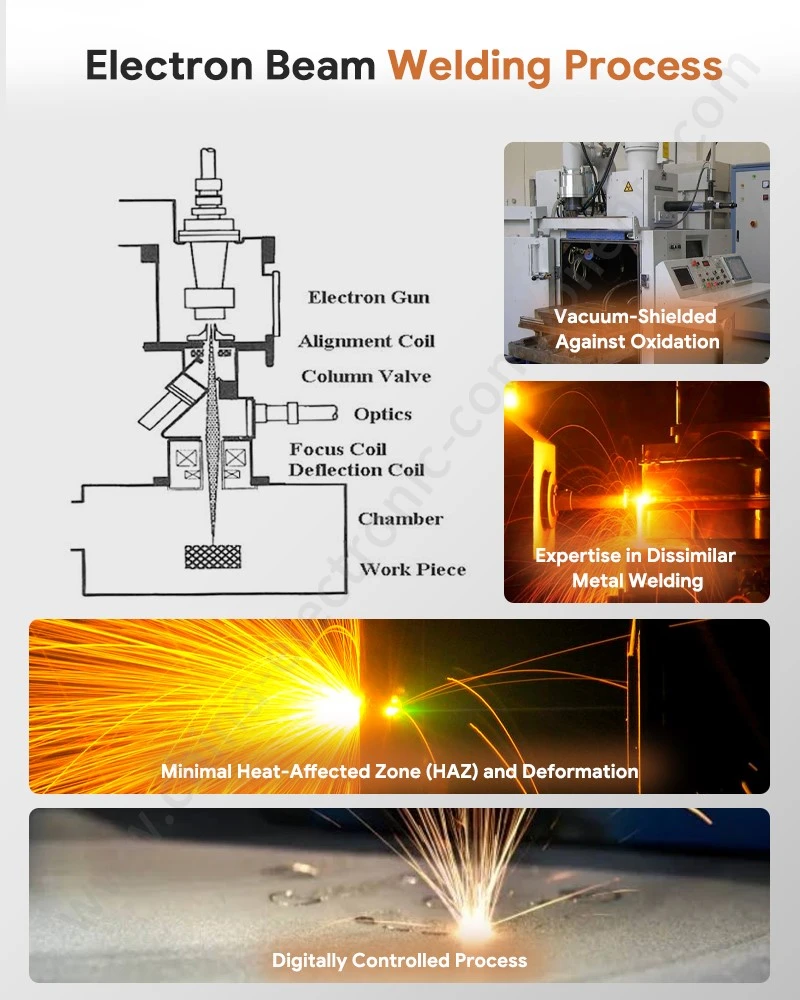
Electron beam welding (EBW) is a process that joins base materials by bombarding the workpiece surface with an accelerated, focused electron beam to melt the material; it is most widely applied in a vacuum environment. Leveraging the high power density characteristic of EBW, the production of EBW Manganese Copper Shunts overcomes several engineering challenges associated with welding these alloy components. Operating at accelerating voltages of 30–150 kV, the electron beam forms a high-energy stream with a controllable focal diameter of 0.1–1 mm and a power density exceeding 10⁶ W/cm², enabling rapid melting of the manganese-copper and copper base materials to form stable, well-defined welds.

The fundamental principle of EBW involves electrons gaining kinetic energy within an electric field; this kinetic energy converts into thermal energy upon impact with the workpiece. Electrons possess negligible mass and a high charge-to-mass ratio, allowing for precise, high-speed control via electric and magnetic fields. By utilizing the rapid, controllable nature of the electron beam, the EBW process minimizes heat input, thereby preventing resistivity drift in the manganese-copper alloy caused by overheating. Compared to laser welding, EBW offers faster beam response and superior resistance to reflective interference, making it ideal for precision components like manganese-copper shunts that are sensitive to electrical performance.
A primary advantage of EBW is its exceptional penetration capability, achieving weld depth-to-width ratios of up to 60:1. Thick-section workpieces can be joined using a single-pass process without the need for pre-machined weld grooves; this reduces filler material usage and energy consumption compared to arc welding. When applied to manganese-copper shunts, this process enables the fusion of thick manganese-copper and pure copper layers within limited installation spaces, resulting in stable weld cross-sections free from localized lack-of-fusion defects and meeting the structural requirements for high-current-carrying shunts.
EBW is characterized by concentrated heat input and high welding speeds, resulting in a narrow heat-affected zone and minimal thermal deformation. This characteristic is crucial for precision electrical components; welding serves as the final joining step in manufacturing, allowing the workpiece to retain its dimensional accuracy upon completion. For Bar Shape Shunt Resistor, the process results in minimal dimensional variation, eliminating the need for extensive post-weld correction. This ensures consistent resistance parameters and reduces downstream sorting costs.
The vacuum environment of electron beam welding excludes harmful gases like oxygen and hydrogen, inhibiting the oxidation of molten metal while facilitating gas outgassing to purify the weld metal. This makes the process ideal for reactive alloys like manganese-copper, as it prevents defects such as porosity and inclusions. Electron Beam Welding Manganin Shunts welded in a vacuum exhibit low impurity levels within the weld; consequently, their electrical performance degrades less under long-term current flow, meeting the requirements for stable, long-term operation in energy storage and industrial control equipment.
The electron beam can be transmitted remotely to specific locations within the vacuum chamber, enabling welding in confined spaces that are inaccessible to conventional welding torches. Combined with magnetic deflection control, the beam can follow preset paths to automate the welding of complex joints. Electron Beam Welding Shunt Resistor Shunt production leverages the electron beam's scanning capability to dynamically adjust the weld pool shape, eliminate localized defects, and enhance the mechanical and electrical stability of the joint, making it suitable for the mass production of shunts in various specifications.
Electron beam welding does have certain engineering limitations; the equipment is complex, and both acquisition and maintenance costs are high. Strict requirements apply to pre-weld joint machining and assembly precision: joints must be accurately positioned with minimal, uniform gaps, as assembly deviations directly impact fusion quality. During the production of Manganese Copper Resistance shunts, machining tolerances must be tightly controlled and tooling/positioning standards standardized to minimize welding defects caused by assembly errors and ensure product consistency across batches.
The processing space for vacuum electron beam welding is constrained by the volume of the vacuum chamber, imposing limits on workpiece dimensions and maximum weight; consequently, this process is unsuitable for large-scale shunt assemblies. The electron beam is susceptible to interference from external stray electromagnetic fields, which can cause beam deflection and alter the formation of the weld pool. Production facilities for Maganin Shunt for Electronics Meters must implement effective electromagnetic shielding to isolate external magnetic interference, stabilize the beam trajectory, and prevent quality issues such as insufficient weld penetration or weld misalignment.
The process of electron beam bombardment on the base material generates X-ray radiation; therefore, production stations must be equipped with comprehensive shielding structures and standardized safety operating procedures to protect on-site personnel. During the process selection phase, engineers must evaluate factors such as workpiece dimensions, production targets, and the investment required for radiation protection to comprehensively assess process feasibility. For the Maganin Shunt Resistor Shunt project, safety assessments and the implementation of protective measures must be carried out concurrently to ensure compliance with workshop safety standards while meeting product performance specifications.
When selecting the manufacturing process, engineers must compare the performance of electron beam welding, laser welding, and arc welding for Electron Beam Welding Shunt Resistors. Arc welding creates a large heat-affected zone, which can easily alter the material's resistivity; laser welding is sensitive to surface reflectivity, resulting in limited stability regarding weld penetration. Electron beam welding offers distinct advantages for manganese-copper shunts-specifically regarding deep penetration, minimal deformation, and weld purity-making it ideal for high-power shunts that demand high precision and stability. Welding procedure qualification can be conducted using prototype samples based on engineering drawings to verify resistance and mechanical performance metrics.

Before mass production, welding procedure qualification must be completed to evaluate weld quality across various accelerating voltages, beam currents, and welding speeds. Testing protocols include weld metallography, mechanical strength analysis, and long-term DC resistance stability tests to establish the optimal process parameter window. Once the process parameters for the Manganin Shunt Resistor are finalized and locked in, mass production can commence. Continuous monitoring of weld formation and component resistance data allows for the timely detection of process drift, ensuring that every batch of shunt components meets the requirements for integration into electrical equipment.
contact us
Send your drawings and performance requirements for EBW Manganese Copper Shunt; our factory can carry out welding process qualification and sample testing to support your component development schedule.

Send Inquiry