










What are the production methods for copper busbars? A comprehensive analysis of the manufacturing process and application characteristics of copper busbars.
Jun 16, 2026
Leave a message
Copper busbars are crucial conductive components in modern power transmission and distribution systems. Due to their excellent conductivity, mechanical strength, and machinability, they are widely used in power distribution equipment, new energy systems, rail transportation, power electronic equipment, and industrial automation. Whether in high-voltage or low-voltage busbar systems, copper busbars play a vital role in transmitting current and connecting electrical equipment.
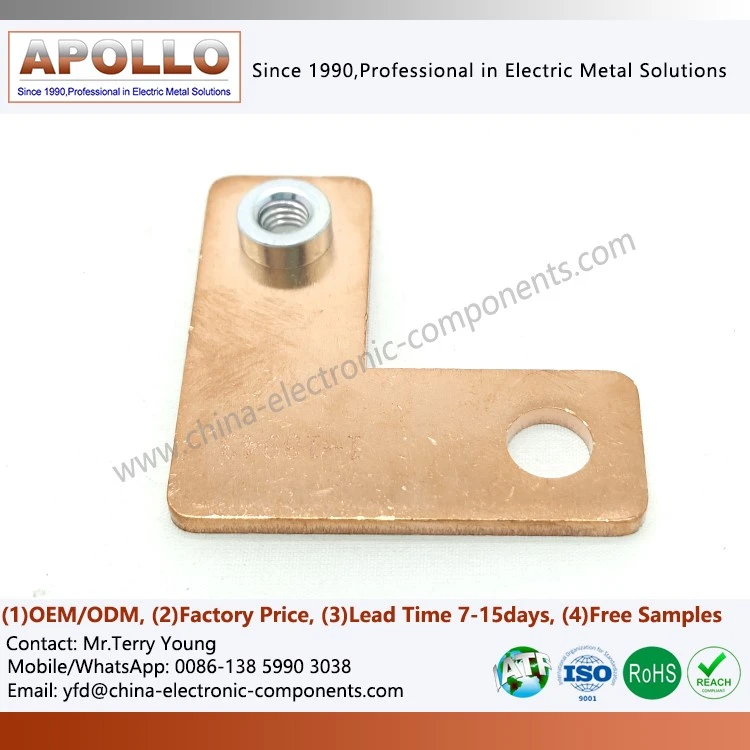
Structurally, copper busbars typically employ rectangular or rounded rectangular cross-sections and can be manufactured into various forms, such as Solid Copper Busbars, Copper Ground Busbars, Positive Busbars, and Negative Busbars, depending on equipment requirements. In modern power systems, distribution busbars have gradually become a key component for improving power supply efficiency and equipment reliability.
The Role of Copper Busbars in Power Systems
As a typical busbar electric conductor, copper busbars are primarily used to carry high-current transmission tasks. They are frequently found in switchgear, distribution cabinets, energy storage devices, power transformers, and new energy inverters.
Based on electrical system design requirements, engineers typically fabricate them into Positive and Negative Bus Bar structures for positive and negative connections in DC systems; in AC systems, they are commonly found in AC Bus Bar networks to achieve stable conductive connections between devices.
With increasing demand for customized industrial equipment, Custom Bus Bar solutions are gaining more market attention. Different equipment manufacturers design custom copper bus bar structures based on space layout, current capacity, and insulation requirements to improve overall system integration.
The Importance of Copper Bus Bar Manufacturing Processes
Copper bus bar performance depends not only on the purity of the copper material but also closely on the manufacturing process. Different manufacturing methods affect the dimensional accuracy, conductivity, mechanical properties, surface quality, and subsequent processing capabilities of the copper bus bar.
Currently, the five most common copper bus bar manufacturing processes in the industry are as follows:
1. Rolling-Sawing Method
The rolling-sawing method is one of the traditional copper bus bar manufacturing processes.
Its basic process includes:
Ingot heating → Hot rolling → Cold rolling → Pickling → Sawing → Edge treatment → Finishing and straightening → Fixed-length packaging. This process allows for good control over the mechanical and electrical properties of copper busbars, and has therefore been widely adopted by some copper busbar manufacturers.
However, due to the need for sawing, it is prone to producing burrs and flash, resulting in poor edge rounding, limited surface finish, and relatively insufficient dimensional tolerance control. When applied to high-precision power distribution equipment, additional processing steps are often required, leading to higher overall manufacturing costs.
2. Rolling-Drawing Method
The rolling-drawing method is a manufacturing process that adds a drawing step to the traditional rolling process.
The main process includes:
Ingot heating → Hot rolling → Cold rolling → Shearing → Annealing → Pickling → Drawing → Straightening → Cutting and Packaging.
Drawing further improves the dimensional accuracy and surface quality of the copper busbars, and enhances product straightness.
Currently, many copper busbar suppliers use this process to produce standard-sized copper busbars for use in electrical equipment, energy storage systems, and industrial control equipment. This process boasts high production efficiency and relatively reasonable costs, but the flash generated during shearing still requires further control.
3. Profile Rolling
Profile rolling is a high-precision continuous forming process.
The production flow is as follows:
Hot rolling → Pickling → Rough rolling → Annealing → Finish rolling → Finishing and straightening → Packaging to length.
This process utilizes specialized rolls to perform multi-pass forming of the copper busbar, achieving high dimensional accuracy and consistency.
For demanding Distribution BusBar, BusBar ABB equipment, and BusBar for Eaton power distribution systems, profile rolling offers more stable product quality.
However, due to significant equipment investment and complex mold structures, the overall production cost is relatively high.
4. Extrusion-Stretching
Extrusion-stretching is a highly efficient copper busbar production technology.
A typical process flow includes:
Ingot heating → Extrusion → Stretching → Annealing → Pickling → Secondary stretching → Finishing and straightening → Fixed-length packaging.
By adding annealing and pickling processes, the plasticity and bending properties of the material can be effectively improved, giving the copper busbar better formability.
This process is particularly suitable for manufacturing complex Custom BusBar products, as well as the Copper BusBar for Siemens and BusBar for Weidmuller applications commonly seen in the new energy field.
Its advantages are high production efficiency, large capacity, and good product consistency, but equipment investment and energy consumption are relatively high.
5. Continuous Casting-Rolling-Stretching Method
Continuous casting is a rapidly developing copper busbar manufacturing method in recent years.
The main process is:
Upward continuous casting (or horizontal continuous casting) → Cold rolling → Annealing → Pickling → Stretching → Straightening → Fixed-length packaging.
Compared to traditional ingot casting, continuous casting can reduce intermediate processing steps, significantly reducing production costs.
For the mass production of standard-sized copper busbars, this process offers significant advantages and is therefore widely adopted by some busbar system manufacturers.
However, due to equipment and process limitations, its mechanical properties and dimensional flexibility are generally inferior to traditional rolling processes, making it more suitable for standardized product manufacturing.
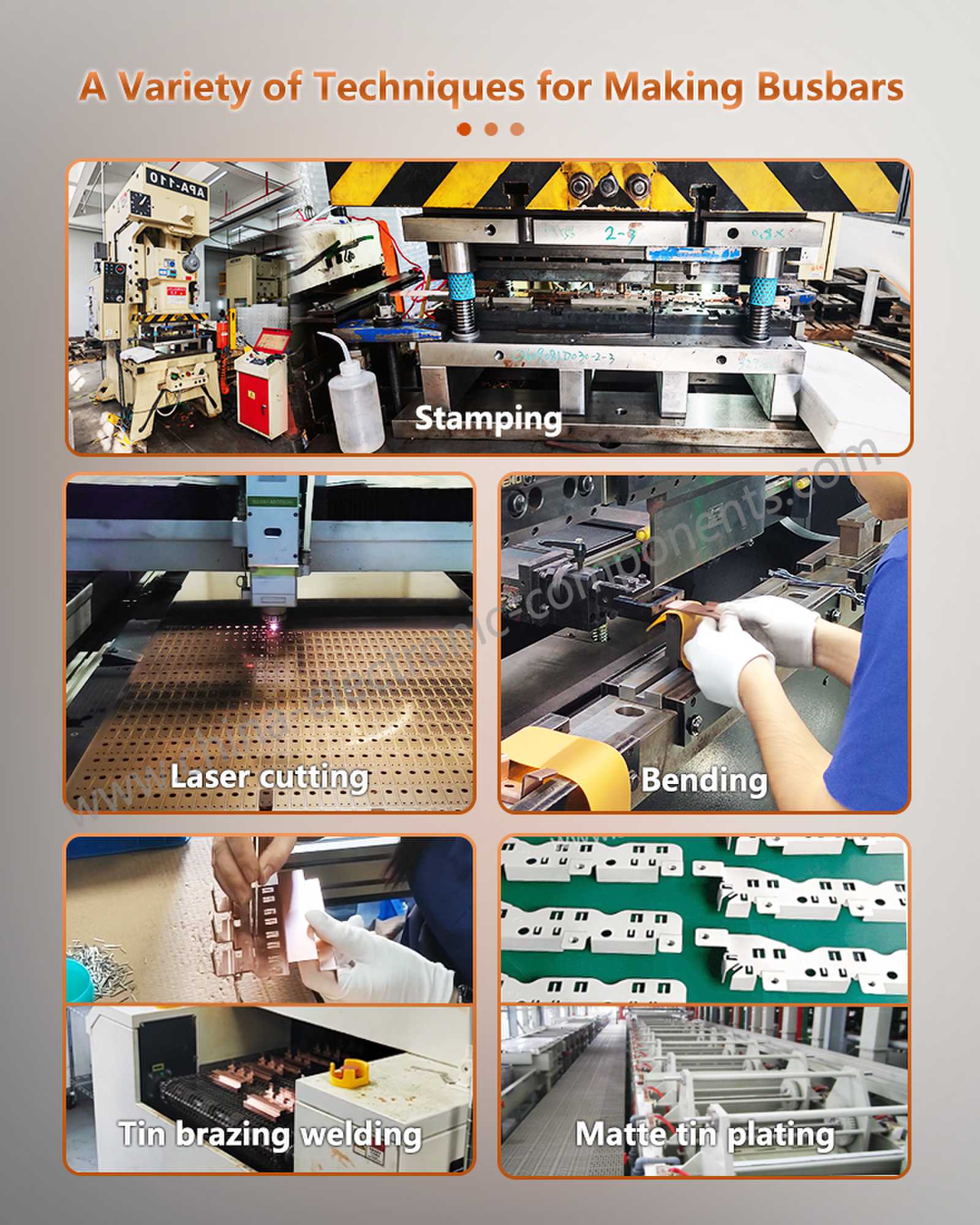
How to choose the appropriate copper busbar process?
Different application scenarios have different performance requirements for copper busbars.
In large industrial power distribution systems, High Voltage Busbars prioritize conductivity and temperature rise control; in building power distribution and low-voltage switchgear, Low Voltage Busbars prioritize ease of fabrication and cost control.
For specialized industries, such as fuse systems, energy storage devices, and power electronics products, customized structural designs, such as BusBar for Mersen Ferraz and BusBar for Siemens, are used to meet the installation requirements of different equipment.
Furthermore, with the miniaturization of electronic devices, PCB busbars are increasingly being used in new energy vehicles, battery management systems, and high-power electronic modules, providing a more reliable solution for high-current transmission.
Conclusion
The development of copper busbar manufacturing processes directly impacts the safety, stability, and operational efficiency of power systems. From traditional rolling to modern continuous casting technology, each process has its advantages. For engineers and procurement personnel, a thorough understanding of the characteristics of various production methods helps in selecting appropriate copper busbar products based on actual application needs, improving system performance, and optimizing overall costs.
In the future, with the rapid development of new energy, data centers, electric vehicles, and intelligent power distribution systems, high-performance copper busbars will continue to upgrade towards higher precision, higher conductivity, and higher reliability.
contact us
Send Inquiry