










The Importance of Seamless Riveting at the Shaft-Bore Mating Point in Brass Stamping Switch Terminal Accessories and Its Impact on Electrical Life
Apr 08, 2026
Leave a message
In the manufacturing process of electrical products such as relays and switches, the riveting quality of riveted electrical contacts directly affects the product's conductivity, temperature rise characteristics, and service life. Riveting between the contacts and the reed is typically done using a stamping machine with a free upsetting method. However, the unevenness of free upsetting deformation can lead to localized gaps between the contact rod and the reed hole, reducing the shaft-hole contact area, increasing transition resistance, causing abnormal temperature rises and exacerbating arc erosion, ultimately resulting in premature failure of Brass Stamping Switch Terminal Accessories. This paper systematically analyzes the impact of riveting quality on electrical life based on the deformation characteristics of free upsetting and compares the advantages and disadvantages of different riveting methods.
Deformation Characteristics of Free Upsetting
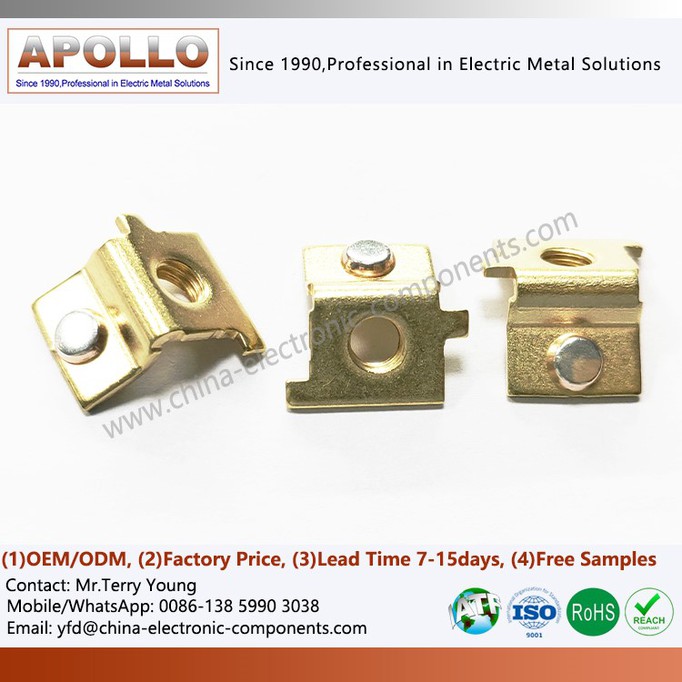
When upsetting a cylindrical billet using a flat riveting die, the metal continuously flows outwards as the height decreases. Due to the friction on the die surface, two difficult-to-deform conical zones form in the deformation area. These two conical zones act like wedges driven into a rigid body, decomposing the external force into axial and radial components: the axial component causes compressive deformation, while the radial component produces upsetting deformation. After upsetting, the billet has a drum-like appearance, and this also causes uneven internal flow for Custom Brass Stamping riveted with Silver contact.
Taking the deformation process of the rod diameter during free upsetting of a copper rod as an example, when the original length-to-diameter ratio is 1.33, the ratio of the middle rod diameter to the end rod diameter after upsetting increases as the height-to-diameter ratio decreases, and the drum shape becomes more pronounced. When the height-to-diameter ratio is 1, this ratio is 0.056; when the height-to-diameter ratio is 0.5, the ratio increases to 0.078. This indicates that the smaller the height-to-diameter ratio, the more significant the unevenness of the upsetting deformation for Customized Brass Stamping Contact Parts For Wall Socket Plug.
The Impact of Free Upsetting on Riveting Quality
The non-uniformity of free upsetting deformation specifically affects riveting quality by creating localized gaps between the shaft and hole after riveting. This prevents the outer surface of the deformed metal from achieving complete contact with the spring hole, thus reducing the contact area between the shaft and the hole. The size and location of these gaps are closely related to factors such as the length of the contact rod diameter, the shaft-hole fit clearance, the shape of the upper riveting die, and the riveting method.
When the contact rod diameter is too long or the shaft-hole fit clearance is too large, the uniformity of upsetting deformation increases, making instability, bending, and cracking more likely during the riveting process, and making it difficult to control the riveting quality. Custom Brass Stamping riveted with Silver contact. Riveting methods are broadly classified into two categories based on the equipment: punch riveting and spin riveting. Punch riveting head shapes include flat riveting heads, concave riveting heads, and V-shaped riveting heads. Flat or concave riveting heads generate the greatest friction during punch riveting, which is highly detrimental to riveting quality. When using a V-shaped riveting head, the contact area between the contact rod and the die is small, resulting in less obstruction to metal flow on the blank end face, reducing the difficult-to-deform zone and improving the uniformity of upsetting deformation. However, this method is susceptible to bending and other undesirable deformations due to the large impact force of the riveting pressure, and it is only suitable for single-sided contact riveting.
Spin riveting and punch riveting differ significantly in their force output. Spin riveting machines utilize both axial downward pressure at a certain swing angle and radial rotational force, while punch riveting machines only apply vertical downward axial pressure. Spin riveting ensures uniform material flow and virtually eliminates difficult-to-deform zones. Furthermore, spin riveting has lower impact pressure; to achieve the same riveting effect, the force required is only one-tenth that of punch riveting, effectively preventing cracking, bending, upsetting, and other undesirable deformations. The resulting contact surface is aesthetically pleasing. Choosing the spin riveting method is particularly important for double-sided contact riveting with long rod diameters.
Comparative Tests of Different Riveting Methods
In the comparative test of different riveting methods for the 32F relay, contacts of the same specification were used, and both punch riveting and rotary riveting were performed. The test load was also a 10-amp, 250-volt AC resistive load, with a rated electrical life of 100,000 cycles. Pre-test contact cross-section sampling inspection showed that after punch riveting, there was a significant gap at the mating of the moving and stationary contact shaft holes, while after rotary riveting, the mating of the moving and stationary contact shaft holes was good.
Test Results: The punch-riveted product failed due to adhesion after more than 50,000 cycles, while the rotary-riveted Electrical Brass Metal Stamping for Socket Switch achieved an electrical life of over 100,000 cycles without failure. A comparison of contact and spring hardness before and after the test showed that the hardness of the punch-riveted contacts and springs decreased significantly: contact hardness decreased from 100 Hv to 50 Hv, a reduction rate of 50%; spring hardness decreased from 165 Hv to 128 Hv, a reduction rate of 22%. The hardness of the rotary-riveted contacts and springs remained essentially unchanged, with hardness reduction rates of only 1% and 0%, respectively.
Experimental results show that poor riveting of the stamped contact is the main cause of overheating of the contact, deterioration of the spring's elastic properties, and ultimately, early fusion welding failure of the electrical terminal brass block riveted with silver contact. In terms of resistance to fusion welding, spin riveting is significantly superior to stamped riveting.
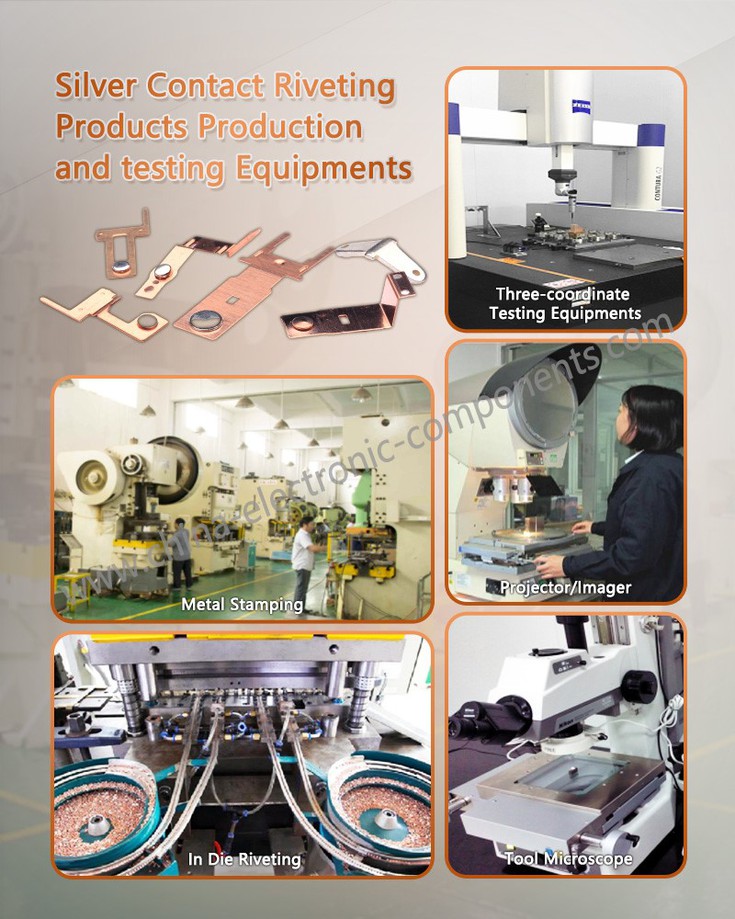
In electrical products such as relays and switches, the seamless fit between the shaft and hole after contact riveting is crucial for ensuring electrical life. The unevenness of free upsetting deformation is the root cause of gaps. Compared to stamping, spin riveting, through the combined action of downward pressure at the oscillating angle and radial rotation, ensures uniform material flow, virtually eliminating areas prone to deformation. This effectively guarantees a tight fit between the shaft and hole, significantly improving the product's electrical life and reliability. For products like switch parts riveted with silver contact, selecting spin riveting is key to achieving high-quality riveting.
contact us
For more professional information on Silver Contact Points with brass terminal technology and customized manufacturing of switch components, please contact our technical team for detailed consultation and support.

Send Inquiry