










Managing Silver and Copper Raw Material Price Fluctuations in B2B Electrical Component Procurement
Sep 25, 2026
Leave a message
Silver and Copper Price Exposure: ±20% Raw Material Moves Can Reshape Component Cost
Silver and copper are not interchangeable cost variables in electrical components: silver primarily affects contact material cost, while copper directly affects current-carrying structures such as busbars, terminals, cores, and stamped conductors. A ±20% movement in silver or copper benchmark prices does not necessarily create a ±20% change in finished-part pricing because material yield, silver loading, processing cost, scrap recovery, plating thickness, and alloy composition determine the actual exposure.
For procurement teams, the correct response is therefore not simply to negotiate a lower piece price. The controllable variables are silver mass per contact, copper utilization, material yield, manufacturing scrap, specification tolerance, and the commercial mechanism used to adjust raw-material exposure.
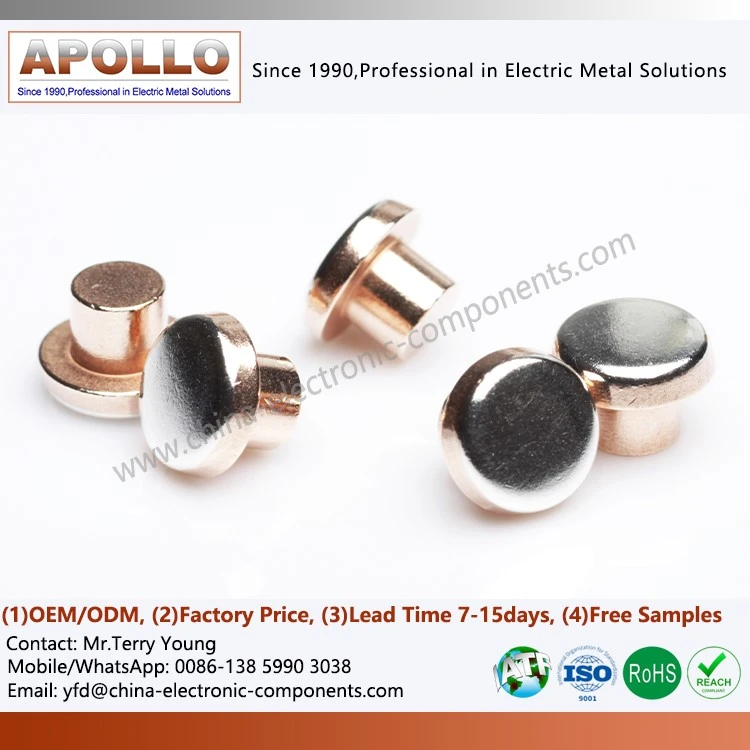
Silver Contact Cost Exposure: Ag Mass, Alloy Grade and Electrical Duty
For a silver contact, the raw-material contribution can be approximated as:
Silver Material Cost = Silver Mass × Silver Reference Price × Material Conversion Factor
A solid silver contact exposes the entire contact volume to silver pricing. A bimetal or trimetal silver contact concentrates the silver alloy in the functional contact zone while using copper or copper alloy as the structural backing.
| Contact structure | Silver utilization | Current-carrying structure | Typical procurement consideration |
| Solid silver contact | High | Ag throughout | High exposure to silver price |
| Bimetal silver rivet | Reduced | Cu/Cu alloy backing | Lower silver mass per piece |
| Trimetal contact | Further optimized | Cu-based conductive layer + Ag alloy head | Suitable for controlled contact geometry |
| Silver-plated contact | Surface-dependent | Cu/Cu alloy substrate | Plating thickness becomes a cost variable |
| AgNi / AgSnO₂ contact | Alloy-dependent | Silver alloy matrix | Electrical performance must remain within validated specification |
For switching components, reducing silver content must not be treated as a simple material substitution. Contact resistance, welding tendency, arc erosion, temperature rise, electrical endurance, and contact force remain part of the engineering acceptance criteria.
A procurement specification should therefore identify silver alloy grade, silver mass, contact dimensions, backing material, joining process, plating thickness where applicable, and electrical validation requirements rather than only specifying "silver contact."
Copper Raw Material Price Risk: C1100, C2680 and Material Yield
Copper components experience a different cost structure. A stamped copper terminal or busbar can contain a relatively high percentage of the raw material cost in the blank itself.
C1100 / C11000 copper is commonly selected where high electrical conductivity is required. C2680 brass provides higher mechanical strength and different forming behavior, but its electrical conductivity is substantially lower than high-conductivity copper.
| Parameter | C1100 / C11000 copper | C2680 brass |
| Primary advantage | High electrical conductivity | Higher strength and forming characteristics |
| Conductivity requirement | Can be specified at ≥100% IACS, depending on temper/specification | Significantly below pure copper |
| Typical role | Busbars, terminals, conductive plates | Terminals, brackets, mechanical conductive parts |
| Material-cost exposure | High copper content | Copper + zinc alloy exposure |
| Forming consideration | High ductility; burr and deformation control | Good stamping/forming response |
| Typical selection logic | Minimize electrical loss | Balance conductivity and mechanical strength |
The important procurement variable is not only the copper price per kilogram. Material utilization ratio can produce a comparable effect.
For example, if a stamping blank weighs 100 g but the finished component weighs 62 g, the theoretical material utilization is:
62 / 100 × 100% = 62%
If progressive-die nesting, strip layout, carrier design, or blank geometry raises utilization to 72%, the same finished component requires materially less purchased copper per unit.
Request Free DFM Evaluation & Quote
Silver Reduction at ±0.01 mm Tolerance: Bimetal Contact Engineering
The most direct method for reducing silver exposure is to place silver only where its electrical switching function is required.
A bimetal silver rivet typically combines a silver-based contact head with a copper or copper-alloy supporting material. The interface must provide sufficient mechanical integrity and stable electrical performance throughout the component's specified operating life.
This approach changes the procurement equation from:
Entire contact volume = silver exposure
to:
Functional contact zone = silver exposure + structural zone = copper-based material
Bimetal Silver Rivet Design: Ag Mass Reduction Without Contact Failure
The silver head geometry should be determined by actual current density, contact pressure, arc energy, switching frequency, and expected electrical endurance.
Reducing the silver head diameter or thickness without validation can create:
Higher current density at the contact interface.
Increased temperature rise.
Faster arc erosion.
Reduced electrical endurance.
Increased risk of contact welding.
Inconsistent contact resistance after repeated switching.
For production parts, the engineering drawing should control the silver head dimensions, backing material, joining interface, rivet geometry, and critical tolerances. Where required, dimensional control can be maintained to ±0.01 mm using CMM inspection or dedicated optical measurement systems.
In-Die Riveting and Molecular Interface Control
In-die riveting can reduce secondary handling and maintain consistent component positioning during high-volume production. The process must control rivet force, material flow, contact-head seating, and interface geometry.
For copper-to-silver or silver-alloy assemblies, interface integrity is more important than visual appearance. Metallographic cross-sections can be used to evaluate:
Bond-line continuity.
Cracks and voids.
Material deformation.
Interface separation.
Silver-head positioning.
Localized defects after forming.
Where joining methods such as resistance silver brazing or other metallurgical processes are used, the qualification plan should specify tensile/shear requirements and electrical resistance limits rather than relying solely on dimensional inspection.
Material Optimization Must Preserve Electrical Performance
The engineering objective is not "minimum silver." It is minimum validated silver mass that satisfies the electrical duty cycle.
| Design variable | Cost impact | Electrical risk | Validation method |
| Silver head diameter | High | Current density/erosion | Electrical endurance |
| Silver head thickness | High | Arc erosion life | Switching-cycle test |
| Silver alloy grade | High | Welding/resistance | Contact-resistance test |
| Backing material | Medium | Conductivity / mechanical strength | Conductivity + tensile test |
| Rivet geometry | Medium | Contact stability | Dimensional + endurance test |
| Joining interface | Medium | Interface resistance | Metallography + resistance test |
For procurement, this means a lower-cost quotation should not be evaluated only by silver percentage. The correct comparison is cost per validated electrical cycle or cost per qualified assembly, depending on the component application.

Silver Plating at 3–5 µm: Thickness Control and Functional Surface Area
For silver-plated electrical components, plating thickness is another controllable cost variable.
A specification such as 3–5 µm silver plating should not be treated as an arbitrary coating number. The required thickness depends on the base material, electrical duty, contact environment, mating cycles, corrosion conditions, and expected service life.
Excessive plating thickness increases precious-metal consumption without automatically improving electrical performance. Insufficient thickness can expose the substrate prematurely and change contact resistance or corrosion behavior.
Plating Thickness: XRF Measurement and Statistical Control
X-ray fluorescence (XRF) can be used for non-destructive coating-thickness measurement on production samples. A robust quality plan should define:
Nominal coating thickness.
Minimum local thickness.
Measurement locations.
Sampling frequency.
Calibration standard.
Base-material composition.
Acceptance criteria.
For example, a drawing requirement of Ag 3–5 µm should identify whether the range applies to average thickness, minimum local thickness, or a defined measurement location.
This distinction directly affects purchasing cost because suppliers may quote materially different silver consumption based on the same nominal coating specification.
Surface Area Reduction Through Functional Geometry
Silver should be applied to the electrically active region where practical. Unnecessary plated areas increase precious-metal consumption.
For stamped terminals and electrical connectors, procurement and engineering teams can jointly review:
Plated Area × Coating Thickness × Silver Density
as a direct material-consumption parameter.
A design-for-manufacturing review can therefore identify areas where plating can be locally restricted without affecting electrical performance or corrosion protection.
Silver Recovery and Scrap Accounting
Silver-bearing stamping scrap has recoverable material value. A transparent procurement model should distinguish between:
Gross silver input → Finished silver content → Process scrap → Recoverable silver → Net silver consumption
This prevents the same precious-metal loss from being hidden inside a general conversion charge.
For high-volume silver-contact production, scrap segregation by alloy and grade is also important. Mixing AgNi, AgSnO₂, AgCdO alternatives, plated copper, and other silver-bearing materials can reduce recycling efficiency and complicate material accounting.
Copper Scrap Reduction at 70%+ Utilization: Progressive Stamping and Strip Layout
Copper price exposure can often be reduced without changing the finished component by improving material utilization.
For progressive stamping, the strip layout determines the relationship between purchased coil weight and finished-part output. Small changes in carrier width, pitch, nesting, bridge design, and component orientation can materially change scrap generation.
Progressive Die Optimization: Strip Pitch and Scrap Ratio
The basic material utilization calculation is:
Material Utilization (%) = Finished-Part Weight / Purchased Material Weight × 100
For a continuous strip process, the engineering team should evaluate:
Strip width.
Feed pitch.
Component orientation.
Carrier width.
Scrap bridge dimensions.
Part nesting.
Coil width availability.
Burr direction.
Forming sequence.
The objective is not to maximize utilization at the expense of tool stability. A strip layout that produces extremely narrow bridges may increase deformation, strip instability, punch breakage, or dimensional drift.
Tool design therefore has to balance material utilization, die life, production speed, burr control, and dimensional stability.
±0.01 mm Dimensional Control and Burr Management
High-current terminals and electrical connection plates may require tight control of critical hole diameters, contact surfaces, locating features, and mating dimensions.
A practical inspection plan can combine:
| Characteristic | Typical control approach | Purpose |
| Critical hole dimension | CMM / optical measurement | Connector fit |
| Flatness | CMM / dedicated gauge | Assembly stability |
| Burr height | Optical microscope/gauge | Electrical and assembly safety |
| Plating thickness | XRF | Precious-metal control |
| Material thickness | Micrometer/laser gauge | Forming consistency |
| Conductivity | Conductivity meter | Electrical performance |
The actual tolerance must remain application-specific. ±0.01 mm should be assigned only to dimensions where the assembly function justifies the additional process and inspection cost.
Tool Life and Cost per Million Parts
Procurement should avoid comparing stamping quotations solely on piece price.
A lower piece price can become more expensive if it produces higher:
Tool maintenance frequency.
Scrap rate.
Burr rejection.
Dimensional drift.
Unplanned downtime.
Secondary processing.
A more useful commercial metric is:
Total Conversion Cost per Qualified Million Parts
This incorporates tool amortization, maintenance, scrap, inspection, and production efficiency.
LBMA and LME Indexing: Transparent Raw-Material Price Adjustment
Long-term electrical-component contracts can become difficult when the supplier absorbs all commodity-price fluctuations while the buyer expects a fixed annual piece price.
A more transparent approach is to separate commodity exposure from conversion cost.
Silver can be referenced against an agreed LBMA silver benchmark, while copper can be linked to an agreed LME copper reference. The commercial formula should specify the reference date, quotation basis, currency, conversion unit, adjustment frequency, and applicable premium.
Indexed Pricing Formula: Benchmark + Conversion Cost
A simplified structure can be expressed as:
Part Price = Indexed Material Component + Fixed Conversion Component + Agreed Processing/Logistics Charges
For silver-bearing parts:
Silver Component = Ag Mass per Part × Ag Index × Ag Conversion Factor
For copper stamped components:
Copper Component = Net Cu Mass per Part × Cu Index × Cu Conversion Factor
The conversion component can cover:
Stamping.
Riveting.
Welding.
Brazing.
Plating.
Heat treatment.
Inspection.
Packaging.
Tool amortization.
This structure prevents commodity movement from being mixed with manufacturing efficiency.
Indexing Parameters That Must Be Written Into the Contract
| Commercial parameter | Example definition | Procurement purpose |
| Silver benchmark | LBMA silver reference | Commodity transparency |
| Copper benchmark | LME copper reference | Copper price transparency |
| Currency | USD | Avoid FX ambiguity |
| Weight unit | g / kg / metric tonne | Prevent unit mismatch |
| Adjustment period | Monthly / quarterly | Control volatility |
| Base date | Contract-defined date | Establish starting index |
| Trigger band | Contract-defined threshold | Avoid insignificant adjustments |
| Conversion cost | Fixed or separately indexed | Protect manufacturing economics |
| Scrap credit | Agreed recovery mechanism | Prevent double charging |
The contract should also define whether the benchmark is based on a daily price, monthly average, or another agreed reference.
Without this definition, two parties can use the same "LBMA silver" or "LME copper" terminology but calculate different adjustment values.
Procurement Should Audit Mass Before Negotiating Price
Commodity indexing is only useful when the physical material quantity is transparent.
For silver contracts, the buyer should request:
Silver mass per finished part → alloy grade → backing material → process scrap → recoverable scrap
For copper stampings:
Gross blank weight → finished-part weight → strip utilization → process scrap
This converts a raw-material negotiation from a subjective price discussion into a measurable engineering-cost model.
Procurement Decision Matrix: Silver Contact Cost vs Electrical Qualification
A purchasing team can use the following engineering matrix before approving a material-reduction proposal.
| Option | Raw-material exposure | Engineering change | Electrical validation | Procurement application |
| Solid Ag → bimetal Ag rivet | Lower | Medium | Required | High-volume switching parts |
| Increase Ag plating efficiency | Lower | Low–Medium | Required | Plated terminals |
| Reduce plated area | Lower | Medium | Required | Defined conductive zones |
| Improve copper strip layout | Lower | Low–Medium | Usually dimensional validation | Stamped busbars/terminals |
| Change C1100 → alternative alloy | Potentially lower | High | Full validation | Only after electrical review |
| Introduce LBMA/LME indexing | Commercial risk reduction | Low | None | Long-term supply contracts |
| Segregate precious-metal scrap | Recovery improvement | Low | Process audit | High-volume silver production |
The correct sequence is:
Material specification → functional requirement → manufacturing process → material utilization → commodity index → final purchase price.
Changing the sequence often produces misleading savings.
Quality Documentation at IATF 16949 and PPAP Level 3
Raw-material cost optimization should remain inside the supplier's existing quality system.
For automotive applications, material changes or significant process changes may require engineering change control, customer approval, and PPAP documentation according to the applicable customer-specific requirements.
A typical qualification package may include:
Material certificate and chemical composition.
Dimensional inspection report.
CMM measurement data for critical dimensions.
Plating-thickness report where applicable.
Electrical resistance or conductivity data.
Mechanical joining test results.
Metallographic cross-section.
Process capability data for critical characteristics.
Control Plan and PFMEA updates.
PPAP Level 3 documentation where contractually required.
For insulation-related electrical components, additional standards such as UL 94 V-0 may apply to polymeric materials, while high-voltage assemblies may require application-specific dielectric, temperature-rise, endurance, or insulation-resistance testing.

Engineering Cost Model: From Commodity Index to Qualified Piece Price
A transparent sourcing model should separate four layers:
Layer 1 - Commodity: LBMA silver or LME copper reference.
Layer 2 - Physical consumption: silver mass, copper mass, strip utilization, and scrap recovery.
Layer 3 - Manufacturing: stamping, in-die riveting, laser welding, resistance silver brazing, plating, inspection, and packaging.
Layer 4 - Quality and supply: tooling amortization, PPAP, inspection frequency, traceability, logistics, and agreed commercial terms.
This model allows procurement teams to identify exactly where a price increase originates.
For example, if the copper benchmark increases while the supplier's material consumption per finished component simultaneously decreases because of improved strip utilization, the final piece-price movement should not simply mirror the commodity increase.
Conversely, if silver content is reduced through a bimetal contact design but electrical endurance testing requires a larger contact head, the nominal silver-saving calculation may not represent the final qualified cost.
The Practical KPI Set for Commodity-Exposed Components
A supplier review should track measurable indicators rather than general statements about cost reduction.
| KPI | Measurement |
| Silver mass per piece | g/pc |
| Copper mass per piece | g/pc |
| Material utilization | % |
| Scrap rate | % |
| Silver recovery rate | % |
| Plating thickness | µm |
| Critical dimensional tolerance | mm |
| Contact resistance | µΩ / mΩ as specified |
| Production yield | % |
| Tool life | Parts per maintenance cycle |
| PPAP status | Level/approval status |
| Commodity adjustment | Index-based formula |
These indicators allow procurement, engineering, QA, and the supplier to work from the same cost structure.
Sourcing Strategy at ±20% Commodity Volatility: Engineering and Commercial Controls
A resilient electrical-component sourcing strategy does not depend on predicting the next silver or copper price movement. It reduces the amount of uncontrolled commodity exposure embedded in each qualified component.
The engineering side focuses on:
Lower silver mass without compromising contact performance.
Optimized plating thickness.
Functional-area plating.
Higher copper strip utilization.
Reduced stamping scrap.
Stable joining processes.
Controlled dimensional tolerances.
The commercial side focuses on:
Defined LBMA silver references.
Defined LME copper references.
Transparent adjustment formulas.
Fixed conversion-cost components.
Agreed scrap-recovery mechanisms.
Clearly defined review periods.
The quality side maintains:
Material traceability.
CMM inspection.
XRF coating measurement.
Metallographic verification.
Electrical endurance testing.
Process capability monitoring.
PPAP documentation where required.
For long-term procurement, these three layers should be reviewed together. A lower commodity exposure that creates additional electrical failures is not a valid engineering saving; similarly, a fixed purchase price that transfers uncontrolled commodity risk into supply instability is not a stable sourcing model.
Final Procurement Framework: Silver Contact and Copper Component Cost Control
The most measurable approach to silver and copper price risk is to establish a physical cost baseline before negotiating the commercial price.
For silver contacts, determine:
Silver alloy → silver mass → functional contact geometry → plating requirement → joining method → electrical endurance.
For copper components, determine:
Copper grade → blank weight → finished-part weight → strip utilization → scrap recovery → dimensional requirement.
Then connect the physical consumption model to LBMA silver and LME copper reference mechanisms.
This creates a procurement structure in which commodity volatility, engineering design, manufacturing conversion, and quality requirements remain visible instead of being combined into a single unexplained unit price.
For OEM electrical-component programs, Apollo Electronic Components (Xiamen) can evaluate silver-contact and precision copper-component drawings from the material, stamping, riveting, welding, plating, inspection, and commodity-cost perspectives. The engineering review can then determine whether the proposed specification allows silver-mass reduction, improved copper utilization, or a more transparent indexed pricing structure.
FAQ
How can a buyer reduce silver contact procurement cost without changing electrical performance?
Use a validated bimetal or trimetal silver-contact structure to concentrate silver in the functional contact zone. Verify contact resistance, temperature rise, welding tendency, arc erosion, and electrical endurance before approving the material change.
How should LBMA silver and LME copper indexes be used in electrical-component contracts?
Define the benchmark, currency, unit, averaging period, base date, adjustment frequency, trigger threshold, and conversion-cost component in the contract. This separates commodity movement from manufacturing conversion cost.
Can a copper stamping supplier reduce raw-material cost without changing the finished part?
Yes. Progressive-die strip optimization can improve material utilization through pitch, nesting, carrier, and blank-layout changes. The revised process should be validated for dimensional tolerance, burr height, tool stability, production yield, and required electrical performance.
contact us
Send Inquiry