










How does brazing affect the process selection for Electric Resistance Spot Welding Silver Contact?
Jun 04, 2026
Leave a message
When mass-producing various conductive contacts, the optimal processing method must be selected based on process characteristics. In the production of Electric Resistance Spot Welding Silver Contact, flame brazing and resistance spot welding are often compared. Flame brazing, as a traditional and mature process, has become one of the alternative processing solutions for silver contacts due to its flexibility and low cost. The structures of silver and copper contacts differ significantly depending on the material, and the two processes each have their advantages and disadvantages in terms of cost and precision.
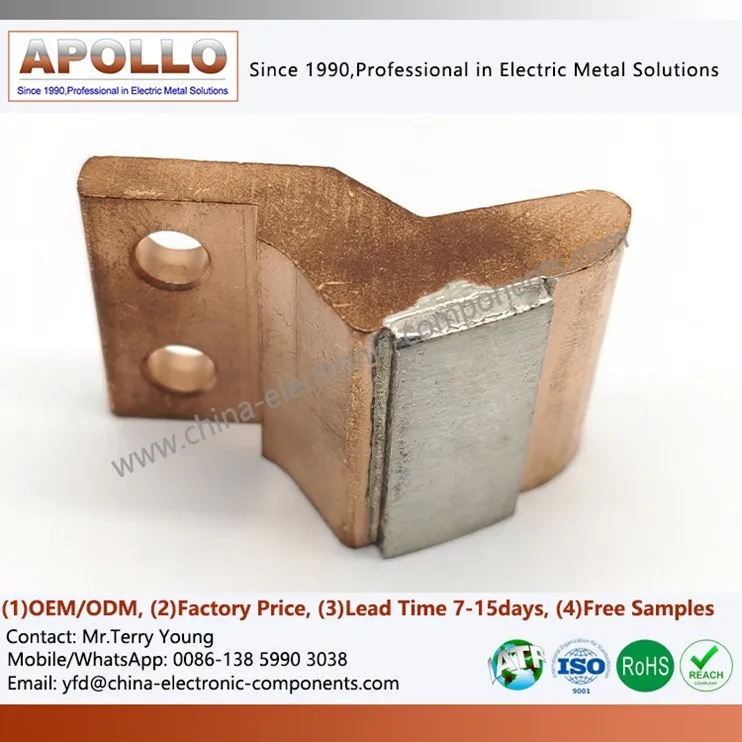
Flame brazing relies on the combustion of combustible gas to generate a heat source, melting only the brazing filler metal to complete the component connection. In the process benchmarking of Resistance Seam Welding Silver Contact, this process has low equipment investment, a convenient gas source procurement, and is suitable for small-batch contact sample production. Various types of brazing filler metals, such as silver-based and copper-based, can be selected, and their shapes are not limited, flexibly adapting to the brazing operation requirements of different specifications of silver contacts.
The flexibility of handheld operation is a key feature of flame brazing. When machining irregularly shaped contacts, such as Silver Contact Hard Brazing Assembly with complex shapes and scattered points, flame brazing allows for free adjustment of the heating angle to complete local joint welding. For equipment rework and single-piece sample modification scenarios, flame brazing can be performed on-site, overcoming the limitation of fixed-point resistance spot welding in terms of flexible repositioning.
Standardized process control can effectively improve the yield rate of finished contacts. When conducting brazing alternative tests on Silver Contact Welded Assembly for Contactor, pre-welding decontamination, flame adjustment, and uniform heating are all crucial steps. Thorough cleaning of the workpiece surface, combined with uniform heating in a neutral flame, can prevent over-burning of the silver layer and ensure the forming quality of the conductive contact surface.
In terms of material compatibility, flame brazing is suitable for copper, stainless steel, and other substrates paired with silver contacts, optimizing alternative processing ideas for Electrical Contact Assembly with Silver Welded Tip. This process is not suitable for processing easily oxidized special metal contacts such as titanium and zirconium. For the production of such high-precision contacts, resistance spot welding is more stable in controlling welding deformation and oxidation.
In terms of joint mechanical properties, flame brazing does not melt the base material, resulting in a joint strength slightly lower than that of the base material. Optimizing the lap structure can compensate for this weakness. In small-batch production of Welded Assembly of Silver Electrical Contacts, this process is often chosen to reduce production costs for short-cycle, small orders. However, the efficiency advantage of resistance spot welding becomes more pronounced in large-scale production of standardized contacts.
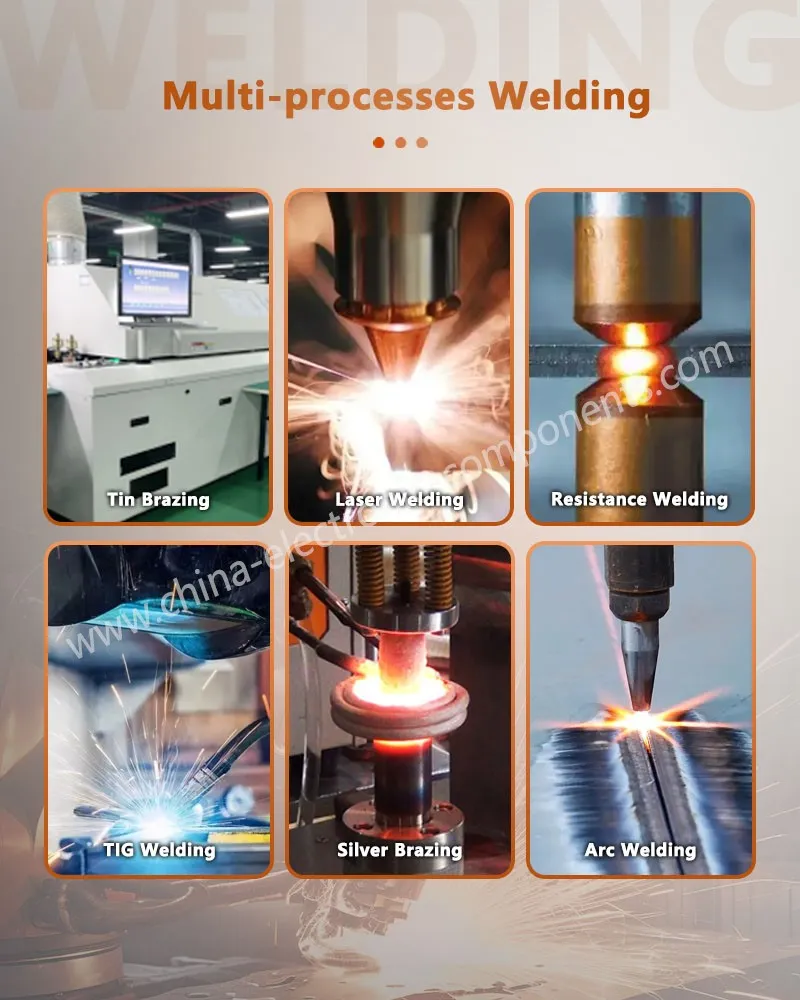
The two processes differ significantly in their applicable production scale. Flame brazing is often used for prototyping of single-piece, multi-specification customized silver contacts, while resistance spot welding is generally preferred for large-scale production lines of Brazing Silver Electrical Contacts. By leveraging the complementary characteristics of the two processes, manufacturers can flexibly switch production plans based on order volume, balancing quality and manufacturing costs.
With the continuous development of the low-voltage electrical appliance industry, the market demand for silver contacts is steadily increasing, and the processing technology for Precision Welding for Copper Part is constantly evolving. Industry professionals are continuously combining the low-cost advantages of flame brazing with the high-precision advantages of resistance spot welding to continuously improve the contact manufacturing process system, driving the continuous development of silver contact processing towards high efficiency and economy.
Built using mature resistance spot welding technology, the Electric Resistance Spot Welding Silver Contact features a tight silver-copper bond, a smooth contact surface, and stable conductivity. It effectively avoids defects such as poor soldering and silver layer peeling, making it suitable for various electronic control components such as relays and switches. Having undergone multiple performance tests, its overall quality surpasses industry standards. New and existing customers are welcome to inquire about samples and bulk purchases.
contact us

Send Inquiry