


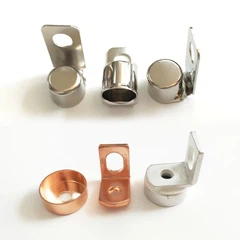


Cap And Contact For Battery Pack Fuse
Products Description

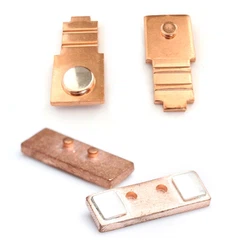
This series of Cap and Contact for Battery Pack Fuses are terminal conductivity and mechanical support sealing unit for high-voltage direct current (HVDC) fast-break fuses, specifically designed for the harsh vibration and alternating heat flow conditions of power lithium battery packs.
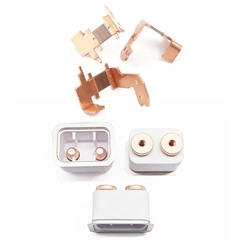
Bimetallic Heterogeneous Integrated Architecture: Breaking away from the physical limitations of traditional single-type copper end caps, the product innovatively adopts a heterogeneous metal composite architecture of a "purple copper outer cap + brass inner cap." The outer layer primarily provides high conductivity, fast heat dissipation, and low contact resistance with external busbars; the inner layer focuses on providing high-rigidity mechanical locking and creep-resistant mechanical support for molten metal assembly, internal control alignment, and the high-voltage arc-extinguishing chamber.
Stepped Three-Dimensional Structure and Highly Flexible Process Adaptation: The component surface features streamlined steps formed by precision cold stamping, locating pin holes, and contact interconnect interfaces. It supports mechanical gripping on fully automated high-speed assembly lines and can perfectly match various post-melt connection processes such as resistance brazing, high-temperature soldering, and laser welding, greatly reducing thermal residual stress in the overall manufacturing process of fuses.
Manufacturing Advantages: Closed-Loop Control of the Process Chain and Metallurgical Consistency
| Full lifecycle management of stamping dies is the starting point | The cavities are periodically scanned by a coordinate measuring machine, and maintenance or replacement is arranged before wear exceeds tolerance, preventing uneven wall thickness, tool misalignment, or riveting hole drift caused by die wear. Full-dimensional inspection is performed on both the first and last stamped parts to monitor dimensional stability within the batch. |
| For online monitoring of riveting and welding | The riveting station is equipped with a pressure-displacement curve monitoring system to record the peak pressure and final insertion depth at each riveting point, identifying riveting quality drift caused by material hardness fluctuations or die wear. The welding station (whether brazing or resistance welding) is equipped with infrared thermal imaging or thermocouple temperature feedback to monitor the temperature field distribution of the brazed seam in real time, ensuring that the brazing filler metal is fully melted and does not overheat and oxidize. |
| Non-destructive testing of brazed seam quality | uses ultrasonic C-scanning or X-ray fluoroscopy to detect incomplete fusion, porosity, or inclusion defects inside the brazed seam. For resistance brazed components, the key inspection focus is on whether there is localized overheating and ablation in the electrode End Cap and Terminal Welding Components area due to uneven current density. |
| The end-to-end traceability system | covers T2Y2 copper coil batches, H65 brass bar furnace numbers, stamping die batches, riveting stations, welding parameter packages (temperature/current/time/pressure), and final inspection data. Quality files for any component can be retrieved within minutes, supporting customer review and failure analysis. |

Material Advantages: Precise Metallurgical Allocation Based on Current-Carrying and Mechanical Requirements
Under high-voltage and high-current conditions, a single material cannot simultaneously meet the dual requirements of extreme conductivity and extreme rigidity. Our bimetallic strategy involves a deep reconstruction of the material's physical properties:
T2Y2 Copper Outer Cap: A Low-Loss Current-Carrying Sentinel: T2 copper has extremely high purity and excellent electrical and thermal conductivity, ensuring micro-ohm-level contact resistance between the fuse tip and the system busbar. The semi-hard state of Y2 provides moderate yield strength, ensuring micro-deformation during bolt tightening to fill microscopic unevenness on the Outer Cap and Terminal Welded Components surface, while resisting connection loosening caused by long-term vibration.
H65 Brass Inner Cap: A Rigid Skeleton Resistant to Electrodynamic Tear: When a short-circuit current passes through, a huge Lorentz force (electrodynamic force) is generated between the Outer Cap and Terminal Welding Components. H65 brass possesses tensile strength and hardness far exceeding that of pure copper. As the inner cap fastening ceramic tube and internal molten material, it can maintain controllable deformation under millisecond-level electrodynamic impact, preventing the internal structure of the fuse from mechanically disintegrating at the moment of disconnection.

Application Advantages: Covering All Power Ranges of Fuses
Main Fuses for New Energy Vehicle BDU/PDUs
800V platform, rated current 200~500A, breaking capacity 150kA. Extremely high requirements for vibration and thermal cycling resistance of the Copper Cap and Fuse End Blade Females. Our resistance-brazed assemblies are already being mass-produced and supplied to battery pack fuses of several major automakers.
DC Fuses for Energy Storage Systems
1500V, current 300~800A, ambient temperature up to 60℃. Fuses are typically installed in containers, resulting in long maintenance and replacement cycles. Our soldered assemblies demonstrate stable performance in high-temperature aging tests, meeting the 15-year design life requirement.
Photovoltaic Combiner Box Fuses
1000V/1500V DC, current 15~50A, large quantity, cost-sensitive. We provide standard assemblies with high-speed stamping and furnace soldering, significantly reducing procurement costs while ensuring reliability.
Industrial Variable Frequency Drive and Rectifier Fuse
Frequent overloads and disconnections require the Outer Cap and Automotive Fuse Terminals to withstand multiple thermal cycles without fatigue. Our design employs a double redundancy system of riveting and welding, ensuring electrical connection at the riveting points even if micro-cracks appear in the weld layer.

contact us
We not only provide standardized Copper Contact for Bolted Tag Fuse products, but also offer complete engineering support tailored to customers' high-voltage fuse platform needs, from material selection and conductive structure design to welding process development and automated mass production. This helps new energy projects achieve a more stable and consistent long-term supply system.

Hot Tags: cap and contact for battery pack fuse, China cap and contact for battery pack fuse manufacturers, suppliers, factory, fuse contact and cap, Fuse Cap and Contact, EV Fuse Contact With Bolt Mount, EV Fuse Copper Contact, Outer Cap and Contact, Copper Cap Contact For Electric Cars
You Might Also Like


Send Inquiry