










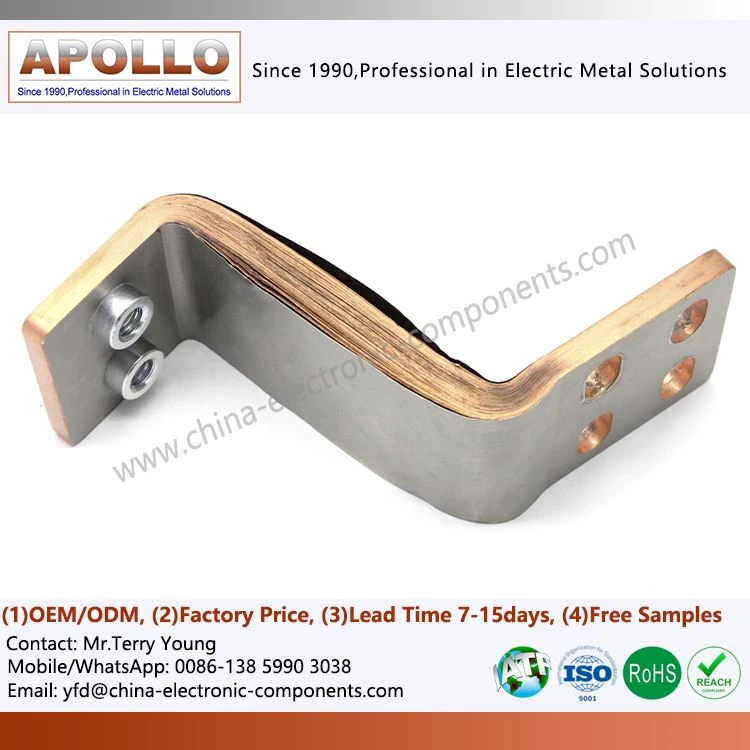
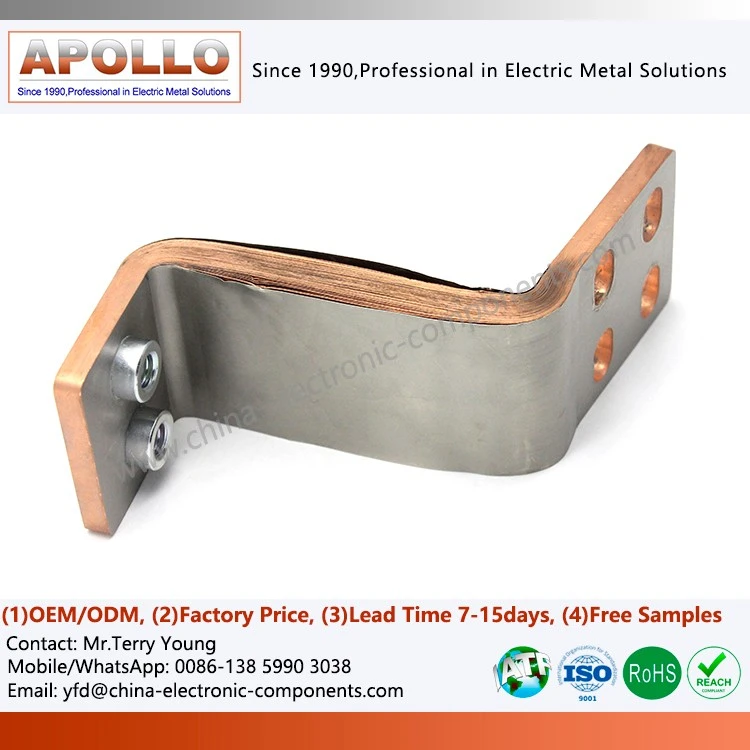
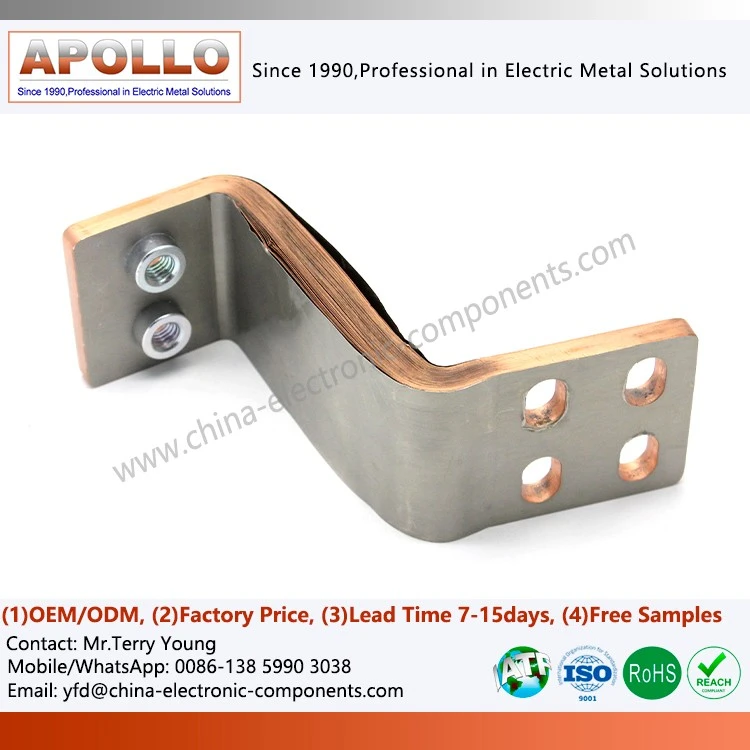
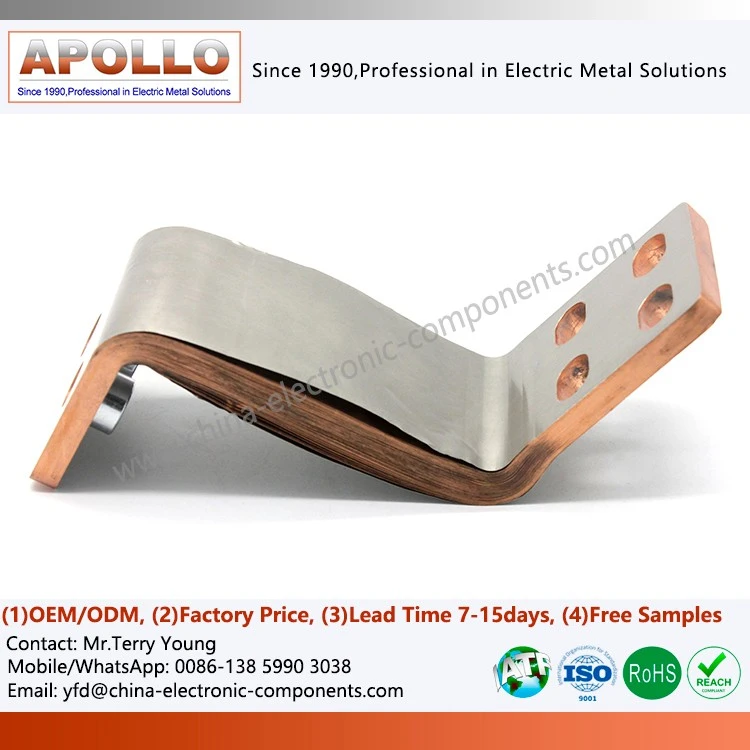

Laminated Connector For Electrical Equipment
Products Description
Xiamen APOLLO manufactures Laminated Connector for Electrical Equipment for electrical equipment, EV battery systems, energy storage devices, and high-current power assemblies. The product uses multiple layers of high-purity copper foil welded together through precision press welding technology to provide high current conductivity and mechanical flexibility.
Our flexible copper busbar solutions are produced with 100% IACS copper materials, supporting customized thickness, width, hole patterns, and insulation structures. The laminated copper foil shunt design reduces mechanical stress caused by vibration and thermal expansion in high-power electrical systems.
The manufacturing process includes copper foil cutting, layer stacking, diffusion bonding, press welding, insulation coating, and dimensional inspection. Kapton, PET, and heat-shrink insulation options are available for different voltage requirements.
With internal tooling development and automated welding capability, Ansite supports OEM and Tier 1 suppliers with rapid prototype delivery, mass production capability, and PPAP Level 3 documentation.

Technical Specifications & Material Standards
Laminated Flexible Copper Foil Connector Specification
| Parameter | Technical Data |
| Product Type | Laminated Flexible Copper Foil Busbar / Copper Foil Shunt |
| Base Material | T2 / C1100 Pure Copper Foil |
| Copper Purity | ≥99.95% |
| Electrical Conductivity | ≥100% IACS |
| Copper Foil Thickness | 0.05mm - 0.3mm |
| Layer Structure | Multi-layer laminated copper foil |
| Welding Process | Press Welding / Diffusion Bonding |
| Insulation Material | Kapton / PET / PVC / Heat Shrink Tube |
| Dielectric Breakdown Voltage | >15kV/mm (Kapton insulation) |
| Operating Temperature | -40℃ to +150℃ |
| Inductance | <10nH low inductance design available |
| Surface Treatment | Nickel Plating / Tin Plating optional |
| Dimensional Tolerance | ±0.05mm (precision machining available ±0.01mm) |
| Application Standard | IATF 16949 / ISO 9001 |

Application Scenarios & Industry Integration
Laminated flexible copper foil connectors are widely used where high current transmission, vibration resistance, and compact installation are required.
Typical applications include:
800V EV battery pack PDU copper flexible connections
Electric vehicle battery module busbar assemblies
High-power SiC inverter copper foil connectors
Commercial energy storage ESS battery cabinets
Solar PV inverter internal power connections
Industrial resistance welding equipment, flexible copper busbar
High-current electrical switchgear connections
5G telecom power supply grounding systems
The flexible copper foil laminated busbar structure absorbs mechanical vibration and thermal expansion, improving connection reliability in long-term electrical operation.

Frequently Asked Questions
Q1: How does Kapton insulation ensure zero-pinhole performance under 800V high-voltage working conditions?
-
We adopt a hot-press integrated lamination process to eliminate insulation gaps. Each layer undergoes high-voltage aging testing to avoid pinholes, sustaining stable insulation performance under 800V automotive high-voltage systems.
Q2: What advantages does press-welded lamination have over ordinary stacked copper foil connections?
-
Integral press welding reduces internal contact resistance and avoids layered loosening. It lowers overall inductance and cuts heat generation, improving stability for high-frequency and high-current operation.
Q3: How does laminated copper foil welding prevent electrical resistance increase during long-term operation?
-
Laminated copper foil connectors use press welding technology to create a stable copper layer bond without additional solder materials. The process reduces contact resistance variation caused by vibration, thermal cycling, and mechanical fatigue in EV and ESS applications.

contact us
Send your 2D/3D CAD drawings (STEP/DWG), electrical parameters, or insulation requirements to our engineering team. We provide DFM analysis, prototype support, and factory-direct quotation for laminated flexible copper foil connectors within 24 hours.

Hot Tags: laminated connector for electrical equipment, China laminated connector for electrical equipment manufacturers, suppliers, factory
You Might Also Like


Send Inquiry