

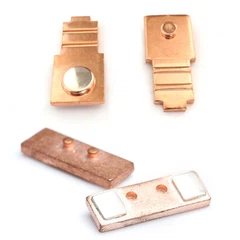
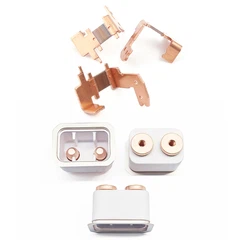

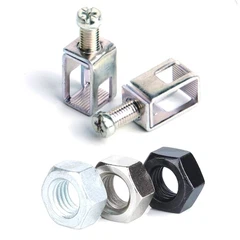
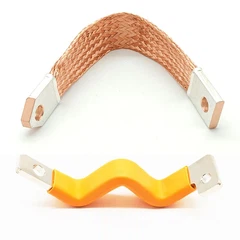
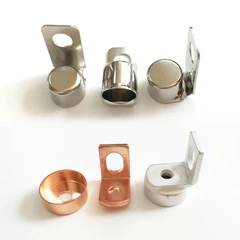



Trimetal Contact Rivets For Electronics
Products Description

The Trimetal Contact Rivets For Electronics is, in essence, a high-precision, functional contact component. Its uniqueness lies in the composite structure of three dissimilar metals: the head and shank are made of highly conductive, arc-resistant silver alloy, while the core consists of highly thermally conductive and ductile pure copper. This configuration retains the silver alloy's superior electrical conductivity and arc resistance while leveraging the copper core to significantly enhance overall structural strength and heat dissipation, all while effectively optimizing precious metal usage.
Key Features:
Double-sided silver layer design: Both the head and shank are clad in a uniform silver alloy layer, ensuring consistently excellent conductivity at the contact interface during switching operations.
Metallurgical bonding: The three layers are joined via a high-temperature, high-pressure process that creates an atomic-level bond.
Production Process and Manufacturing Strengths: Exceptional Engineering Capabilities
| High-Precision Pre-Bonding of Tri-Metal Strip | Silver alloy and oxygen-free copper strips undergo surface activation and solid-state diffusion bonding within micron-level tolerances. This step demands extremely high standards for environmental cleanliness and pressure uniformity, serving as a critical "genetic" process that prevents delamination in the finished rivets. |
| Multi-Station Precision Cold Heading | Utilizing customized, high-precision cold heading equipment, we employ a multi-stage progressive forming process to prevent tearing at the composite interface caused by excessive deformation in a single step. Molds feature nano-coatings to ensure a superior surface finish and minimize subsequent electric field concentration. |
| Stress Relief and Stabilization Annealing | To address internal residual stresses resulting from the bonding process, we implement a stepped vacuum annealing cycle. This not only restores the toughness of the copper but also promotes deeper atomic interdiffusion at the silver-copper interface, eliminating microscopic defects. |
| Comprehensive Non-Destructive Testing | Moving beyond traditional destructive sampling, we employ ultrasonic scanning for interface bonding integrity and optical 3D inspection for dimensional accuracy. This ensures that every Contact delivered to the customer offers 100% reliability in interface bonding. |

Detail Showcase: Quality You Can See
Uniformity of the Silver Layer
The thickness of the silver alloy layer at the head and shank is precisely controlled to ensure consistency across the entire working face. An excessively thin silver layer compromises arc resistance, while an overly thick one adds unnecessary material costs.
Interface Bonding Integrity
Under high-magnification metallographic examination, the silver-copper composite interface must show a continuous metallurgical bond, free from porosity, inclusions, or delamination.
Concentricity and Dimensional Accuracy
High concentricity is maintained among the three material layers during cold heading, ensuring precise alignment with the stationary Contacts upon installation.
Surface Quality
The product surface is clean and free from oil, rust, and burrs; the silver alloy surface is smooth and polished, ensuring stable contact resistance.

Material Science Advantages: A Value Proposition Beyond Solid Silver Contacts
Enhanced Thermal Management
Oxygen-free copper possesses thermal conductivity far superior to that of silver alloys. In the high-temperature arc environment generated during Contact making and breaking, the copper core acts as a "heat sink."
Balancing Strength and Toughness
Pure silver is relatively soft and prone to deformation under high-intensity mechanical impact. This product utilizes the high strength of copper as a "skeleton" to support the silver alloy "skin." This structure-combining rigidity with resilience-ensures that the Point resists plastic deformation during frequent mechanical operations while maintaining excellent contact elasticity.
Efficient Utilization of Scarce Precious Metals
We precisely confine the expensive silver alloy to the critical working layer (achieving micron-level accuracy) while replacing non-functional internal bulk with cost-effective, highly conductive copper. This approach reflects both a respect for material science and an ultimate optimization of supply chain costs.

contact us
Trimetal Silver Composite Contact Rivets for Switch combine high-reliability electrical performance with material optimization through the precise bonding of silver alloys and pure copper, representing an advanced solution for industrial relay changeover contact applications.
If you are developing projects involving industrial relays or control equipment, we can provide stable, reliable, and customized contact solutions by leveraging our mature trimetal contact manufacturing technology, precision machining capabilities, and extensive engineering support experience.

Hot Tags: trimetal contact rivets for electronics, China trimetal contact rivets for electronics manufacturers, suppliers, factory, Bimetal Silver Contacts, Silver Alloys Contact, Silver Contacts For Breaker, Silver Electrical For Contactor, Silver Nickel Contact, Trimetal Silver Contact Rivets
You Might Also Like


Send Inquiry