











Silver Electric Contacts
Products Description

The Silver electric contacts are an electrical contact element integrally formed using a cold-forging composite process, with high-purity silver (Ag) as the working layer and copper (Cu) as the substrate. Its core design concept lies in the functional separation of the conductive layer and the load-bearing layer:
The silver layer provides excellent conductivity and oxidation resistance.
The copper substrate ensures structural strength and good plastic deformation capacity.
Through cold-forging technology, the two metals achieve a tight metallurgical bond under high-pressure plastic deformation, forming a dense, non-porous composite interface, significantly improving the electrical stability and mechanical reliability of the contact.
Key Product Features and Technical Advantages
Excellent Electrical and Thermal Conductivity
Silver boasts a high electrical conductivity of 106% IACS, combined with the high thermal conductivity of copper, enabling the composite contacts to maintain low temperature rise and low contact resistance even under high current, effectively reducing energy loss and heat generation risk.
01
Resistance to Welding and Arc Erosion
In environments with frequent arc switching, the silver layer rapidly disperses arc heat, preventing weld adhesion and surface oxidation; the uniform composite interface structure significantly extends switch life and stability.
02
Outstanding Mechanical Strength and Fatigue Resistance
The cold heading process densifies the internal grain structure of the contacts, resulting in hardness and impact resistance far superior to traditional silver-bonded contacts. It can withstand repeated mechanical actions and vibration impacts, making it suitable for high-frequency operation.
03
High-Dimensional Consistency and Strong Adaptability
Through multi-station cold heading equipment, the products are formed in one step, ensuring high dimensional accuracy and strong batch stability. Different specifications (diameter, thickness, silver layer thickness, etc.) can be customized according to customer needs, adapting to various switch and relay systems.
04
Green Manufacturing, Material Saving, and Cost Reduction
Compared to solid silver contacts, composite structures significantly reduce the amount of silver used; the cold heading process achieves zero cutting and welding pollution, reducing production energy consumption and material waste, which aligns with the concept of sustainable manufacturing.
05

Production Process and Manufacturing Capabilities
The production process of composite silver-copper contacts combines materials science and precision forming technology, and is a core step in the manufacturing of electrical contact components.
1. Material Preparation and Composite Processing
High-purity silver strips and T2 copper strips are selected, and after annealing, surface cleaning, and alloy matching are performed.
High-precision rolling and solid-state diffusion composite technology are employed to ensure a strong metallurgical bond between the silver and copper layers, eliminating delamination and porosity.
2. Cold Forging
A multi-station cold forging machine is used to apply high-pressure plastic deformation to the composite material at room temperature.
After forming, the contact structure is compact, the surface is smooth, and the dimensional error is controlled within ±0.02mm.
Cold forging allows for the completion of multiple processes such as cutting, extrusion, and chamfering in one operation, resulting in high production efficiency and excellent batch consistency.
3. Precision Machining and Stress Relief
After molding, precision deburring, micro-polishing, and thermal stabilization treatment are performed.
This ensures the flatness of the contact surface and fatigue resistance, guaranteeing stable conductivity without degradation over long-term use.
4. Quality Inspection and Performance Verification
Each batch of products undergoes:
Microstructure analysis (ensuring no cracks in the metallurgical bond);
Conductivity and hardness testing;
Arc durability and fusion welding tests;
Full dimensional and appearance inspection.
Ensuring that every contact meets IEC, GB/T, and UL electrical performance standards.
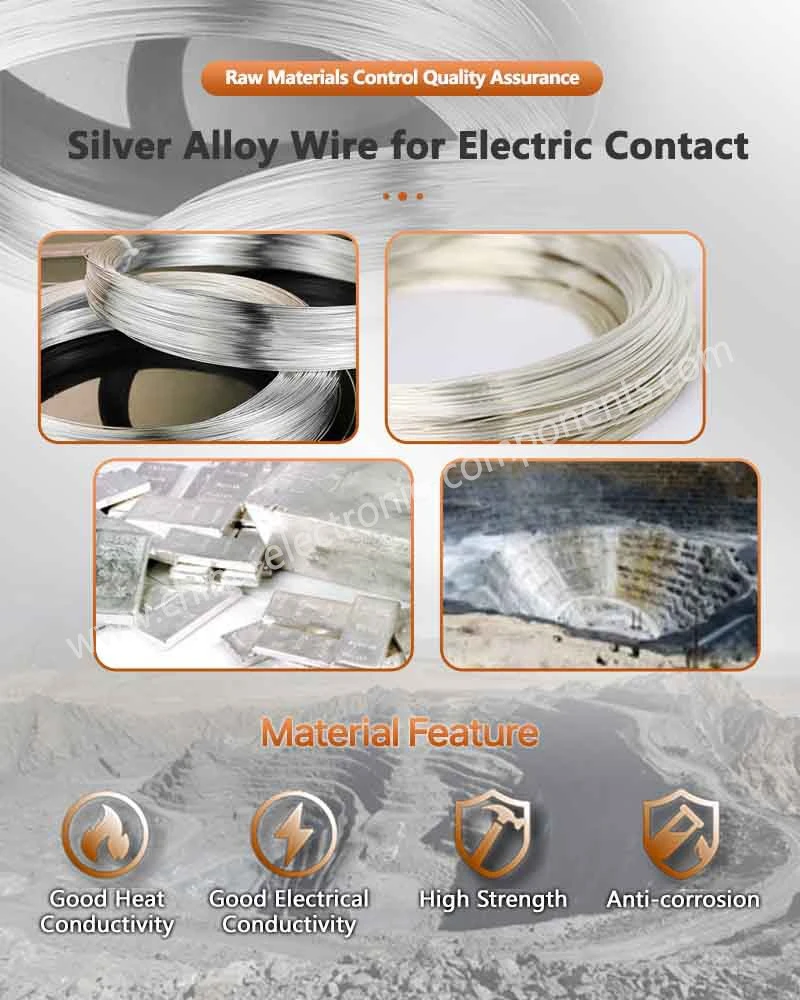
Technical Highlights and Design Advantages
Integrated Cold Forging Design
The cold forging process eliminates weak areas and potential for incomplete soldering in traditional silver soldering contacts, resulting in a more robust structure and avoiding the risk of delamination under high temperatures or arc impact.
Multi-Layer Interface Stress Relief Structure
The composite interface forms a micro-gradient transition layer during rolling, effectively absorbing mechanical stress and differences in thermal expansion, preventing silver layer detachment.
Customizable Engineering Design
We offer various combinations of silver layer thickness, shape, and size; customized solutions can be developed based on the customer's switching current rating, load type, and environmental conditions.
Precision Automated Production Line
Utilizing an automated feeding, inspection, and packaging system, the entire process from raw material entry to finished product delivery is traceable, ensuring product consistency and reliable delivery.

contact us

Hot Tags: silver electric contacts, China silver electric contacts manufacturers, suppliers, factory, Three Compound Contacts, Silver Alloy Contacts, Silver Cadmium Oxide Contact, Trimetal Silver Contact Rivets, Composite Contacts, Silver Electrical Contacts
You Might Also Like


Send Inquiry