

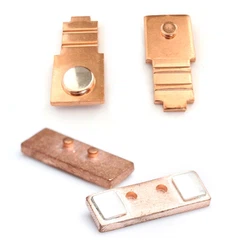
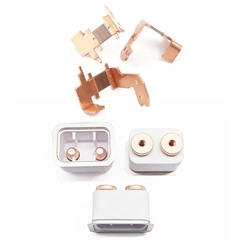

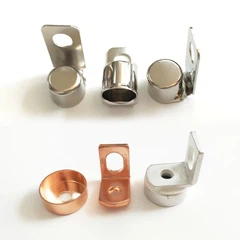


Metallized Ceramics For DC Relay Components
Products Description

Metallized Ceramics for DC Relay Components are advanced ceramic-metal composite structural materials. By bonding a ceramic substrate with a metal layer, they combine the excellent insulating properties of ceramics with the superior weldability, electrical conductivity, and mechanical connection capabilities of metals.
These products are primarily used in:
HVDC (High-Voltage Direct Current) relays
High-voltage contactors for new energy vehicles (EVs)
Battery Management Systems (BMS)
High-voltage control modules for energy storage systems
High-voltage switchgear for charging stations
Industrial DC power supply systems
High-reliability insulation
The ceramic substrate offers excellent electrical insulation, effectively isolating high-voltage zones to prevent leakage and dielectric breakdown, thereby enhancing the operational safety of high-voltage equipment.
Key Functions & Application Benefits
High-Efficiency Arc Quenching Support
High-voltage DC arcs lack the "zero-crossing point" characteristic of AC arcs, making them extremely difficult to extinguish. Our Metallized Alumina Relay Ceramics components withstand the pressure of high-pressure arc-quenching media (such as hydrogen or nitrogen), assisting the contactor in rapidly breaking and extinguishing powerful arcs.
Long-Lasting Thermal Shock Resistance
Localized, instantaneous high temperatures occur during the making and breaking of contacts. Our materials offer exceptional resistance to thermal shock and mechanical impact, ensuring structural integrity-without cracking or leakage-even after tens of thousands of charge-discharge cycles.
Enhanced System Energy Efficiency
Thanks to extremely low dielectric loss and excellent thermal conductivity, these components effectively dissipate heat generated at the contact points, enabling the contactor to operate efficiently while maintaining low impedance and minimal heat generation.

Detailed display: ultimate consideration of millimeter-level craftsmanship
Ultimate surface finish
After precise grinding and polishing, the roughness of the High Precision Alumina Ceramic Components' sealing surface is controlled to an extremely low level, ensuring that the brazing solder can be spread evenly and eliminating chronic air leakage caused by local virtual soldering.
Strict dimensional tolerance control
Whether it is the inner diameter of the special-shaped arc extinguishing tube or the mounting hole position of the flange, the dimensional tolerance is strictly controlled. This enables customers to achieve smooth grabbing and positioning on automated assembly lines, greatly improving production yield.
Uniform metallization layer thickness
Through optimized screen printing and sintering curves, the metallization layer thickness is uniform, avoiding the concentration of sealing stress caused by uneven layer thickness, and improving the 95% Alumina Mn Mo Metallized Ceramic's resistance to mechanical impact.

Precision Manufacturing Process
Powder Formulation and Granulation
Alumina powder and sintering additives are precisely weighed according to product performance requirements. Through ball milling and spray drying, a granulated powder with excellent flowability is produced, ensuring uniform density in the formed green bodies.
01
Precision Forming
Dry pressing or isostatic pressing processes are employed in conjunction with high-precision carbide molds. Under controlled pressure, Metallized Ceramics for DC Relay Components green bodies with precise shapes and consistent densities are produced, providing a stable foundation for subsequent sintering.
02
High-Temperature Bisque Firing
Green bodies undergo high-temperature binder burnout and pre-sintering to produce bisque-fired ceramic parts with sufficient strength for subsequent precision machining and metallization coating, while also stabilizing shrinkage rates for the final sintering stage.
03
Metallization Paste Application
Screen printing or dip coating processes are used to precisely apply formulated molybdenum-manganese metallization paste to designated areas of the High Voltage Relay Machining Metallized Alumina Ceramics. Coating thickness and edge definition are strictly controlled to ensure consistency across metallized regions.
04
High-Temperature Metallization Sintering
Coated Metallized Alumina Ceramics Relay Parts undergo high-temperature sintering in a furnace with a protective hydrogen atmosphere. This facilitates a thorough diffusion reaction between the metallization layer and the ceramic substrate, creating a robust metallurgical bond.
05

contact us
EV Relay Metallized High Alumina Ceramic relays are indispensable, mission-critical materials in HVDC (High-Voltage Direct Current) systems. By combining ceramic insulation properties, metal-bonding capabilities, and advanced manufacturing processes, they provide safe and reliable core solutions for new energy vehicles, energy storage systems, and high-voltage power equipment.
As the new energy industry evolves toward higher voltages, higher power densities, and greater reliability, high-performance metallized ceramic components will play an increasingly vital role in next-generation HVDC relay and DC contactor systems.
If you are developing high-voltage relays for new energy vehicles, HVDC systems for energy storage, or DC contactors, we can provide customized metallized ceramic component solutions tailored to your structural designs and performance requirements. Leveraging our mature manufacturing processes and engineering support capabilities, we help you rapidly achieve reliable mass production.

Hot Tags: metallized ceramics for dc relay components, China metallized ceramics for dc relay components manufacturers, suppliers, factory, HVDC Relay Skeleton Pure Iron, New Energy Contactor Contact, new energy hvdc part, New Energy HVDC Parts, New Energy Relay Yoke, Relay Armature Soft Magnetic Iron
You Might Also Like


Send Inquiry