











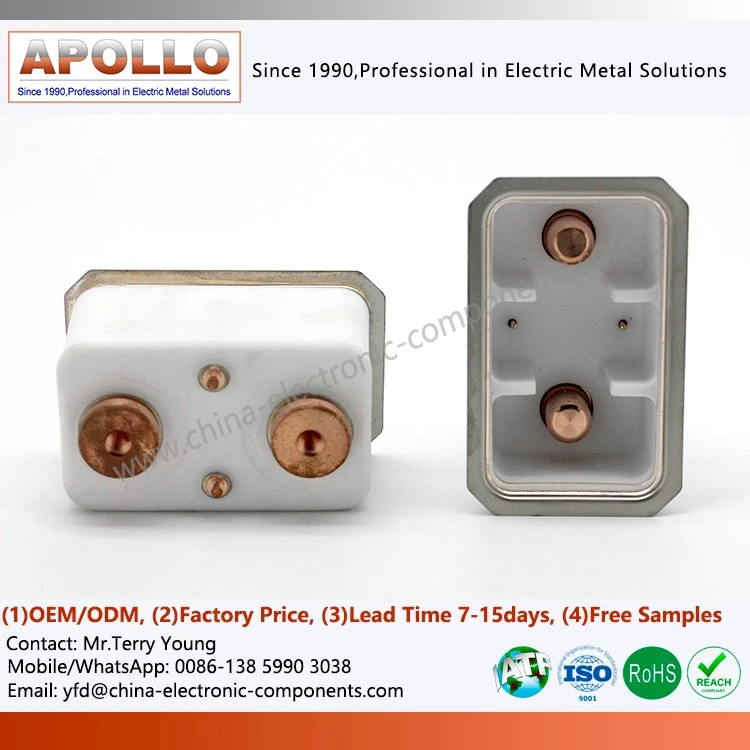
EV Alumina Ceramic Relay Housing
Products Description
With the continuous increase in voltage of new energy vehicle platforms, 800V and even higher voltage architectures have become an industry trend. Traditional plastics or ordinary insulating materials are prone to performance degradation under high temperature, arcing, and long-term aging conditions. Alumina ceramics, with their superior comprehensive performance, have become an important material choice for the structural upgrade of HVDC contactors.
EV Alumina Ceramic Relay Housing HVDC offers the following typical benefits:
Provides high-level electrical insulation
Resistance to thermal shock from high-voltage arcing
Maintains long-term dimensional stability
Supports precise assembly of metal terminals and internal structures
Adapts to vehicle vibration, thermal cycling, and complex operating conditions
Enhances contactor life and system safety redundancy

Technical Features: Superior Engineering Capabilities Beyond General-Purpose Ceramic Parts
Metallization Capability
The Metallization of alumina can be metallized with Mo-Mn in areas specified by the customer, supporting subsequent brazing or silver-copper soldering, and achieving a leak rate as low as 1 × 10⁻⁹ Pa·m³/s (as measured by helium mass spectrometry leak detection).
Customizable Structures
Various structures are available, including straight-through, stepped, observation window, and multi-medium interface types, adaptable to electromagnetic, permanent magnet, or thermomagnetic arc extinguishing solutions.
Adjustable Dielectric Strength
By adjusting the alumina purity in the formula (92%, 95%, 99%), different ratios of dielectric and mechanical strength can be achieved to meet the needs of different voltage platforms.
High Thermal Conductivity and Heat Dissipation Assistance
Alumina has a thermal conductivity of approximately 25-30 W/(m·K), effectively dissipating the instantaneous heat generated by the contact arc from the Alumina Metallized Ceramics for Bonding cavity to the external heat dissipation structure, mitigating heat accumulation.

Detailed Analysis: A Professional Buyer's Microscopic Perspective
Surface Finish of Unmetallized Areas
A high-quality casing should exhibit a smooth, natural Metallized Ceramics For Electrical sheen in non-welded areas, without obvious machining marks or grinding traces. Any microscopic machining scratches will become the "starting line" for surface discharge under a high-voltage DC electric field.
Edge Rigidity of the Metallized Layer
Observe the transition area between HVDC Contactor High Purity Ceramics Shell For Relay and metal. The edges of the metallized paste should be straight, burr-free, and free from penetration and staining. Edge defects will directly lead to uncontrolled solder creep during brazing, thus weakening the seal strength.
Concentricity of the Ceramic Body and Metal Terminals
Extremely high concentricity not only reflects precise machining capabilities but also ensures that a uniform electric field gap is formed between the internal contacts and the casing during final assembly, avoiding excessively high local electric field strength caused by eccentricity.

Application Advantages: Covering All High-Voltage Operating Scenarios
Our EV HVDC Relay Ceramic Housing is widely used in:
BEV/PHEV Power Battery Packs: As a disconnection device for the main positive electrode, main negative electrode, and fast charging circuit.
High-Voltage DC Charging Piles: Supporting frequent switching with high current and long lifespan.
Megawatt-level Energy Storage Systems: Ensuring the electrical safety of large-scale battery clusters under high energy density.
Photovoltaic Inverters: Providing reliable DC-side shutdown protection.

contact us
If you are seeking a Relay Alumina Ceramic Components supplier with experience in high-voltage relay projects, stable volume delivery capabilities, and collaborative engineering development expertise, please submit your drawings or requirements. We will provide a more reliable manufacturing solution for your project.

Hot Tags: ev alumina ceramic relay housing, China ev alumina ceramic relay housing manufacturers, suppliers, factory, New Energy HVDC Parts, Alumina Metallized Ceramics, New Energy Contactor Contact, Metallization Ceramic, Ceramic To Metal, New Energy Relay Yoke
You Might Also Like


Send Inquiry