



Application Of High-Frequency Brazing Technology in Custom Brass Welded Components
May 26, 2026
Leave a message
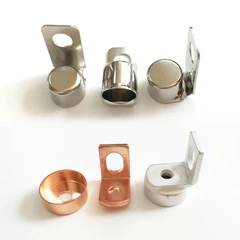
High-frequency brazing technology is a crucial process for precision metal joining. Utilising the principle of electromagnetic induction, it achieves efficient welding and is widely used in the processing of copper components. It is a core technological support for the production of Custom Brass Welded Components. When a high-frequency current flows through an induction coil, it generates an alternating magnetic field. The copper component, placed within this magnetic field, forms eddy currents. These eddy currents rapidly heat up under the influence of resistance, quickly bringing the workpiece to the brazing temperature. This non-contact heating method offers rapid heating, a small heat-affected zone, and precise temperature control, preventing deformation of the copper component and providing a reliable guarantee for the stable production of various products.

The welding process for Precision Welding for Brass Parts mainly consists of three key stages: preparation, welding, and cooling inspection. Each stage is closely linked and directly determines the quality of the finished product. The preparation phase requires careful workpiece pretreatment and equipment parameter debugging: First, thoroughly remove oil and oxide layers from the copper parts to prevent impurities from affecting the wettability of the brazing filler metal. Pretreatment can be done by sanding or chemical cleaning. Second, set equipment parameters according to the workpiece size and material, including current frequency, power, and welding time, to adapt to the welding requirements of different specifications of the components.
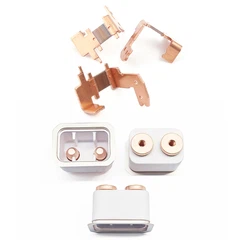
The welding stage is divided into semi-automatic and fully automatic modes to adapt to different production scales and ensure efficient production of Welded Brass Terminal Assemblies. The semi-automatic mode relies on manual positioning and automatic heating. Operators accurately place the workpiece into the induction coil, and the equipment heats up according to preset parameters. Once the temperature is reached, brazing filler metal is added manually to complete the gap-filling welding. This mode offers high flexibility and is suitable for small-batch, multi-specification welded component processing. The fully automatic mode relies on an automatic feeding, positioning, brazing, and unloading system. No manual intervention is required throughout the process. Parameters are precisely controllable, and welding consistency is high, making it suitable for large-scale standardised product mass production.
Cooling and quality inspection are the crucial final steps to ensure the performance of Welded Brass Socket Contacts. After welding, the workpiece is slowly cooled using natural or air cooling to allow the brazing filler metal to fully solidify and form a strong joint. External forces should be avoided during the cooling process to prevent cracking. Once the workpiece has cooled to room temperature, a comprehensive quality inspection is conducted. This includes visual inspection, magnification examination, and non-destructive testing to check for joint strength, porosity, cracks, incomplete penetration, and other defects. Defective workpieces are promptly reworked or re-welded with adjusted parameters to ensure product compliance with industry quality standards.
Both welding modes have their advantages, adapting to different production scenarios and contributing to the efficient development of the Brazed Contact Assembly industry. The semi-automatic mode offers outstanding flexibility, handling irregularly shaped and specially sized workpieces, and is suitable for small-batch customised production. However, it relies heavily on operator experience and has relatively lower efficiency. The fully automatic mode offers high production efficiency and strong quality stability, suitable for large-scale standardised production. However, it requires high-precision equipment control systems and sensors, and involves a larger initial investment. Enterprises can rationally choose the welding mode based on production scale, product specifications, and quality requirements to optimise production processes, effectively improve product processing efficiency and quality, and adapt to the needs of various industrial applications.

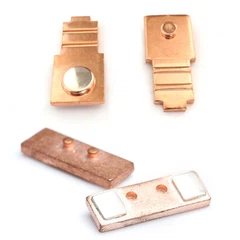
Leveraging mature high-frequency brazing technology and standardised production processes, we can customise various high-precision Brazing Silver Contacts to Copper Bars to meet diverse needs. We strictly control every production step to effectively avoid welding defects. Our products boast advantages such as high precision, excellent sealing, and strong durability, making them suitable for customised applications in various scenarios, including industrial electrical systems and precision instruments.
We offer a diverse range of high-quality Custom Brass Welded Components and one-stop customisation services. We welcome inquiries and bulk orders from our customers.
Contact us

Send Inquiry