










Understanding the Difference Between the Charging Cabinets and Charging Piles
Mar 12, 2026
Leave a message
With the increasing popularity of electric vehicles and energy storage devices, charging infrastructure is evolving from single devices to diversified solutions. Currently, the two most common forms on the market are charging cabinets and charging piles, which differ significantly in structural design, application scenarios, safety mechanisms, and operating models. For operators deploying battery charging stations or planning urban energy supply networks, understanding the technical characteristics and usage logic of both helps in making a more rational choice of charging infrastructure solutions.

From a structural design perspective, charging cabinets typically adopt a multi-compartment integrated structure, with each compartment providing an independent charging environment for a single battery. Their overall shape resembles a storage cabinet, and they are equipped with a power control system and monitoring module. These devices are essentially integrated lithium-ion battery charging cabinets, typically containing multiple charging modules and a management system for battery status monitoring, temperature control, and charging scheduling. Charging piles, on the other hand, are mostly independent power supply devices, installed on the ground or wall, supplying power to the entire vehicle through a charging interface. Some home appliances also use wall-mounted chargers, which have a relatively simple structure, mainly composed of a power supply module, a communication module, and a billing module.
In terms of application scenarios, the two types of equipment differ significantly in their suitable environments. Charging cabinets are more suitable for light electric vehicles with removable batteries, such as two-wheeled or three-wheeled electric vehicles. Users can remove the battery and place it in the cabinet for charging, making them ideal for space-constrained urban communities, commercial districts, or office buildings. These devices often work in conjunction with a centralized battery management system to monitor and schedule multiple batteries uniformly. Charging piles, on the other hand, are mainly used for charging entire vehicles, such as in parking lots for new energy vehicles or public charging stations. Some high-power devices support DC fast charging or DC rapid charging technologies, enabling vehicles to recharge in a shorter time, making them more suitable for long-term parking scenarios such as parking lots and highway service areas.

Regarding safety, charging cabinets typically employ a closed structure design with independently partitioned internal spaces, effectively reducing the impact of the external environment on the battery charging process. The equipment is generally equipped with multiple safety mechanisms such as temperature control, overcurrent protection, and smoke detection, and is linked to a power supply cabinet through a centralized power supply system. This structure reduces the risks posed by rain, dust, or external impacts to a certain extent. In contrast, traditional charging stations are mostly open-type devices. Although modern equipment has multiple protection functions, it still requires regular maintenance in extreme weather or due to equipment aging. High-power EV fast chargers, in particular, have higher requirements for wiring, heat dissipation, and electrical safety.
Regarding ease of use, charging cabinets offer advantages primarily in battery management. Users simply place the battery inside the cabinet to complete the charging process, without occupying a parking space, making them ideal for densely populated areas. For operators, these devices are essentially a combination of a centralized battery storage cabinet and a charging system, capable of managing multiple batteries simultaneously and improving space utilization. Charging stations, on the other hand, require vehicles to be parked and connected to a charging port to complete the charging process. Some homes or small parking lots may install EV home chargers or low-power lead acid battery chargers to meet daily slow-charging needs.
The two types of equipment also differ in terms of construction costs and maintenance. Charging cabinets, due to their complex structure, require the integration of power systems, temperature control systems, and monitoring modules, resulting in relatively higher initial construction costs. Their internal structure is similar to industrial-grade charger enclosures or energy storage inverter battery cabinets. However, its advantage lies in its high space utilization, making it suitable for high-density charging needs. Charging piles, on the other hand, are more suitable for large-scale deployment, with simpler equipment structures and shorter construction cycles. Some power system equipment also provides stable power support to the power supply system through external battery systems, such as Liebert EXM battery cabinets or Liebert GXT3 external battery cabinets.
Looking at future development trends, charging cabinets are gradually upgrading to intelligent battery swapping systems. Through centralized management of battery resources and cloud data platforms, the equipment can not only realize charging functions but also support battery leasing and rapid replacement modes. These systems typically combine high-density battery management structures, such as 12V battery charger cabinets or multi-battery integrated cabinets, to improve battery turnover efficiency. At the same time, charging pile technology is also constantly upgrading, with high-power DC charging technology gradually becoming an important direction for new energy vehicle refueling, bringing charging speeds close to the refueling efficiency of traditional gasoline vehicles.
Overall, charging cabinets are more suitable for electric vehicles with removable batteries, especially in space-constrained environments such as urban communities and commercial districts, where their centralized battery management mode has significant advantages. Charging piles are more suitable for charging new energy vehicles, especially in scenarios involving long-term parking such as parking lots and highway service areas. With the continuous upgrading of energy infrastructure, these two types of equipment are likely to gradually merge at the technological level in the future, forming a more efficient and intelligent electric transportation energy network.
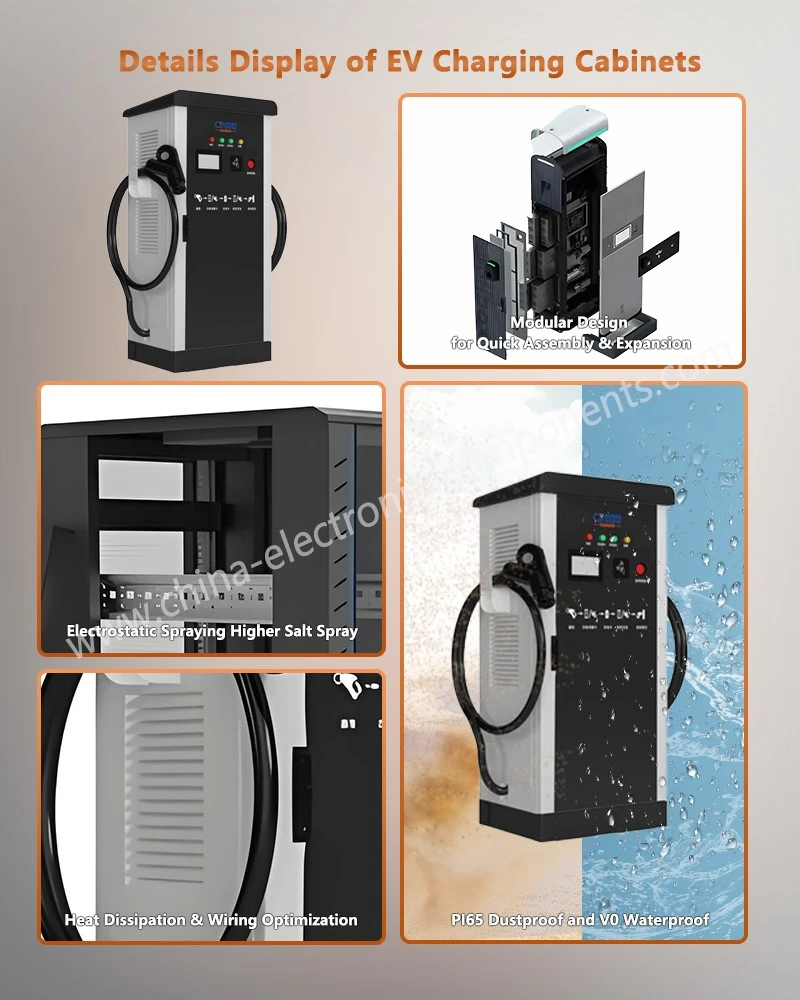
Against the backdrop of the rapid development of the electric vehicle and energy storage industries, the structural design and manufacturing capabilities of related power supplies and charging equipment have become increasingly important. Our company has long focused on the manufacturing of various new energy structural components and power equipment parts, such as lithium battery charging cabinets, inverter battery box cabinets, and various industrial-grade power cabinet structural components, all centered around charging systems and energy equipment. Through mature metal processing and precision manufacturing processes, we can provide stable and reliable structural solutions for new energy charging systems, energy storage systems, and power equipment, helping to build a safer and more efficient energy charging infrastructure.
contact us

Send Inquiry