










The difference between silver contacts and silver-based contacts in low-voltage electrical appliances
Apr 01, 2026
Leave a message
In the field of low-voltage electrical appliances, contact materials directly determine the conductivity, lifespan, and operational reliability of equipment. Among these, "silver contacts" and "silver-based contacts" are the two most common types of conductive contact materials, differing fundamentally in their material structure, performance, and applicable operating conditions. A proper understanding of the technical characteristics of these two types of electrical contacts is a crucial prerequisite for selection and design optimization.
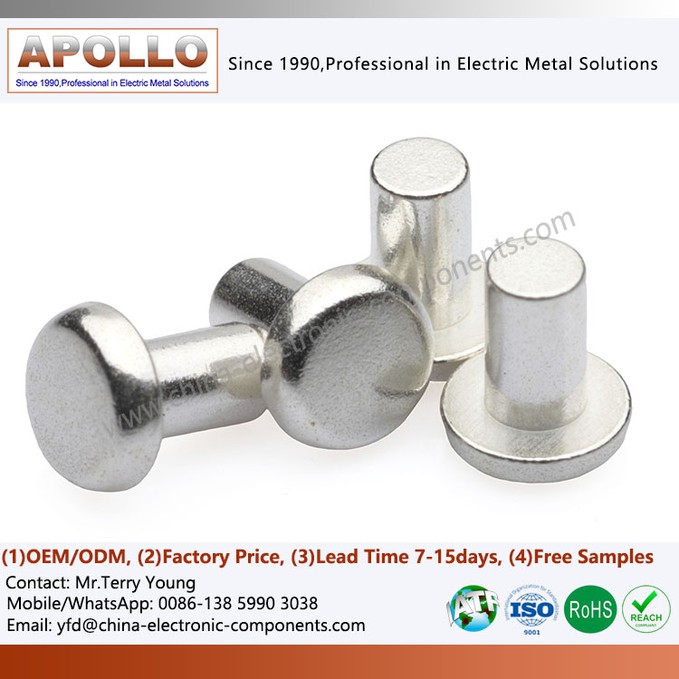
From a material composition perspective, silver contacts typically refer to contacts made primarily of high-purity industrial silver, such as Pure Silver Contacts or Solid Silver Contacts. These materials contain almost no other alloying elements and possess the excellent conductivity and thermal conductivity of silver itself, making them suitable for conductive connection scenarios sensitive to resistance. Silver-based contacts, on the other hand, are composite material systems formed by adding a certain proportion of metals or functional phases (such as oxides or alloying elements) to silver, such as Silver Alloy Contacts or Alloy Silver Contacts. Their core objective is to improve overall mechanical and electrical performance while maintaining conductivity.

In terms of performance, the biggest advantage of pure silver contacts (such as silver electrical contacts) lies in their extremely high conductivity and low contact resistance, enabling efficient and stable current transmission. Therefore, they perform exceptionally well in devices with high conductivity requirements but low operating frequencies. However, due to the low hardness and limited arc erosion resistance of pure silver, it is prone to adhesion, welding, or burn-off under frequent switching or high-arc environments, which limits its application in complex working conditions to some extent.
In contrast, silver-based contacts (such as silver alloy rivets or silver alloy contacts) effectively improve the material's arc erosion resistance, welding resistance, and thermal stability by introducing a reinforcing phase. These electronic contacts significantly reduce contact erosion and material migration under high-frequency operating conditions, thereby extending their service life. Simultaneously, their higher mechanical strength and wear resistance make them suitable for switching systems or relay structures with repetitive operation.
In terms of application scenarios, silver contacts (such as silver contact points or solid silver contacts) are more suitable for low-frequency operation scenarios requiring low contact resistance, such as static conductive connections, precision instruments, or some power supply terminals. Silver-based contacts are widely used in low-voltage electrical equipment requiring frequent switching, such as relays, contactors, and circuit breakers. They offer superior stability in complex contact-in-electrical environments.

From a cost and engineering perspective, pure silver contacts, due to their simple material composition and relatively easy processing, offer a cost-controllable advantage in certain large-scale applications, such as Silver Solid Contact Rivets. Silver-based contacts, however, involve alloy design and processes like powder metallurgy and composite sintering, resulting in a relatively higher overall manufacturing cost. However, the improved lifespan and reliability often offset the initial investment over long-term use.
Furthermore, in practical engineering design, contact performance depends not only on the material itself but also on surface treatment, structural design, and assembly processes. For example, a suitable plating system or optimized contact pressure can further improve the conductivity and corrosion resistance of electrical contacts. Therefore, selection should comprehensively consider material type, operating conditions, and system lifespan requirements, rather than solely relying on material properties.
In summary, silver contacts emphasize ultimate conductivity, while silver-based contacts focus more on a balanced overall performance. Neither is inherently superior; the key lies in matching specific application requirements. As low-voltage electrical appliances continue to evolve towards higher frequencies and higher reliability, the application ratio of silver-based alloy contacts is steadily increasing, while pure silver contacts retain irreplaceable value in specific high-conductivity scenarios.
At the product level, we focus on the research and development and manufacturing of various high-performance contact solutions, covering a product system of solid contacts, composite contacts, and silver contacts with various structural forms. Through material optimization and process control, we can provide stable and reliable conductive connection solutions for different application scenarios, meeting the continuous demand for high-quality electrical contacts in the low-voltage electrical appliances, automotive electronics, and new energy fields.
contact us

Send Inquiry