










Ceramic Bodies for HVDC Contactors and New Energy Fuses: Material Properties & Metallization
Aug 11, 2026
Leave a message
HVDC contactor ceramic bodies and high voltage fuse ceramic tubes require electrical insulation above 15kV/mm, stable mechanical strength under thermal cycling, and reliable metal-ceramic bonding during long-term DC interruption. 95% alumina ceramic is widely selected because its dielectric strength, thermal conductivity, and vacuum compatibility meet the requirements of EV battery systems, ESS protection units, and high voltage power electronics.
For HVDC applications, ceramic performance depends not only on material composition but also on metallization thickness, Mo-Mn adhesion control, brazing temperature profile, and dimensional accuracy. A qualified ceramic body manufacturer must control the complete process chain from ceramic forming to CMM inspection and helium leak testing.
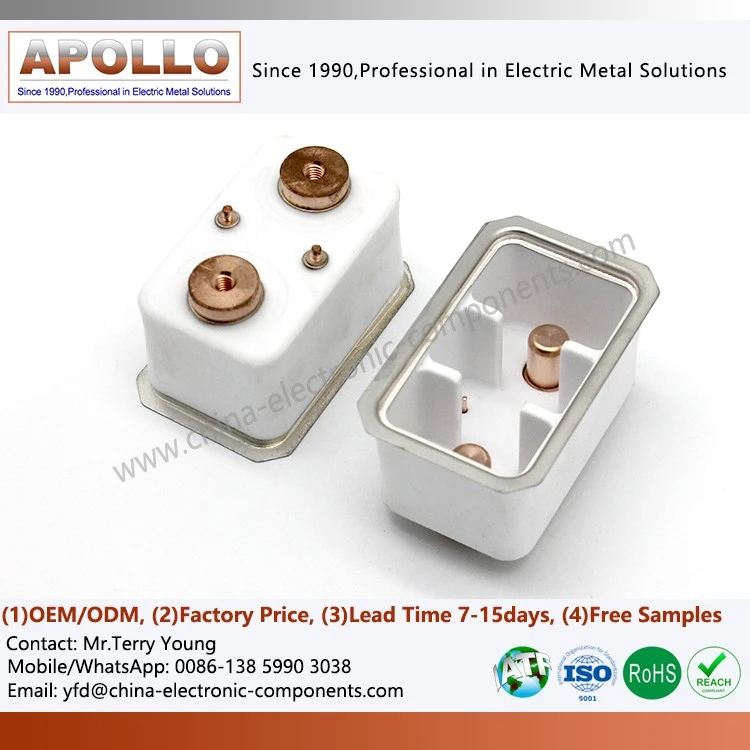
Why HVDC Contactors Require 95% Alumina Ceramic Body with >15kV/mm Dielectric Strength
HVDC Contactor Ceramic Body Performance Requirements under 900V–1500V DC Systems
Unlike AC switching devices, HVDC contactors face continuous arc energy during current interruption because DC has no natural zero-crossing point. The ceramic housing provides electrical isolation and maintains internal vacuum or gas-tight sealing conditions.
The ceramic body must withstand:
DC voltage insulation requirements from 450V to 1500V battery platforms
Repeated arc interruption cycles above 100,000 operations
Thermal shock caused by rapid temperature changes
Mechanical stress from metal sealing structures
Vacuum leakage requirements below 1×10⁻⁹ Pa·m³/s
Typical engineering requirements for HVDC ceramic components:
| Parameter | Typical Requirement | Testing Method |
| Ceramic Material | 95% Alumina (Al₂O₃) | Material composition analysis |
| Dielectric Strength | >15kV/mm | IEC 60243 |
| Volume Resistivity | >10¹⁴ Ω·cm | IEC 60093 |
| Thermal Conductivity | 20–25 W/m·K | ASTM E1461 |
| Flexural Strength | >300 MPa | ISO 14704 |
| Operating Temperature | -55°C to +200°C | Thermal cycling test |
| Dimensional Tolerance | ±0.01mm | CMM inspection |
95% alumina ceramic contains approximately 95% aluminum oxide with controlled glass phase additives. The microstructure provides higher mechanical strength than many conventional insulating materials while maintaining stable electrical properties at elevated temperatures.
Ceramic Insulation Failure Risks in HVDC Contactors and Fuse Assemblies
Common ceramic body failures are related to:
Internal micro-cracks caused by improper sintering temperature
Low metallization adhesion strength
Brazing voids between ceramic and copper/metal terminals
Thermal expansion mismatch between ceramic and metal components
The coefficient of thermal expansion must be carefully matched:
| Material | Thermal Expansion Coefficient (×10⁻⁶/K) | Application Consideration |
| 95% Alumina Ceramic | 6.5–7.5 | Suitable for Mo-Mn metallization and brazing |
| Copper C1100 | 16.5 | Requires controlled brazing stress |
| Kovar Alloy | 5.0–5.5 | Common sealing alloy for ceramic assemblies |
| Stainless Steel 304 | 17.2 | Requires an expansion compensation design |
A mismatch exceeding the designed range may generate residual stress during cooling after brazing, leading to ceramic cracking.

95% Alumina Ceramic vs Steatite Ceramic: Material Selection Based on Electrical and Mechanical Data
Material Comparison for High Voltage Fuse Ceramic Tube and Contactor Housing Applications
95% alumina and steatite ceramic are both electrical insulation materials, but their performance differs significantly in high voltage DC environments.
| Property | 95% Alumina Ceramic | Steatite Ceramic |
| Al₂O₃ Content | 95% | 30–45% |
| Dielectric Strength | >15kV/mm | 8–12kV/mm |
| Flexural Strength | 300–400MPa | 120–200MPa |
| Thermal Conductivity | 20–25W/m·K | 2–4W/m·K |
| Thermal Shock Resistance | High | Medium |
| Mechanical Precision | ±0.01mm achievable | ±0.03mm typical |
| High Voltage DC Application | Recommended | Limited |
| Cost Level | Higher | Lower |
For high-voltage fuse ceramic tubes operating under IEC 60269 requirements, alumina ceramic provides better resistance against arc-generated heat and mechanical shock.
Steatite ceramic is mainly used in low-voltage insulation components where thermal cycling and dielectric stress are lower.
High Voltage Fuse Ceramic Tube Design Requirements under IEC 60269 Standards
New energy fuse ceramic tubes must maintain:
Arc extinguishing capability
High temperature resistance
Stable insulation distance
Mechanical strength during fault current interruption
Typical applications include:
EV battery pack fuse protection
Energy storage battery cabinet protection
Solar inverter DC protection systems
Charging pile power modules
For lithium battery protection systems exceeding 500A continuous current, the ceramic tube design directly affects interruption reliability.
Request Free DFM Evaluation & Quote
Mo-Mn Metallization and Brazing Process Control for Ceramic-to-Metal Bonding
Mo-Mn Metallization Layer with Controlled Adhesion Strength
Ceramic itself cannot directly bond with copper, Kovar, or stainless steel because of the different surface chemistry between ceramic oxide structures and metals.
The standard solution is Mo-Mn metallization.
The metallization process includes:
Ceramic surface cleaning and activation
Mo-Mn paste printing
High-temperature hydrogen atmosphere firing
Nickel plating
Vacuum brazing assembly
Typical metallization parameters:
| Process Parameter | Control Range |
| Mo-Mn Layer Thickness | 10–30μm |
| Nickel Plating Thickness | 1–5μm |
| Firing Temperature | 1300–1450°C |
| Atmosphere | Hydrogen/Nitrogen |
| Adhesion Strength | >20MPa |
The molybdenum particles create mechanical anchoring inside ceramic pores, while manganese oxide improves chemical bonding between ceramic and metal.
Resistance Brazing and Active Brazing Process Comparison
| Process | Temperature Range | Bond Strength | Typical Application |
| Mo-Mn Metallization + Brazing | 780–900°C | High | HVDC contactors |
| Active Brazing (Ag-Cu-Ti) | 850–950°C | Very High | Ceramic-metal vacuum assemblies |
| Resistance Brazing | 700–850°C | Medium-High | Localized metal joining |
For HVDC contactor ceramic bodies, controlled furnace brazing is preferred because it provides uniform temperature distribution and reduces residual stress.
Quality Control of Ceramic Metallization and Brazing Joints
Production inspection includes:
CMM dimensional measurement
Metallization adhesion testing
X-ray inspection for brazing voids
Helium leak testing
Thermal shock testing
High voltage insulation testing
Typical quality criteria:
| Inspection Item | Acceptance Requirement |
| Ceramic Dimension | ±0.01mm |
| Brazing Void Rate | <5% |
| Helium Leakage | <1×10⁻⁹ Pa·m³/s |
| Insulation Voltage | >15kV/mm |
| Metallization Adhesion | >20MPa |

Manufacturing Process of Alumina Ceramic Bodies for EV, ESS, and PV Power Electronics
Ceramic Forming and Sintering Control under ISO 9001 Production Systems
The manufacturing process includes:
Ceramic powder preparation
Dry pressing or injection molding
Green machining
High temperature sintering
Precision grinding
Metallization
Brazing
Final inspection
Key production parameters:
| Manufacturing Stage | Controlled Parameter |
| Powder Mixing | Particle distribution |
| Press Forming | Density uniformity |
| Sintering | 1600–1700°C |
| Grinding | ±0.01mm tolerance |
| Metallization | Layer thickness control |
| Inspection | CMM + electrical testing |
Improper sintering control can generate:
Open pores
Reduced dielectric strength
Surface cracks
Lower mechanical reliability
Quality Management Requirements for Automotive and Energy Storage Customers
For global EV and ESS supply chains, ceramic component suppliers commonly follow:
IATF 16949 automotive quality management
ISO 9001 manufacturing control
ISO 14001 environmental management
PPAP Level 3 submission
RoHS and REACH compliance
Supplier quality documentation normally includes:
Material certificate
Process flow chart
Control plan
FMEA analysis
Dimensional inspection report
Reliability test report
Typical Applications of HVDC Ceramic Bodies in New Energy Systems
EV Battery Systems with 400V–1000V High Voltage Platforms
HVDC ceramic components are used in:
Main battery contactors
Pre-charge contactors
DC fast charging modules
Battery disconnect units
Requirements:
High dielectric isolation
Low leakage current
Long switching lifetime
Resistance against arc erosion
ESS and PV Inverter Protection Systems under IEC Standards
Energy storage systems require ceramic insulation components for:
Battery rack protection
DC combiner boxes
Power conversion systems
High-voltage fuse assemblies
Typical operating conditions:
| Application | Voltage Range | Current Range |
| EV Battery System | 400–1000V DC | 100–600A |
| ESS Rack | 750–1500V DC | 200–1000A |
| PV Inverter | 600–1500V DC | 50–500A |
Selecting an Alumina Ceramic Body Manufacturer for HVDC Applications
A qualified supplier should provide:
95% alumina ceramic material capability
Mo-Mn metallization technology
Vacuum brazing process
CMM inspection capability
PPAP Level 3 documentation
Batch traceability system
For engineering teams developing HVDC contactors, fuse protection devices, and power electronic modules, ceramic material selection must be evaluated together with metallization design, sealing process, and lifetime reliability requirements.

Frequently Asked Questions
Q1: What is the recommended ceramic material for HVDC contactor ceramic bodies?
95% alumina ceramic is recommended because it provides dielectric strength above 15kV/mm, flexural strength above 300MPa, and stable performance under thermal cycling.
Q2: Can an alumina ceramic body manufacturer provide PPAP Level 3 documents?
Yes. Automotive suppliers can provide PPAP Level 3 packages, including PFMEA, control plan, dimensional reports, material certificates, and reliability test records.
Q3: How is the Mo-Mn metallization thickness controlled on ceramic fuse tubes?
Mo-Mn metallization thickness is typically controlled within 10–30μm using screen printing parameters, firing conditions, and adhesion testing after metallization.
contact us
Send Inquiry