



How to use relay silver contacts professionally
May 21, 2026
Leave a message
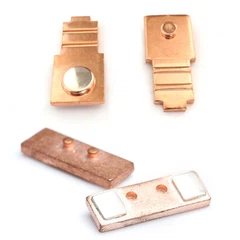
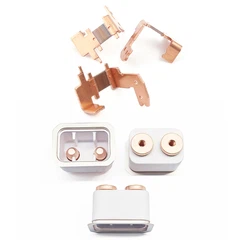
In relays and low-voltage electrical systems, the performance of contact materials directly affects the conductivity stability, breaking capacity, and overall service life of the equipment. As a core conductive component in switches, circuit breakers, and relays, Electrical Silver Contacts are widely used in industrial control, power distribution, new energy equipment, and automation systems due to their excellent conductivity, arc resistance, and low contact resistance. Different types of Silver Electrical Contacts perform critical functions such as connecting, disconnecting, current switching, and protection in practical applications; therefore, the appropriate selection of material type and manufacturing process is crucial.

Currently, common contact materials in the industry mainly include pure silver contacts, silver-cadmium contacts, silver-nickel contacts, and silver-tin oxide contacts. Among these, Silver Contacts in Breakers and relay products typically match different material systems based on the load current, voltage level, and breaking frequency. For example, high-frequency breaking scenarios emphasize anti-welding performance, while high-current applications focus more on conductivity and wear resistance. Some high-performance products utilize Bimetal Silver Contact or Silver Alloy Electrical Contact Rivets structures to reduce precious metal consumption and improve overall mechanical strength.
In contact manufacturing, material ratios and process control determine the final performance stability. The industry widely employs Cold Forming Technology and Metal Cold Forming processes for precision forming. Cold forming processes effectively improve contact dimensional consistency and internal density. For high-precision Silver Contact Rivet products, Cold Headed Electrical Contacts achieve better coaxiality and surface quality, reducing post-processing errors. Simultaneously, Cold Forming of Metals reduces material loss and improves the utilization efficiency of precious metal alloys.

In some high-load applications, AgSnO2 contact and silver tin oxide materials are gradually replacing traditional cadmium-containing materials due to their environmental friendliness and arc resistance. Meanwhile, Silver Point Contact and Electrical Contact (Silver Point) are widely used in micro relays, automotive electronics, and precision control systems; their contact stability directly affects the signal transmission and long-term reliability of the equipment. Some products also use C10100 Copper Contact as the base material to improve overall conductivity and heat dissipation.
During long-term operation, common faults in relay contacts include overheating, contact welding, surface oxidation, and mechanical fatigue. Abnormal heating of electrical contacts is usually related to insufficient contact pressure, surface contamination, increased contact resistance, or mismatched capacity selection. A large arc generated when the contacts close can cause ablation or even welding of the silver point contact surface, which can severely affect the safe operation of the entire system.
During maintenance, the surface of the electrical contact point should be carefully inspected for oxide layers, ablation marks, or foreign matter. For general contamination, industrial cleaners can be used to treat it, avoiding dust and oil stains that could affect conductivity. While some oxidized electrical contact surfaces may have slight oxidation, silver itself has good conductivity recovery capabilities, and excessive polishing is unnecessary in some operating conditions. If there is significant ablation or molten pitting on the surface, a fine file can be used for minor repair, but coarse abrasive materials are not recommended to avoid residual particles causing poor contact.
For equipment operating at high frequencies for extended periods, the mechanical structure of the contact points should also be checked periodically for looseness. Contact spring fatigue or deformation can lead to a decrease in contact pressure, increasing resistance, and the risk of overheating. Some large electrical contact manufacturers verify product reliability during production through dynamic life testing, contact resistance testing, and temperature rise testing to ensure long-term operational stability.
With the development of smart grids, new energy vehicles, and industrial automation, electrical contact manufacturers are placing higher demands on material performance and manufacturing precision. Modern contact products not only require stable conductivity but also need to consider environmental friendliness, safety, long lifespan, and high-frequency breaking performance. Therefore, bimetallic rivets, silver alloy electrical contact rivets, and multilayer composite structures are gradually becoming important development directions in the industry.

In actual selection, the material solution should be comprehensively judged based on the load type, current rating, operating frequency, and operating environment. For example, high-current equipment is more suitable for high-conductivity silver electrical contacts, while high-frequency breaking scenarios emphasize arc resistance and anti-welding capabilities. Meanwhile, products manufactured using cold-formed metal processes typically have advantages in dimensional consistency, mechanical properties, and batch stability.
Currently, the manufacturing of high-quality electrical contacts is no longer limited to a single material selection, but integrates precious metal alloys, precision molding technology, and automated testing processes. In the future, with the continuous upgrading of high-end electrical equipment, Silver Contact Rivet and composite contact materials will find wider application in new energy, power control, rail transportation, and intelligent manufacturing.
contact us

Send Inquiry