



How to Control the Quality of Silver Soldered Electrical Contacts Through Brazing Material Selection?
Jun 03, 2026
Leave a message
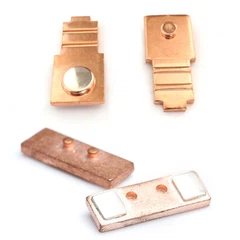
In the field of electrical component manufacturing, the quality of brazing materials directly affects the sealing effect, connection strength, and service life of Silver Soldered Electrical Contacts. The primary consideration in selecting brazing materials is the purity of the components. The alloy ratio determines the conductivity, corrosion resistance, and structural strength of the finished product. Mainstream formulations include environmentally friendly options such as silver-copper-zinc and cadmium-free silver-copper-tin. The silver content is flexibly adjusted according to the application scenario. Electronic conductive components commonly use a silver content of over 45%, while general mechanical components can be suited to 25% to 30% silver content. The total content of impurities such as iron and lead must be controlled below 0.3%.

Matching the melting temperatures of the base material and the solder is a core condition for ensuring a stable connection in Silver Welding Electrical Contacts. The general principle for brazing material selection is that the solder melting point should be slightly lower than that of the base material, which can both fill the weld gap and prevent high-temperature deformation and damage to the base material. Copper-based solders are designed for melting temperatures of 650-700℃, while stainless steel-based solders are suitable for products with melting temperatures between 700-800℃. Imbalances in these temperature parameters can cause oxidation of the base material or high-temperature softening and failure of the joint, compromising the stability of the electrical contacts.
The mechanical properties of the post-weld formed components directly determine the long-term operating tolerance of Brazed Silver Contact Points. Qualified weld points must have a tensile strength of at least 85% of the base material; high-voltage piping electrical components must have a tensile strength exceeding 300MPa; and components used in high-frequency vibration applications must have an elongation rate of at least 10%. Joints processed with inferior solder are brittle and prone to cracking when the material is bent or the weld area is struck, failing to meet the mechanical standards for continuous operation of electrical contacts.
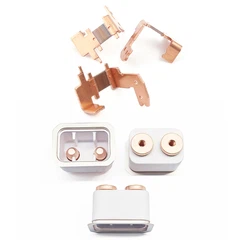
The post-melting process significantly impacts the forming quality of the intricate structure of Silver Brazing Contacts for Electrical. High-quality solder exhibits excellent wetting and flow properties after melting, spreading evenly on the base material surface, achieving a gap-filling rate exceeding 95%, and enabling complete welding even in narrow and complex contact cavities. Meanwhile, excellent slag removal performance simplifies subsequent cleaning; welding slag can be easily wiped away, preventing residue adhesion and corrosion of the contact substrate, and reducing potential electrical faults.
Environmental compliance is a rigid principle for selecting brazing filler metals in modern electrical production, and it also relates to the market access qualifications of finished Silver Welding Connector Contacts. Older cadmium-containing brazing filler metals release harmful fumes at high temperatures, and the waste is difficult to degrade naturally, failing to meet RoHS and REACH environmental standards. For contact processing in medical devices, food equipment, and consumer electronics, only lead-free and cadmium-free environmentally friendly brazing filler metals can be used; verifying environmental certification labels is a necessary step during procurement.

A comprehensive selection of brazing filler metals based on multiple parameters effectively ensures the overall quality of Welding Button Contacts. Selection should be based on the actual application environment of the contacts, prioritizing compliant products with complete component labeling, low impurity content, matching melting point, and excellent mechanical and technological properties. Initial screening can also be done quickly through the appearance, flatness, and bending toughness of the raw materials, ensuring the welding quality and service life of electrical contacts from the source.
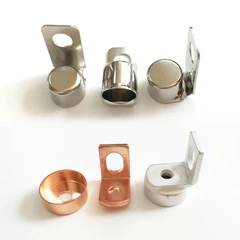
After comprehensively considering various material selection standards, our self-developed Silver Soldered Electrical Contacts, crafted with stringent processes, strictly adhere to the aforementioned production specifications regarding purity, melting point, mechanical properties, and environmental protection. Raw material impurities are rigorously controlled, welding compatibility is outstanding, and excellent molding results are achieved while maintaining environmental certifications. They are suitable for various applications in electronics, medical, and precision electromechanical fields. New and existing customers are welcome to inquire about samples and bulk purchases at any time.
contact us

Send Inquiry