



Application of Diffusion Bonding Technology in Flexible Copper Foil Connectors
May 27, 2026
Leave a message
Diffusion bonding is an advanced solid-state welding process centered on achieving intimate contact between material surfaces under the combined influence of high temperature and pressure. During this process, localized plastic deformation occurs within the materials, facilitating interatomic diffusion that ultimately results in the formation of a new diffusion layer at the interface, thereby establishing a robust solid-state metallurgical bond. In the fields of modern power electronics and new energy, this precision joining technique is widely employed in the fabrication of various high-performance conductive components-such as Copper Foil Flexible Laminated Copper Busbars-devices for which the microstructure of the bonding interface and overall structural integrity are subject to exceptionally rigorous requirements.

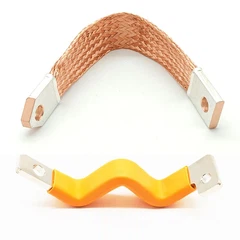
From a physical-mechanical perspective, the process of diffusion bonding can be broadly divided into three overlapping stages. The first is the physical contact stage: under the influence of pressure and temperature, surface asperities undergo plastic deformation; as pressure is continuously applied, the true contact area expands until the entire surface achieves reliable contact. The second is the stage of inter-atomic diffusion, during which a robust bonding layer is formed. The third and final stage involves the growth of this bonding layer into the bulk material. These three processes are not strictly discrete but are accompanied by complex phenomena such as recrystallization. In practical manufacturing, by precisely controlling these parameters, it is possible to successfully fabricate complex electrical components-such as Copper Foil Flexible Busbars with Insulated Tubing-thereby ensuring their safety and reliability during long-term service.
The selection of welding parameters is the critical factor determining the overall performance of the joint, with temperature, pressure, and time being the most significant variables. Temperature not only influences the material's yield strength but also directly governs atomic diffusion behavior and the efficacy of void elimination; typically, an empirical formula of T = (0.6–0.8)Tm is applied, where Tm represents the lowest melting point of the materials involved. Precise temperature control ensures that Copper Foil Flexible Busbar Connectors achieve superior mechanical strength and electrical conductivity without melting the base material, thereby avoiding the thermal stress damage often associated with traditional fusion welding.
A defining characteristic of diffusion bonding is that it induces neither macroscopic deformation nor relative displacement of the parts being joined; furthermore, it can be performed either with or without the use of an interlayer material between the mating surfaces. This attribute makes the technique ideally suited for the direct joining of similar metals and non-metallic materials, yielding joint strengths that are equal or nearly equal to that of the base material. For materials prone to cracking during traditional fusion welding-such as nickel-based superalloys and high-strength aluminum alloys-this technology offers unparalleled advantages. It is frequently employed in the manufacture of highly reliable Copper Foil Battery Busbar Connectors, significantly enhancing the stability of internal connections within battery packs.
Moreover, diffusion bonding demonstrates exceptional performance in the joining of dissimilar materials; indeed, approximately 70% of its practical applications involve such scenarios. Whether joining copper to aluminum, aluminum to stainless steel, or ceramics to Kovar alloys, effective bonding can be successfully achieved. This robust compatibility enables Laminated Flexible Copper Busbars to seamlessly integrate metal materials with diverse properties, thereby fully leveraging the unique advantages of each constituent layer to meet the demanding requirements for electrical transmission and mechanical support under complex operating conditions.

This technology is particularly well-suited for manufacturing applications requiring large-area bonding, stacked components, hollow structures, and parts featuring complex internal channels. For instance, structural components that are difficult to realize using traditional welding methods-such as turbine blades and honeycomb panels-can be successfully fabricated using this process. In the electrical industry, this has also spurred significant demand for flexible copper foil connectors, which frequently incorporate multi-layer stacking or internal cavity structures to optimize heat dissipation and current distribution.
Frequently Asked Questions
What are the core advantages of diffusion bonding for Press Welding Foil Busbar compared to traditional fusion welding?
Diffusion bonding is a solid-state joining process; it does not involve the melting of the base material. Consequently, it avoids defects common in fusion welding-such as porosity and cracking-and results in minimal macroscopic deformation of the workpiece, thereby ensuring high dimensional accuracy. It is particularly well-suited for joining high-temperature alloys prone to cracking, as well as dissimilar materials with significant differences in thickness.
How should the temperature be controlled during the diffusion bonding process for Copper Foil Flexible Connector?
Temperature is a decisive factor influencing atomic diffusion and the elimination of interfacial voids. Typically, the bonding temperature is controlled within the range of 0.6 to 0.8 times the lowest melting point (Tm) of the materials being joined (expressed in absolute temperature). Temperatures that are too high may lead to grain coarsening, while temperatures that are too low will fail to facilitate sufficient atomic diffusion.
Why is diffusion bonding for Copper Foil Battery Busbar Connector particularly suitable for joining dissimilar materials?
Traditional fusion welding often leads to the formation of brittle intermetallic compounds when joining dissimilar metals, resulting in a deterioration of joint performance. Diffusion bonding, which is conducted in the solid state, allows for the suppression of harmful compound formation through the introduction of appropriate interlayer materials. This enables the achievement of reliable metallurgical bonds between otherwise incompatible materials-such as copper and aluminum, or ceramics and metals.
contact us
If you have custom requirements for copper foil connections, please feel free to contact us at any time. Our professional team will provide you with comprehensive technical support and solutions to help your products achieve exceptional performance.

Send Inquiry