










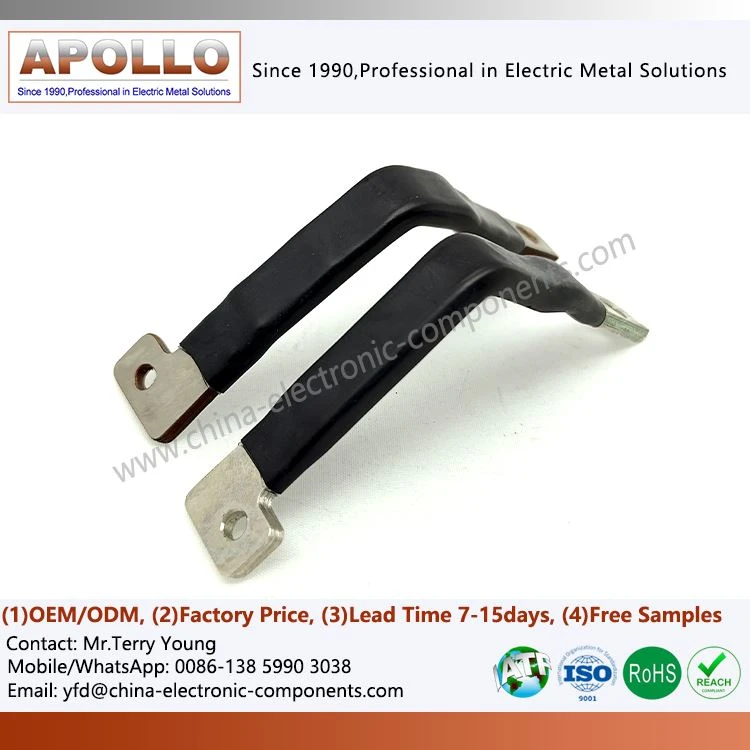
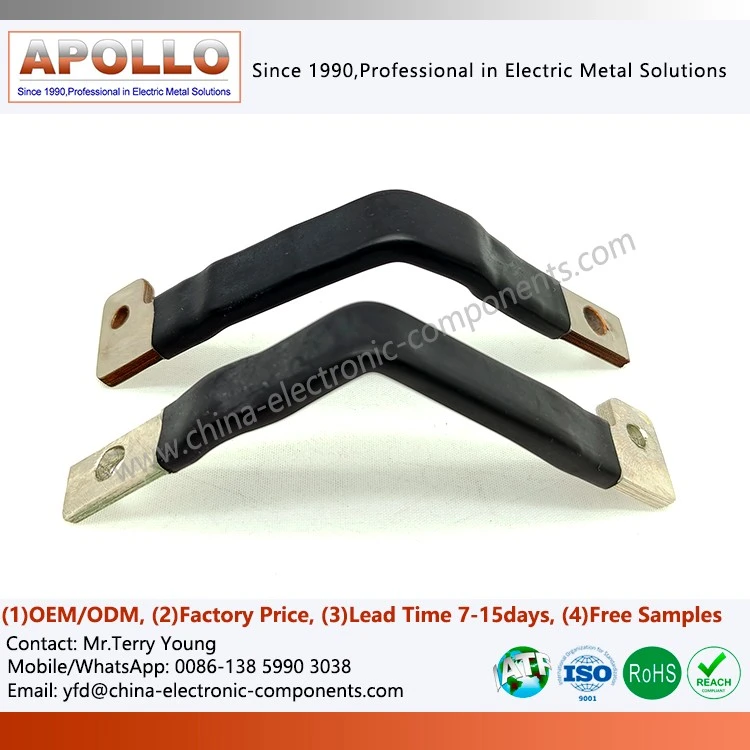
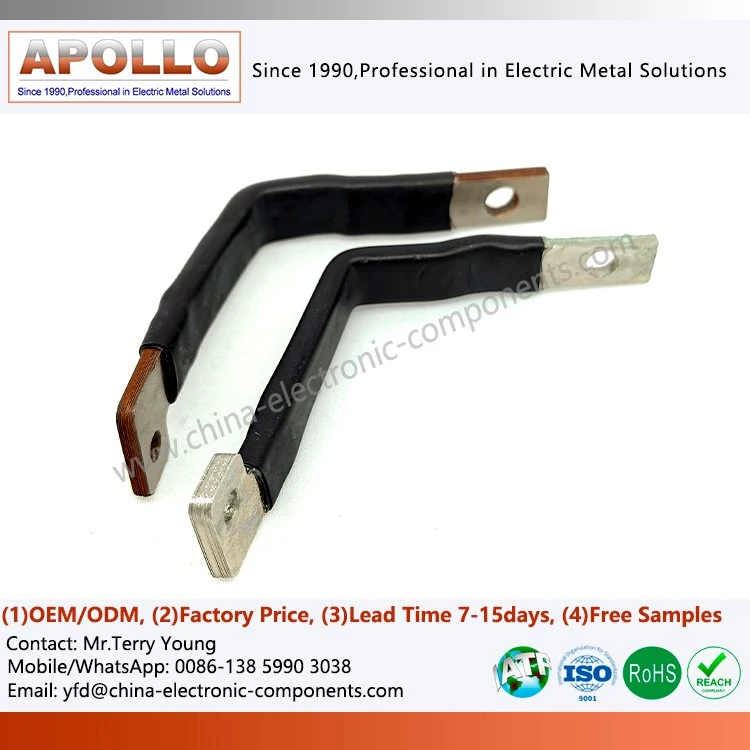
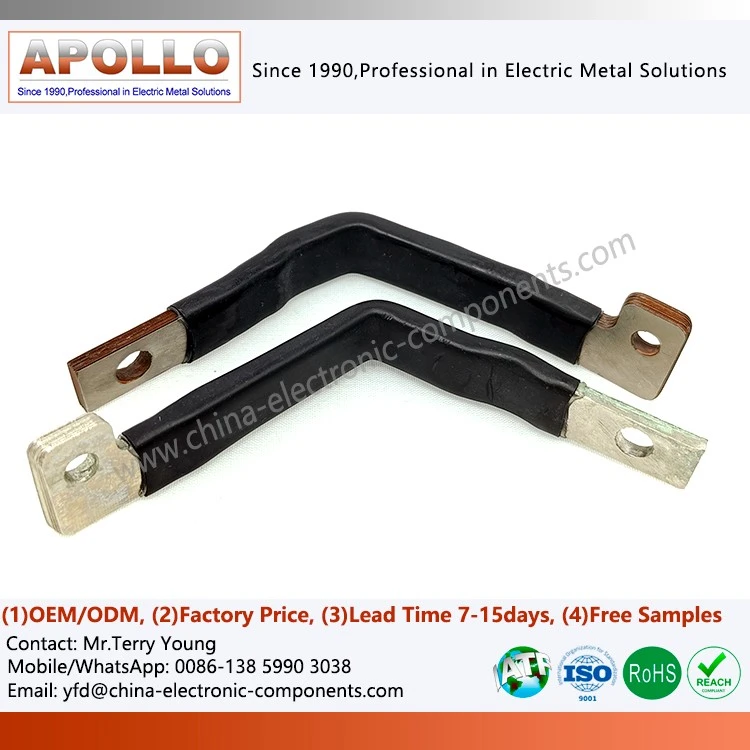
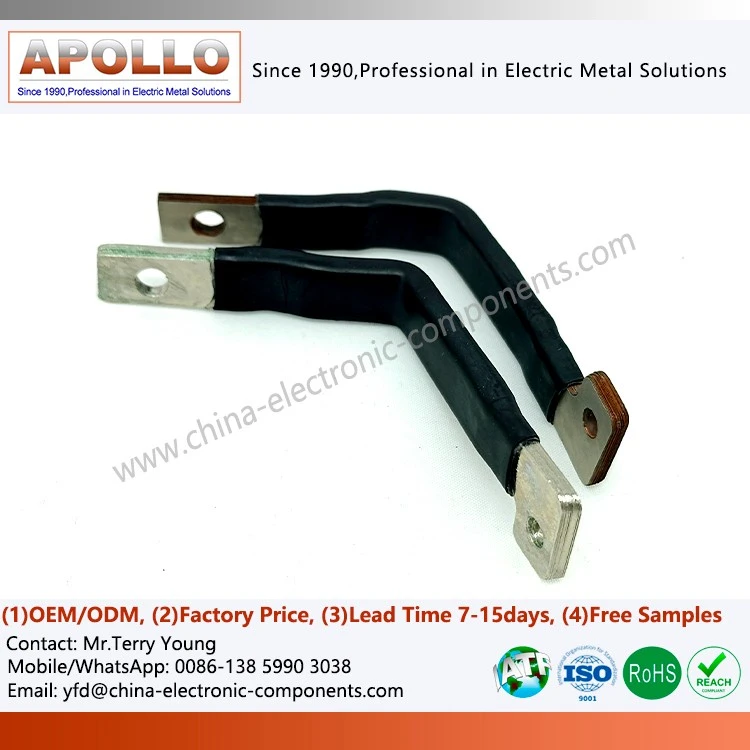
Busbar With Black Heat Shrink Tube
What is a busbar with Black Heat Shrink Tube?

The core concept behind this type of Busbar with Black Heat Shrink Tube is not merely adding a sleeve over the busbar, but rather integrating the conductive metal structure with the insulating protective structure.
Typical structural features include:
Conductive busbar core: Typically made of copper, oxygen-free copper, or other conductive materials meeting project specifications;
Black heat-shrink insulation tubing: Covers exposed areas of the busbar to provide electrical isolation for the conductor;
Connection ends: Designed with punched holes, threaded holes, terminal connection zones, or custom shapes depending on the installation method;
Bending zones: Formed to specific angles and 3D paths to suit the equipment's internal space;
Insulation cutouts: Localized modifications to accommodate bolted connections, terminal mounting, or electrical contact points.
Production Process and Manufacturing Advantages
High-Precision CNC Punching and Bending
Conductive copper or aluminum busbars undergo CNC blanking and forming to eliminate dimensional tolerance accumulation associated with manual bending, ensuring perfect alignment of mounting holes and assembly bolts.
Surface Micro-treatment and Anti-corrosion Plating
Before heat-shrink tubing application, the exposed contact ends and the entire busbar undergo chemical cleaning and high-quality tin (or silver) plating, resulting in strong coating adhesion and excellent oxidation resistance.
Airtight Heat-Shrink Encapsulation Technology
Using high-precision constant-temperature heat-shrink ovens and hot-air forming equipment, the insulating sleeve is uniformly shrunk onto the busbar surface, eliminating trapped air and thereby preventing potential partial-discharge risks during high-voltage operation.
Comprehensive Quality Control
Every batch undergoes 100% power-frequency withstand-voltage testing and continuity testing, along with CMM (Coordinate Measuring Machine) dimensional spot checks, to ensure zero insulation defects.

Application Advantages: Empowering Electrical Architectures Across Diverse Sectors
| High-Voltage and Medium-Voltage (HV/MV) Switchgear | In the extremely space-constrained busbar and circuit breaker compartments at the top of switchgear units, these rigid, heat-shrink-encased busbars significantly reduce phase-to-phase clearance, enhance insulation levels, and meet rigorous internal arc test requirements. |
| New Energy Generation and Energy Storage Systems | Within PV combiner boxes, wind power converters, and energy storage containers, these black heat-shrink busbars withstand harsh environments characterized by high salinity and humidity; their UV and aging resistance ensures insulation stability throughout the product's entire lifecycle. |
| Industrial Variable Frequency Drives (VFDs) and Motion Control | High-frequency harmonics within VFDs place demanding requirements on insulation materials. Cross-linked heat-shrink materials resist corona and partial discharge caused by the high-frequency $du/dt$ pulse voltages generated by variable-frequency motors, thereby extending the service life of busbars within VFD cabinets. |
| Data Centers and UPS Power Distribution | In data centers where continuous power supply is critical, these black insulated busbars provide clear phase-sequence isolation and physical protection, reducing short-circuit risks during operation and maintenance while ensuring high availability of the power supply chain. |

Frequently Asked Questions
1. What are Copper Busbars PVC Heat-Shrink Insulation Sleeves?
-
Busbar with Black Heat Shrink Tube is a conductive metal busbar covered with a heat-shrink insulation sleeve. It combines rigid electrical connection with additional insulation protection and is widely used in power distribution and new energy electrical systems.
2. What materials can be used for the busbar?
-
Copper is commonly used because of its high electrical conductivity and good formability. The material can be selected according to the project's electrical, mechanical, and environmental requirements.
3. Can the busbar shape and bending be customized?
-
Yes. The busbar can be manufactured according to 2D drawings, 3D CAD files or samples. Cutting, punching, drilling and multi-angle bending can be integrated into the manufacturing process.
4. Can the heat shrink tube be customized?
-
Yes. The insulation sleeve can be selected according to the required insulation, temperature resistance, flame-retardant and environmental performance. Coverage areas and exposed connection sections can also be designed according to the assembly requirements.
5. What applications use heat-shrink insulated busbars?
-
They are commonly used in EV high-voltage systems, energy storage systems, solar power equipment, power distribution cabinets, inverters, industrial electrical equipment, and power electronics where compact rigid connections and insulation protection are required.

contact us
If you are developing equipment for energy storage, photovoltaics, high-voltage power distribution, or power electronics, we offer integrated manufacturing solutions-ranging from Heat Shrink Sleeve Insulated Copper Busbar processing and precision bending to heat-shrink insulation-based on your drawings and installation specifications. These solutions help streamline communication during development and ensure consistent quality in mass assembly.

Hot Tags: Busbar with Black Heat Shrink Tube, Heat Shrink Insulated Busbar, Insulated Busbar, Busbar with Insulation Sleeve, Copper Busbar with Heat Shrink Tube, Heat Shrink Busbar, Busbar Coating Powder, Busbar Isolation, Dip Insulated Busbar, Epoxy Powder Coated Busbar Insulation, Insulated Busbar Pin Type, PE Heat Shrink Tube Insulated Busbar
You Might Also Like


Send Inquiry