











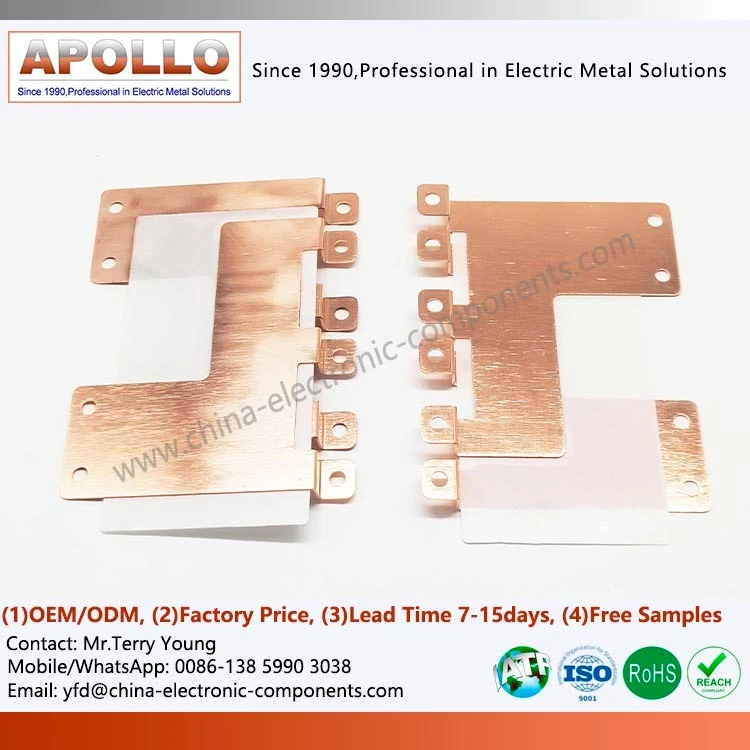


Insulated Busbar For EV Capacitor
Products Description
The Insulated Busbar for EV Capacitor is primarily used for connecting high-voltage capacitor modules and power electronic systems in new energy vehicles. Its structure consists of a conductive copper busbar, a PET insulation layer, and a customised mounting structure.
Compared to traditional wiring harness connections, the PET-insulated busbar significantly reduces line impedance, optimises current transmission paths, improves system integration, and effectively reduces energy loss under high-frequency operating conditions.
The product is widely used in:
New Energy Vehicle Drive Inverters
Motor Controllers (MCUs)
DC Link Capacitor Systems
High-Voltage Capacitor Modules
OBC On-Board Charging Systems
DC/DC Converters
Battery Management Systems (BMS)

Application Advantages and End-User Value
Significantly Increased Inverter Power Density
Thanks to the extremely space-efficient laminated structure, the Copper Busbar for DC Link Film Capacitor for Hybrid Car replace bulky three-dimensional wiring, allowing the electric drive system to be reduced in size by approximately 15%~25%, meeting the extreme chassis space requirements of cars and even sports cars.
Safeguarding SiC (Silicon Carbide) Systems
Designed for the extremely fast switching speeds (High dv/dt) of third-generation semiconductors, our ultra-low inductive reactance automotive battery terminal bus bars effectively suppress switching oscillations, reducing the size and cost of EMI filters.
Seamless Adaptation to Automated Assembly
The rigid, modular structure makes the capacitor busbar a standard "plug-and-play" assembly, perfectly compatible with robotic arm automated gripping and automatic tightening/laser welding processes, significantly reducing pack assembly defect rates for OEMs and Tier 1 suppliers.

Design Advantages: Topological Space Compressibility and Electric Field Edge Passivation
| Three-Dimensional Topological Arrangement | Breaking away from the limitations of single-layer planar thinking, a multi-layered composite busbar (positive, negative, and neutral points stacked) is designed using the isolation effect of the insulation layer. The layers are separated only by thin PET paper, transforming the previously large planar creepage distance into vertical thickness insulation, significantly compressing the envelope volume of the capacitor leads. |
| Electric Field Edge Passivation Design | High-voltage busbar failures often occur at the electric field distortion points at the metal edges. We introduce electric field simulation analysis during the design phase, implement large-area rounded transitions for all metal sharp corners, and add extended PET insulation paper coverage at the edges (creepage distance extension design), effectively passivating the edge electric field and suppressing surface discharge. |
| Precise control of parasitic parameters | The stacked automotive power busbar structure results in extremely small spacing and overlapping areas between the positive and negative electrode current guides, naturally creating a large-capacity distributed capacitor and extremely low loop inductance. This design advantage greatly smooths out the voltage spikes during IGBT switching, protecting the capacitors and power module. |

Technical Features: Insulation System Optimised for High-Frequency, High-Voltage Capacitor Connections
By adjusting the conductor spacing
PET insulation paper thickness, and dielectric constant, the parasitic capacitance of the Insulated BusBars (typically used for filtering or oscillation suppression) can be accurately calculated during the design phase.
Partial Discharge Resistance Design
In addition to vacuum lamination, we add a "stress gradation" shape to the insulation paper edges-that is, gradually thinning the insulation thickness from the conductor edges outwards-to homogenise the electric field gradient and avoid spike discharges.
High-Temperature Aging Resistance
The thermal life curve of the PET insulation paper has been verified through accelerated ageing: after 5000 hours of continuous operation at 125℃, the tensile strength retention rate of the insulation paper is ≥80%, and the breakdown voltage decrease is ≤15%.
A temperature-sensing or shielding layer can be integrated
NTC thermistors or copper shielding layers are pre-embedded in the laminated structure to monitor IGBT Bus Bar temperature rise or reduce EMI radiation without adding extra assembly steps.

contact us
Whether it's new platform development, sample verification, or batch project implementation, we can provide EV Capacitor Power Distribution Bar design and manufacturing support based on capacitor structure, current path, and installation space requirements, helping your high-voltage systems achieve higher integration and more stable mass production performance.

Hot Tags: insulated busbar for ev capacitor, China insulated busbar for ev capacitor manufacturers, suppliers, factory, Automotive Battery Terminal Bus Bar, Automotive Power Busbar, Busbar for Film Capacitor, Capacitor Busbar, Copper Busbar for DC Link, DC Capacitor Busbar
You Might Also Like


Send Inquiry